
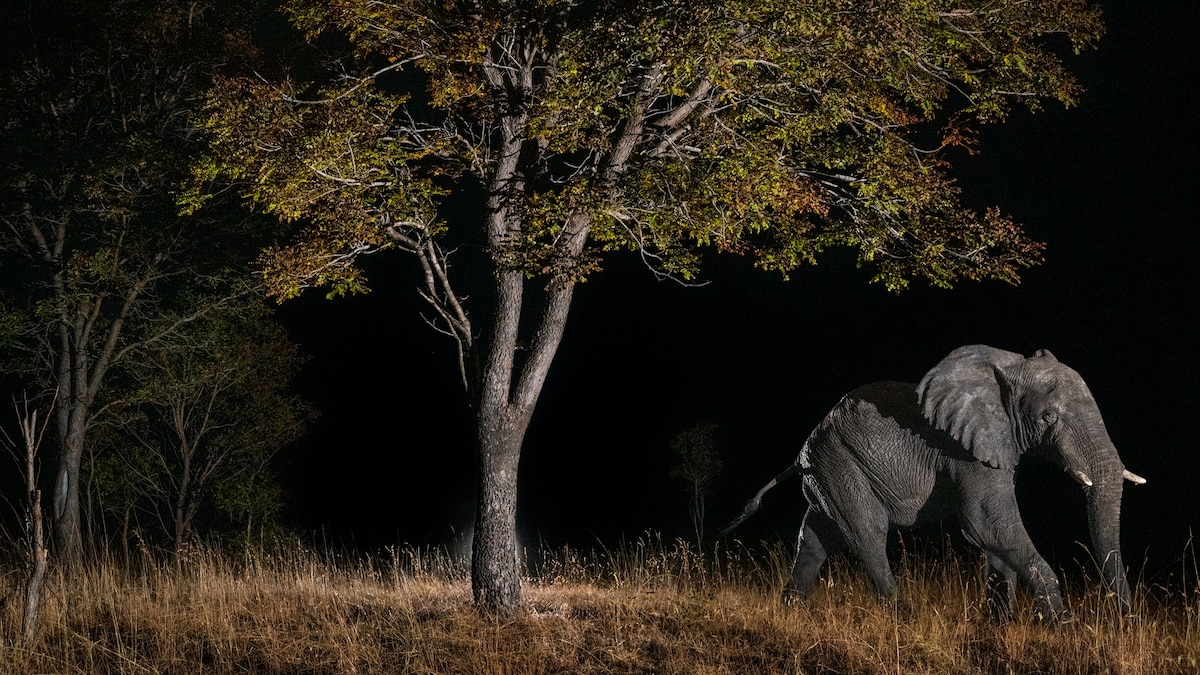
Tracking is one of humanity’s original sciences, built on inference and empathy. It “requires fundamentally the same intellectual abilities as modern physics and mathematics,” wrote Louis Liebenberg in The Art of Tracking. The trackers must project themselves into the elephants’ minds, reading intent from pattern. These elephants move like a herd that has been hunted. A grown elephant has no natural predators, but this group displays an extreme fear of humans, now behaving like wary antelope, feeding at night and seeking cover by day.
Boyes paused at a peculiar pile of dung pinning a curved wreath of Brachystegia greens to the ground. He speculated it was a communiqué from a bull: a warning to others. It sounded like superstition, but the wreath did look deliberate, and elephants often behave in mysterious ways.
Finally, we reached the first of Doest’s camera traps. It was destroyed, the tree uprooted. Boyes sat down, looking defeated, and rolled a cigarette. Costa opened the camera’s battered case and scrolled through the memory card: only black swamp and dark night. The ghost elephants had torn down the camera without stepping in front of it.
These elephants are genetically distinct from anything else we’ve sequenced. It seems they’ve been isolated for centuries.
Katie Solari, conservation geneticist, Stanford University
A few days later, Kalueyo went on a walk to retrieve all the other memory cards from Doest’s cameras, swapping in fresh cards and batteries. Among 10,000 frames of blowing leaves, roan antelope, and inky darkness, there were only a handful of photos of a single middle-age elephant. She looked at the camera, then waddled out of frame. DNA and dung samples were sent back to Stanford, where researchers helped answer at least one question. “A hundred percent savanna elephant,” determined ecologist Jordana Meyer Morgan, who runs the genetic testing program. “We have a population that we didn’t even know existed that high up.”
Yet the preliminary analysis showed that “these elephants are genetically distinct from anything else we’ve sequenced,” said conservation geneticist Katie Solari, who is working with Meyer Morgan on the project. “It seems they’ve been isolated for centuries.”