
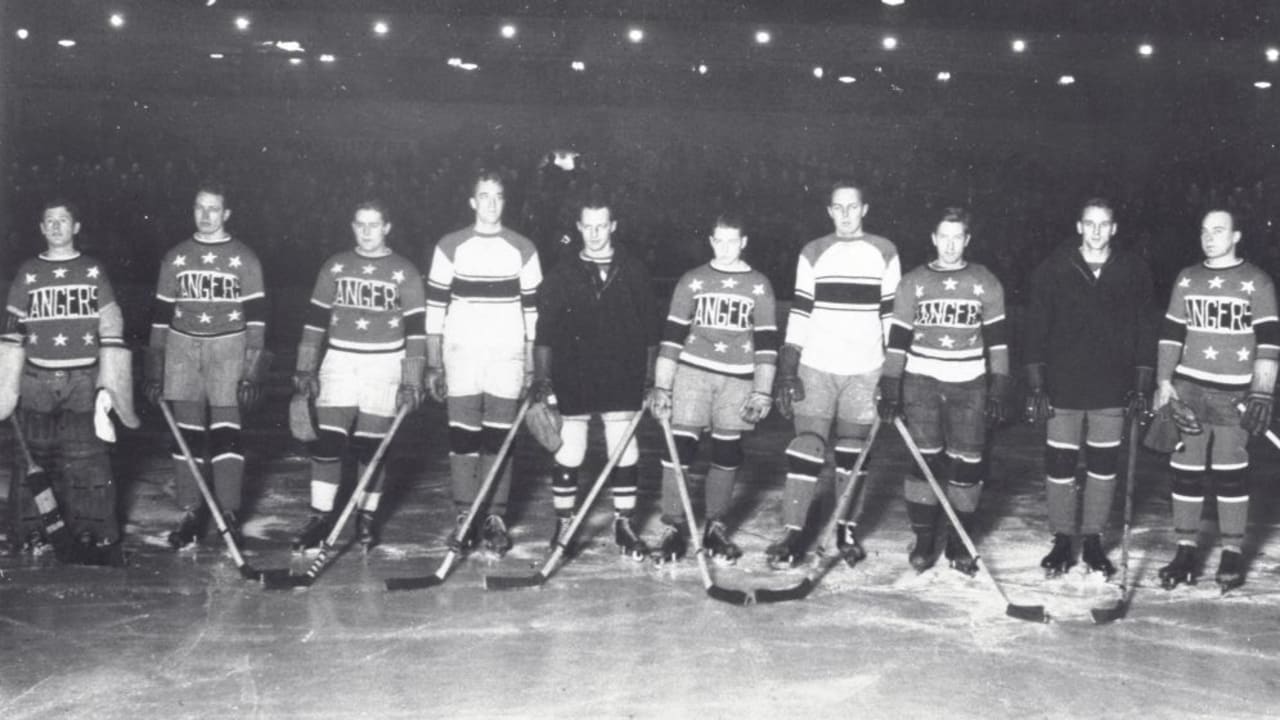
Minnesota hockey historian Roger A. Godin, author of “Prague Winter 1933: The United States Wins an Early Gold,” pointed out that most of Team USA’s skaters hailed from New England.
“Oddly enough,” wrote Godin, “the team was originally named ‘The Boston Olympics’ but then they acquired the ‘Massachusetts Rangers’ nickname and at practices wound up wearing Rangers jerseys although only two players hailed from New York.”
Yale graduate Winthrop “Ding” Palmer, the scoring star of the 1932 U.S. Olympic team, was an early version of Edmonton Oilers captain Connor McDavid, helping the Bulldogs go 45-6-2 while playing for the football team in his three seasons.
John Garrison from West Newton, Massachusetts, who played defenseman and forward, was Harvard’s lone contribution. In Godin’s monograph, Patrick Houda, a Sweden-based hockey historian, likened Garrison to Hockey Hall of Famers Scott Niedermayer and Paul Coffey.
“Garrison was a wonderful skater with a hard shot,” Houda said. “He also was a crowd pleaser with never a dull moment when he was on the ice.”
Said Cosby: “At the time, beating the Canadians was considered a feat in itself.”
As tournament host, the city of Prague built a new “Stvanice” outdoor artificial ice rink.
“It would be the first World Championships to allow forward passing in any zone,” Godin said. “Games would feature 15-minute periods, a practice adopted in 1930.”
The U.S. opened the tournament with a 7-0 win against Switzerland on Feb. 21, 1933, followed by a 4-0 win against Poland. The Neues Wiener Tagblatt on Feb. 23 ran the following critique: “The Americans had the edge by their quickness alone.”
Triumphs against Czechoslovakia (6-0) and Austria (4-0) led to the finale against Canada on Feb. 26. Uncle Sam’s rivals were the defending Allan Cup champion Toronto Nationals, also known as the Sea Fleas (after the team’s sponsors, the National Yacht Club.)
Up until this point, Cosby was the unofficial MVP, having shut out every opponent while Canada had allowed only one score. Canada was still the heavy favorite and the game itself was considered a classic for its time.
“The game was played with frightening speed,” wrote the Tagblatt. “Despite the great effort, despite the strain, it was quite a fair fight and the most memorable advertisement for the game of ice hockey.”
The crowd, listed at 12,000, was solidly behind Canada.
“When we scored the first goal, the fans were quiet, but when Canada finally put a puck past me, the crowd went nuts,” Cosby said. “But by overtime, I could tell a segment began rooting for us.”
Six minutes into OT, John went into high gear, the Tagblatt reporting “he went up along the right side, broke toward the middle and shot on goal for what proved to be the winner.”
The remaining time still had to be played out in the 10-minute OT, with Cosby shutting down the Canadians. The United States won 2-1 and the stars and stripes were raised while the national anthem rang true for the new champs. Even now, the Canada-U.S. rivalry gets top billing. A 19-person NHL.com panel picked Canada to win the Milano-Cortina Olympics, with the United States tabbed as a runner-up.
They were in 1933, until John Garrison settled the issue with an often forgotten overtime score.