
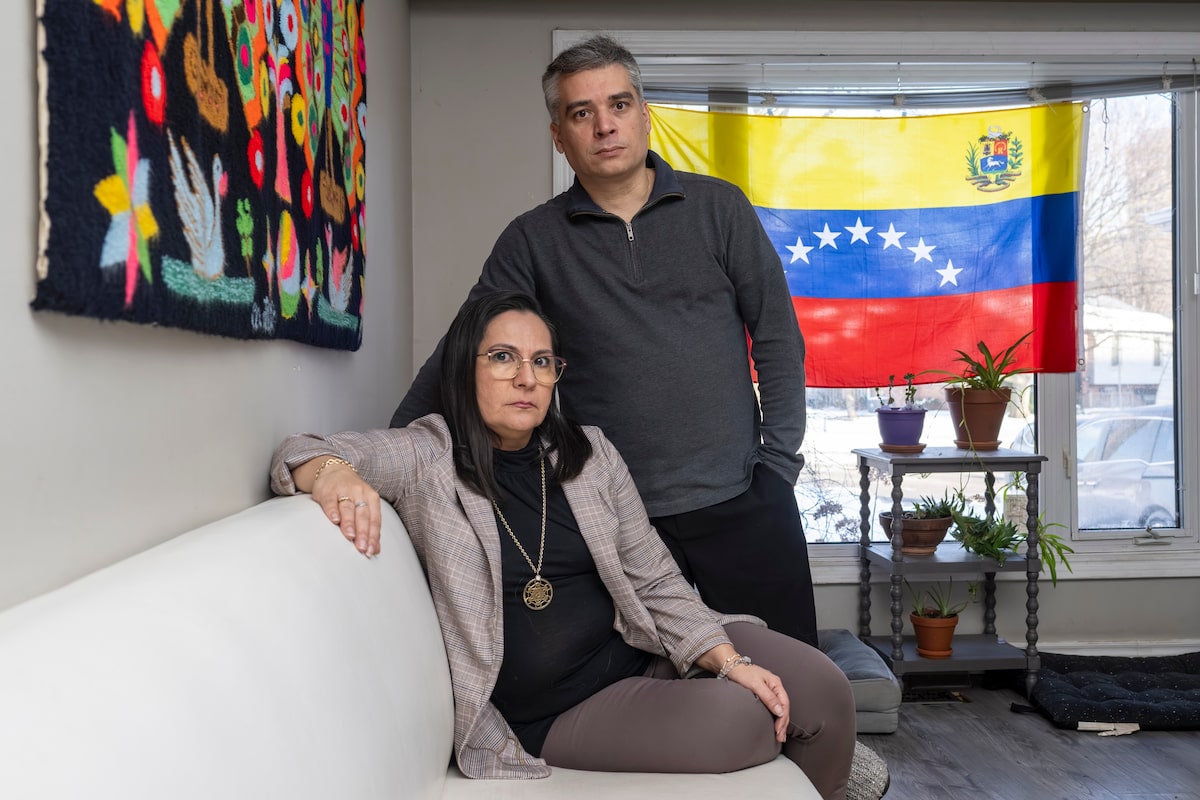
Scarlet Estrada and Igor Marín, Venezuelans living in Canada, have unsuccessfully sought to bring four family members to the country. Estrada’s father recently passed away, while her mother remains in Venezuela.EDUARDO LIMA/The Globe and Mail
Scarlet Estrada applied to sponsor her aging parents for immigration to Canada in 2022, worried they weren’t getting enough food and clean water as Venezuela’s economy crumbled.
The urgency of the process hit home the following year, when her mother came to visit her and insisted on keeping the water used to boil beans as a separate meal.
“We realized how bad it was after seeing her,” said Ms. Estrada, who lives in Oakville, Ont., and who moved to Canada around a decade and a half ago.
More than three years after filing residency applications for her parents, she is still waiting. Her father has since died in Venezuela after struggling with health issues she believes were caused by poor nutrition and the country’s beleaguered health care system.
Her mother, a 72-year-old former teacher, successfully extended her visitor visa for a year in Canada to await her permanent residency approval. That extension has now expired. Ms. Estrada said she has tried to do things by the book – but also doesn’t want to risk sending her mother back to Venezuela.
“It’s devastating,” she said.
People sell groceries at the Coche wholesale market in Caracas. Venezuela’s displacement crisis – one of the world’s most dire – has been fuelled by a mix of political repression and economic collapse.FEDERICO PARRA/AFP/Getty Images
For the past decade, Ottawa has assumed a muscular position on Venezuela’s ruling government. But that hasn’t always been matched by concrete support for those trying to flee, Ms. Estrada, other Venezuelan-Canadians and immigration experts say. Ms. Estrada and her husband have spent years trying to help friends and relatives find safety in Canada. But their loved ones are still in limbo.
Asked whether Immigration, Refugees and Citizenship Canada was planning any special measures to assist Venezuelans fleeing political uncertainty, department spokesperson Matthew Krupovich said there are a range of immigration pathways for eligible Venezuelans to come to Canada, including economic programs, and resettlement through referrals by the United Nations.
Critics note that Canada briefly opened just one humanitarian stream tailored to Venezuelans fleeing Nicolás Maduro’s rule. Unlike Ottawa’s response to crises in countries like Ukraine, for example, where around 300,000 people came here on special temporary residency permits, fewer than 2,200 Venezuelans reached Canada through a now-shuttered family reunification program.
In January, the U.S. launched a military operation to capture Mr. Maduro, after accusing him of “narco-terrorism and drug trafficking.” Responding to the capture, the Canadian government said it “welcomed the opportunity for freedom, democracy, peace, and prosperity for the Venezuelan people.”
But the country’s transition to democracy is far from guaranteed – raising questions about Canada’s role in supporting Venezuelans in the aftermath of Mr. Maduro’s removal from office.
“There’s a lot of uncertainty and a lot of confusion,” Ms. Estrada said. “For regular citizens, there’s not really any significant changes.”
Orlando Viera-Blanco in Ottawa in February, 2020.Justin Tang/The Globe and Mail
Orlando Viera-Blanco, the Venezuelan opposition’s envoy to Canada, says he lobbied Ottawa many times to tailor a comprehensive program to welcome many more of his compatriots while working as a diplomat from 2019 to 2024.
But his birth country’s situation confounds people because its humanitarian challenges are not the result of a war or natural disaster, the calamities that typically drive such efforts, according to Mr. Viera-Blanco, who helped roughly a thousand other Venezuelans immigrate to Canada in recent years. Instead, Venezuela’s displacement crisis – one of the world’s most dire – has been fuelled by a mix of political repression and economic collapse.
Since 2017, Ottawa has maintained sanctions against Venezuelan officials over human rights concerns, and in January, 2019, Ottawa declared that it did not recognize Mr. Maduro as the legitimate President of Venezuela and shuttered its diplomatic presence in the country.
Venezuela’s mounting humanitarian crisis was also recognized through deportation and travel measures. The Canada Border Services Agency imposed a temporary deferral of removals on the country, meaning most deportations of Venezuelans could be postponed. Canada has also eased travel for Venezuelans by recognizing expired passports.
But to critics, Canada’s efforts to resettle Venezuelans have fallen short.
Families of political prisoners gather outside of the Attorney General’s offices as they wait for the release of their loved ones in Caracas. The Venezuelan government is still refusing to release Mr. Marín’s brother, Lieutenant Colonel Igbert Marín Chaparro.THE NEW YORK TIMES/The New York Times
In late 2023, the federal government created a special humanitarian program allowing some Colombians, Haitians and Venezuelans who already had family in Canada to travel here and gain permanent residency. It was part of a commitment to welcome 15,000 migrants from the Americas to support “safe, orderly, and regular migration.”
Around 10,500 people were admitted through the program before it shuttered. Of these 2,100 were Venezuelans, IRCC data shows.
“It was very, very skimpy in relation to the actual needs from the region,” said Sharry Aiken, a professor at Queen’s University Faculty of Law.
Gloria Carrasquero, a lawyer with Toronto-area legal clinic the Centre for Spanish Speaking Peoples, provided guidance to Venezuelans who sought to access the program. But its requirements, which included a criminal record check, made it impossible for most people given the difficulties in obtaining official documentation from the Venezuelan government, she said.
Asked whether Ottawa is considering any special measures tailored to Venezuelans, IRCC spokesperson Mr. Krupovich said Canada cannot speculate on future policy decisions but “stands by the Venezuelan people’s sovereign right to decide and build their own future in a peaceful and democratic society.”
A woman demonstrates with a Venezuelan flag to demand the release of political prisoners outside a prison in Caracas.JUAN BARRETO/AFP/Getty Images
Ms. Estrada said even if their home country is on the road to democracy, she and her husband, Igor Marín, believe the journey will be bumpy.
Despite Mr. Maduro’s removal, the prevailing Venezuelan government is still refusing to release Mr. Marín’s brother, political prisoner Lieutenant Colonel Igbert Marín Chaparro, even though he has completed his sentence. He was jailed over seven years ago and accused of instigating rebellion after he raised concerns about lack of adequate food and supplies for his troops, Mr. Marín said.
Mr. Marín and Ms. Estrada fear the former military officer will still be a target for retaliation by government supporters upon his release – meaning he will still need refugee protection.
Meanwhile, Canada’s Immigration and Refugee Board – the independent tribunal tasked with adjudicating refugee applications – had 2,977 claims from Venezuelans pending as of the end of last September, according to the latest data available.
Acceptance rates for Venezuelan claimants have declined by around 20 per cent since 2023, the tribunal data show. That drop could reflect the increasingly difficult path for Venezuelans with grounds for a refugee claim to reach Canada, Prof. Aiken said.
Venezuelan riot police pass by a demonstration to demand the release of political prisoners.JUAN BARRETO/AFP/Getty Images
Since 2023, when Canada’s refugee pact with the United States was expanded to cover the entire border, most Venezuelans seeking to claim asylum in Canada by land would be turned back to apply for safety in the U.S. instead.
“The people who actually are getting to Canada now may not be the people at most risk,” Prof. Aiken said. “Many people are fleeing dire living conditions that are horrendous, but don’t qualify them for [refugee] protection.”
(To be successful, refugee claimants must show they would be persecuted in their home country on one of five grounds: their race, religion, nationality, their membership in a particular social group, or their political opinion.)
A Caracas-based mother of three interviewed by The Globe and Mail said that in 2016, as violence and repression in Venezuela were intensifying, her family became determined to send her youngest son abroad knowing he didn’t qualify as a refugee since he was not directly being targeted by Mr. Maduro’s government.
She said in a recent phone interview the family made this decision after their middle son and his girlfriend narrowly escaped being kidnapped outside their Caracas apartment and both were hit in the leg with single gunshot wounds as they fled.
The family cobbled together a semester’s worth of tuition for the youngest son to attend a small college in Canada on a student visa beginning in 2017.
A vendor counts Venezuelan bolivar banknotes at the Coche wholesale market in Caracas.FEDERICO PARRA/AFP/Getty Images
He said he arrived with $700 to his name, graduated college while working part time, then became a permanent resident and eventually a citizen. He now has a wife and a well-paying job.
The Globe is not naming the woman or the young man who escaped to Canada because they fear publishing their names could bring recrimination against her and other family members still living in Caracas.
In an interview with The Globe, the son said he graduated high school in Venezuela with 100 classmates, 90 of whom fled the country. Many went to Colombia, while others went to the United States or Spain.
Canada doesn’t even register as a destination, he said, because everyone knows the door is closed.
Given the complexities of Venezuela’s humanitarian crisis, Calgary-based immigration and refugee lawyer Bjorna Shkurti said a model similar to Canada’s Ukraine response – issuing temporary visas for emergency travel – could work well for Venezuela should the country’s situation fail to stabilize.
“That opened up a pathway for individuals that would have otherwise been stuck,” she said.
Ms. Estrada said she wants to see Canada live up to its reputation as a human rights champion. Despite repeated e-mails to her MP, Ms. Estrada says she still doesn’t know how much longer her mother’s permanent residency application will take to process.
“People tend to forget these are humans and families,” she said. “We all bleed red.”
EDUARDO LIMA/The Globe and Mail