
A U.S. F-35 fighter jet performs during the Dubai Air Show in Dubai, United Arab Emirates, Tuesday, Nov. 18, 2025. (AP Photo/Fatima Shbair)Fatima Shbair/The Associated Press
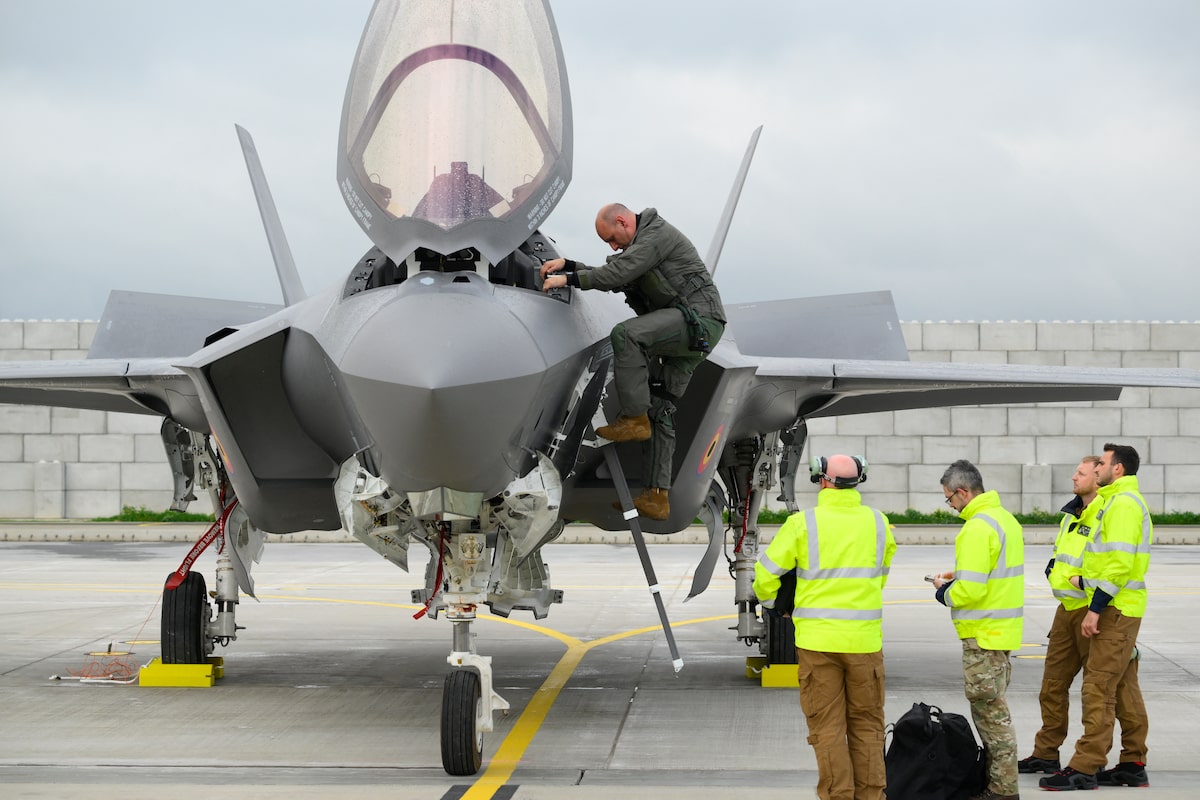
This photograph shows a pilot disembarking a Belgium’s newly purchased Lockheed Martin F-35 Lightning II fighter jet for the first time, after arriving at the Florennes military airbase, southern Belgium on October 13, 2025. (Photo by JOHN THYS / AFP) (Photo by JOHN THYS/AFP via Getty Images)JOHN THYS/AFP/Getty Images
Peter Jones is a professor in the Graduate School of Public and International Affairs at the University of Ottawa.
The endless review of which fighter jet to buy presents difficult choices. For proponents of the F-35, which include the RCAF itself, the imperative of continued, seamless interoperability with the United States is the driving factor. For those enamoured of the Swedish Gripen, considerations of developing a degree of defence independence from the U.S. are important.
Emerging from the din is the idea of mixed fleet, which would combine the two aircraft. Proponents of the Gripen accept the logic of a mixed fleet (because Canada is already committed to at least 16 F-35s anyway, and seems to have quietly put money down on key components on an additional 14 planes). The F-35’s champions are largely against it, hoping that the government will stick with plans for an all-F-35 fleet of 88 aircraft.
Opposition to the mixed fleet is often couched in terms of the inherent costs of operating two different types of fighters. Separate training, maintenance and logistics capabilities are required. We operated mixed fleets during the Cold War, but our military was a lot bigger and better funded.
Opinion: The idea of a mixed fleet of Canadian fighter jets should not take flight
However, if defence and defence-related spending is increased to 5 per cent of GDP, as the government promises, our military will be better funded, at least comparatively, than it was during the Cold War.
Moreover, the per-flight-hour cost of the F-35 ranges between US$35,000 and US$50,000 (depending on the F-35 variant), whereas the Gripen is between US$8,000 and US$12,000. Operating fewer F-35s will free up money to cover the costs of a mixed fleet.
Assuming that the F-35 part of the fleet was to keep the Americans happy, these aircraft would be dedicated to missions most important to that goal: NORAD and possible participation in a future missile defence. Though U.S. Ambassador Pete Hoekstra intimated recently that all 88 F-35s are necessary for the defence of North America, this cannot be true.
Opinion: Trump and Ottawa’s take on TACO will determine Canada’s fighter-jet strategy
We also have NATO and other commitments, so the figure of 88, which was selected years ago, must be sufficient to fulfill both NORAD and other commitments. The RCAF has carefully never made public the number of F-35s required for the NORAD mission only; it simply repeats that all 88 are required to fulfill its needs. It is difficult to know how many of these are required just for the NORAD mission, but something like 40 would likely cover the NORAD mission.
This leaves Canada’s other commitments, such as NATO, to be covered by a Gripen fleet, of perhaps some 70 to 80 aircraft, which could also provide support to Arctic sovereignty in Canada. After all, not every intercept or patrol over northern Canada requires an aircraft that costs US$40,000 an hour to operate; chasing down an errant weather balloon can easily be done by a capable aircraft that costs US$10,000 an hour and is already designed to operate from austere northern air bases (unlike the F-35, which requires extensive support).
In terms of how the Gripen might support Canada’s NATO commitment, there is a ready-made answer in the Baltic/Nordic region. Denmark, Norway, Sweden and Finland, all now NATO allies, are training together and have agreed to create a seamlessly interoperable regional Nordic air defence.
Denmark, Finland and Norway have all selected the F-35, whereas Sweden, of course, operates the Gripen. If you take all four air forces together, you have, in effect, a de facto mixed fleet. Nordic officials say the two aircraft operate very well together. The different capabilities of the two aircraft (the F-35s’ stealth and superior long-range sensors, combined with the Gripens’ superior agility and availability) complement each other, and the two can communicate effectively.
Canada should buy F-35s but plan for European fighter jets next, former general says
The Nordics are developing the F-35 as a “spearhead” weapon, which can penetrate the defences of an attacker and undertake other specialized missions where their stealth and sensors provide advantages, while the Gripen can carry large volumes of weapons into the holes in enemy defences created the F-35. Gripens will also engage enemy aircraft that do get past the F-35 in dogfights, in which the Gripen excels.
In short, if intelligently deployed, a mixed fleet can be a force multiplier. An RCAF fleet of some 30 to 40 F-35s dedicated to the NORAD mission and 70 to 80 Gripens supporting Arctic defence in Canada and also dedicated to NATO, might cost more to operate than an all-F-35 fleet. But that is not at all certain given the difference in flying costs. And it would provide more options and more independence than total reliance on the F-35, and greater industrial benefits.