
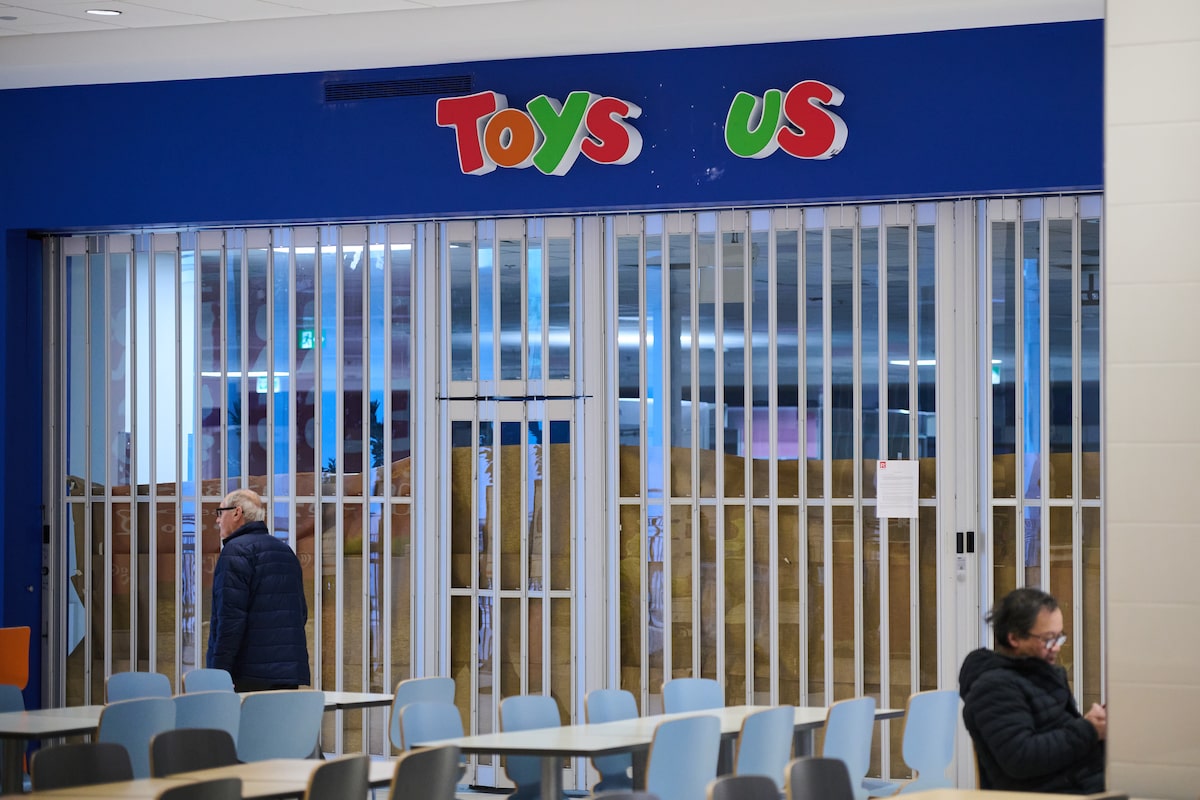
Shoppers pass a permanently closed Toys “R” Us store in Toronto, on Feb. 4.Sammy Kogan/The Canadian Press
At the beginning of this year, Marlon McPherson celebrated the 10th anniversary of his company, a Toronto-based liquidator that works with major retailers to clear out stores and facilities when they shut down. But the celebration was soon followed by a less auspicious milestone: the first time the company has been left holding a substantial unpaid bill, which ran to roughly $200,000.
Mr. McPherson’s firm, Michaels Global Trading, is just one of hundreds of companies owed money by insolvent retailer Toys “R” Us (Canada) Ltd., which was granted court protection from its creditors last week.
“Financially we’re good, but it does take a big hit to our cash flow,” Mr. McPherson said.
His experience is indicative of the wider reverberations that occur when a national retailer enters restructuring proceedings.
Toys “R” Us has closed about 50 stores over the past year, and is looking to either sell the remaining business to new owners, or attract an investor to refinance the operations. Otherwise, it will be forced to liquidate the chain, which now comprises 22 Toys “R” Us and Babies “R” Us stores across Canada, roughly half of them in Ontario.
Multiple Toys “R” Us locations closing, landlords say they are owed unpaid rent
It is not uncommon in such cases for many creditors – who fall in line behind a company’s major secured lenders – to be paid little, or none, of what they are owed.
The list of creditors to Toys “R” Us includes some major names: according to court documents, the company owes $6.7-million to Lego Canada Inc., more than $11-million to companies in Canada and China connected to Mattel Inc., $3.7-million to a Hong Kong division of Canadian toy and entertainment company Spin Master Corp., and $2.2-million to Hasbro Canada Corp. The Florida company Jazwares LLC, known for its popular line of Squishmallows plush toys, is owed $2.6-million.
The chain has run into financial difficulties before. Its U.S. parent company Toys “R” Us Inc. filed for bankruptcy in 2017 and liquidated the U.S. and British stores. The Canadian chain survived after being sold to Toronto-based Fairfax Financial Holdings Ltd. in 2018, for $300-million.
But just three years later, Fairfax sold the struggling operations to family-owned Putman Investments Inc. As the Ancaster, Ont.-based firm sought to stabilize the business, Toys “R” Us cut jobs and closed underperforming stores, shuttering a total of 59 locations since the deal. The company also built indoor playgrounds, called Playlab, in its stores in an effort to make up for falling sales.
“Persistent inflation, rising labour and occupancy costs, post-pandemic supply chain disruptions, and a structural shift toward e-commerce have materially weakened the performance of traditional bricks and mortar retailers,” Neil Taylor, the retailer’s recently-appointed chief restructuring officer, stated in an affidavit on Feb. 2.
Landlord sues Toys “R” Us Canada over claim of unpaid rent at Toronto location
Toys “R” Us Canada recorded a net loss of $54.7-million in 2024, and lost a further $170.4-million in the 10 months ended Nov. 29, 2025.
As it ran out of cash to fund the operations, Toys “R” Us Canada halted payments to its toy vendors and other product suppliers, and also stopped paying rent on some stores that it vacated, but which still have active leases.
A number of suppliers and landlords had launched lawsuits against Toys “R” Us Canada before the creditor-protection proceedings, mostly for breaching leases or breach of contract. They include landlords such as RioCan Holdings affiliate RioTrin Properties, SmartREIT, Calloway Real Estate Investment Trust Inc. and Confederation Park Shopping Centres Ltd., according to court documents.
Major commercial landlords such as Cadillac Fairview Corp. Ltd., Oxford Properties, Ivanhoe Cambridge Inc. and Primaris Management Inc. are also listed among its creditors.
Last August, Everest Toys, which was founded by Putman Investments owner Doug Putman’s father, was placed into receivership. Everest is also listed among the creditors of Toys “R” Us Canada, with Everest Wholesale owed nearly $16-million and a related numbered company owed $1.6-million.
Toys “R” Us Canada files for creditor protection
Mr. McPherson’s work with Toys “R” Us began last October, when his company cleared out three floors of office furniture from its distribution centre in Concord, Ont.
After that job, the retailer contracted Michaels Global Trading to clear out the adjoining warehouse just before Christmas – auctioning off racking and warehouse equipment such as forklifts. The company also cleared out two stores in Alberta and one in Southern Ontario that Toys “R” Us shut down, but the deposits it was paid by the retailer fall far short of the cost of the work it performed. Michaels Global paid all of the subcontractors who worked on the project.
“I have to take it with a grain of salt, because we’ve lasted this long, survived COVID. Business owners eventually are going to get burned some way or another,” Mr. McPherson said, adding that he considers it a kind of badge of honour. “It sounds crazy,” he said with a laugh.
But he does not take the loss lightly, and says it will change the way he does business. Mr. McPherson is considering implementing a stricter deposit structure with clients in future, and paying more attention to signals that a client in financial distress may be unable to fulfill their end of the contract.
“We’re probably not going to be paid. But it’s a lesson,” he said. “We’ve learned a lot over the last three to four months.”