
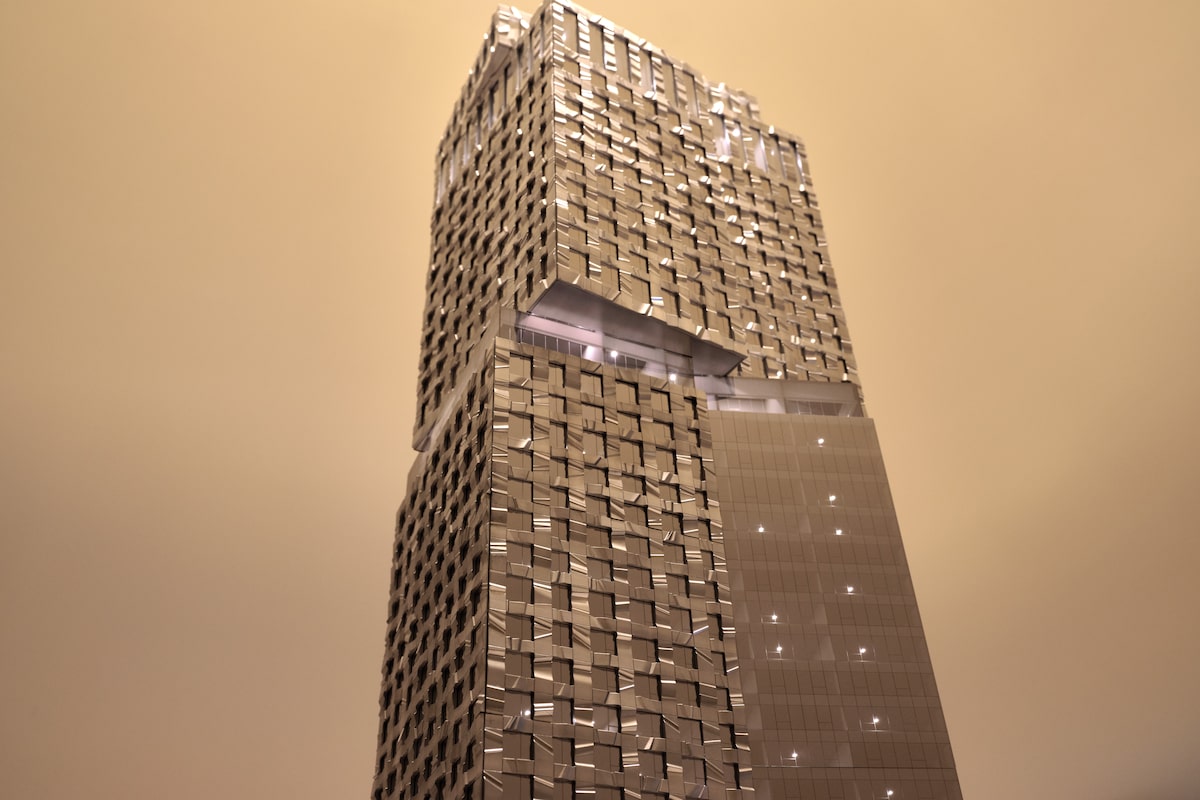
Inside the Forma sales gallery, visitors – by appointment only – will find a miniature museum of architect Frank Gehry’s unconventional design.Joel Esposito/Joel Esposito
It’s a travelogue for a chunk of stainless steel: “The panels are fabricated … an hour north of Venice – it’s the heart of the Prosecco region so I love going there – they’re folded, the glass is put in, they’re shipped to Germany where they’re completed,” says Mitchell Cohen, chief operating officer of Westdale Properties. “They’re put in a container and they’re sailed across to Montreal; they come out of the ship … and trucked to Toronto for immediate hoisting.”
Neck stretched and eyes wide, Mr. Cohen stands in David Pecaut Square near the intersection of King Street West and Ed Mirvish Way. Matching the glint in his eyes are the sparkles of light pinging off the wrinkly bits of stainless steel marching up the 73-storey Forma East. It is one of two towers designed by Toronto-born architect Frank Gehry, who died in Los Angeles this past December at the age of 96.
Mr. Gehry with a model of the Forma towers in his Los Angeles office.Westdale Properties
Standing beside Mr. Cohen is your humble Architourist, who also stands corrected. In January, I wrote that I wished the panels formed a “linked, sculpted pattern … like Manhattan’s 8 Spruce” but instead “seem to be randomized.” But that’s not the case. While they won’t form sweeping, top-to-bottom curves, the 4,400 panels are the result of hundreds of hours of planning.
“There are 27 varieties of horizontal panels and 36 varieties of vertical panels,” Mr. Cohen says. “It’s not a discernible pattern such as [8 Spruce, but] what [Gehry] achieved through his complicated algorithm. There is a reflection of light up; there’s reflection straight ahead, and there’s reflection down
To illustrate this, Mr. Cohen sways back and forth, and then shuffles left and right. As I ape his archi-dance, I realize the way light dances on (and off) the building does change. Quite dramatically, actually. And, due to all of those calculated wrinkles – which look like chess pieces or sculpted stone when viewed from the side – the building won’t blind drivers the way some Toronto towers do.
“Frank once said two words to me: ‘Canadian Shield,’” says Mr. Cohen.
The love poured into the design of those panels – on this day they reach to about the seventh floor – is a direct result of Mr. Gehry’s love of Toronto’s northern light and how it changes during the four seasons, which is so completely different than California, where Mr. Gehry moved (with his family) in 1947. And, says Mr. Cohen, it’s indicative of Mr. Gehry’s general love for Canada: “He was a proud Canadian. … I’ve got video of him singing O Canada.”
To pay back that love – and spread it around a bit – Mr. Cohen, along with development partners Dream Unlimited and Great Gulf, has created a mini-museum dedicated to Ephraim Owen Goldberg, aka Frank Gehry, at the Forma sales office (266 King St. W.). And while viewings are by appointment only, a little bird told this writer it may participate in Toronto’s annual Doors Open this coming May.
A young Frank Gehry with his friend Ross Honsberger, Toronto, 1945.Westdale Properties
The exhibit, A Journey Through the Extraordinary Life and Iconic Practice of Frank Gehry, begins with a wonderful 1945 photograph of young Frank with his best friend Ross Honsberger (who became a mathematics professor at the University of Waterloo). The house behind them must be the Honsberger family home, as young Frank’s house was located at 1364 Dundas St. W., and the other significant house of his childhood was his grandparent’s place at 15 Beverley St., which came down in 2012 for a condominium.
Some pre-starchitect milestones are covered, such as when his own office opened in 1962; his forays into cardboard furniture in the early-1970s; and his pink, 1920 bungalow in Santa Monica, Calif., that he clad in chain link fence and corrugated metal that annoyed the neighbours … at first.
Joel Esposito/Joel Esposito
A photograph of the Vitra Design Museum in Germany (1989), with its deconstructivist curves, ramps, and odd angles, presents as a sort of prototype of what would make the architect internationally famous. A reproduction of Mr. Gehry’s Pritzker Architecture Prize medal (also 1989), sets the stage for 1993, when construction began on the Guggenheim Museum Bilbao, a building so important and transformative that the term “Bilboa Effect” came into existence to describe the way iconic architecture can change a city’s tourism industry.
Mr. Gehry designed these ribbonlike wooden chairs for Knoll between 1989 and 1991.Joel Esposito/Joel Esposito
Joel Esposito/Joel Esposito
And, since no exhibition would be complete without reproductions of famous sketches – magic marker scribbles of curvy concoctions that would never have been buildable without software and supersmart engineers – there are a few of those, as well as an architectural model. The Gehry office sent over the model for LUMA Aries “The Tower” (2021) and, after studying it for a few seconds, I notice there are still pencil marks on it.
While not in cardboard, there are two ribbonlike wooden chairs designed for Knoll between 1989 and 1991, but visitors will likely stop for selfies at the towering model of Forma East, which marks the end of the exhibit. Although this is the shorter of the two towers (Forma West will rise to 84-storeys/308 metres, which places it in the “supertall” category and will be the tallest building ever designed by Gehry) it still commands attention, and not just because it eschews the all-glass curtain wall. It’s quirky, chunky, off-kilter, and will be gorgeous to some – just like Toronto.
Joel Esposito/Joel Esposito
“Frank was an explorer,” says Mr. Cohen. “We have a lot of responsibility; not only are we changing the skyline, but we have the responsibility of completing this legacy for Frank.” Tucking his hands in his pockets, Mr. Cohen smiles, waits for the TTC streetcar to pass, and jogs back to the Forma office.
“I learned in planning school [to] never fall in love with a project,” he finishes. “I wasn’t a great student, I guess.”