
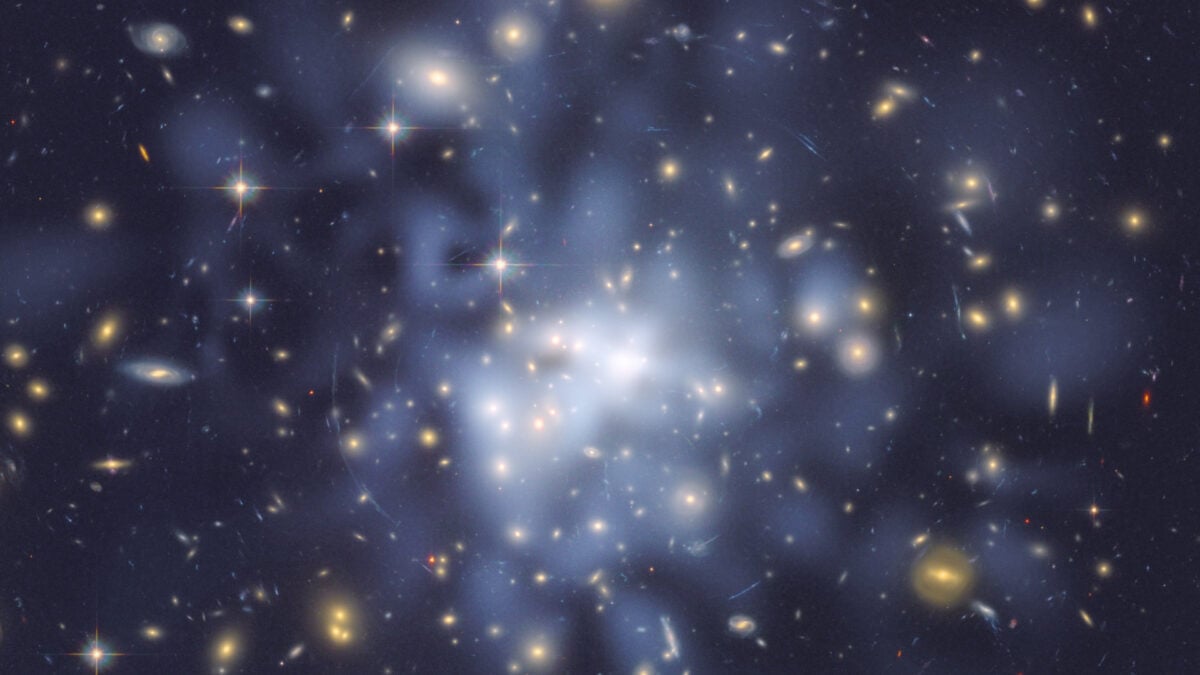
Dark matter is the invisible stuff making up around 85% of the universe’s mass. Like its name, dark matter is “dark” and doesn’t absorb, emit, or reflect light. And crucially, dark matter has yet to be directly detected, or “seen.”
But astronomers have consistently seen the gravitational influence of something on countless cosmic entities—a discrepancy that dark matter resolves too conveniently. What this means is that, for many astronomical observations, accounting for dark matter has been key to better understanding black holes, supernovas, faraway galaxies, or even the universe as a whole. Even if we haven’t actually found any. Nor understand its true form.
To astronomers, however, the stakes can get quite high. As you’ll see, dark matter’s profound presence in the universe means this list addresses a small—yet crucial—portion of cosmic enigmas for which this hypothetical concept serves as the best solution.
1. The entire universe 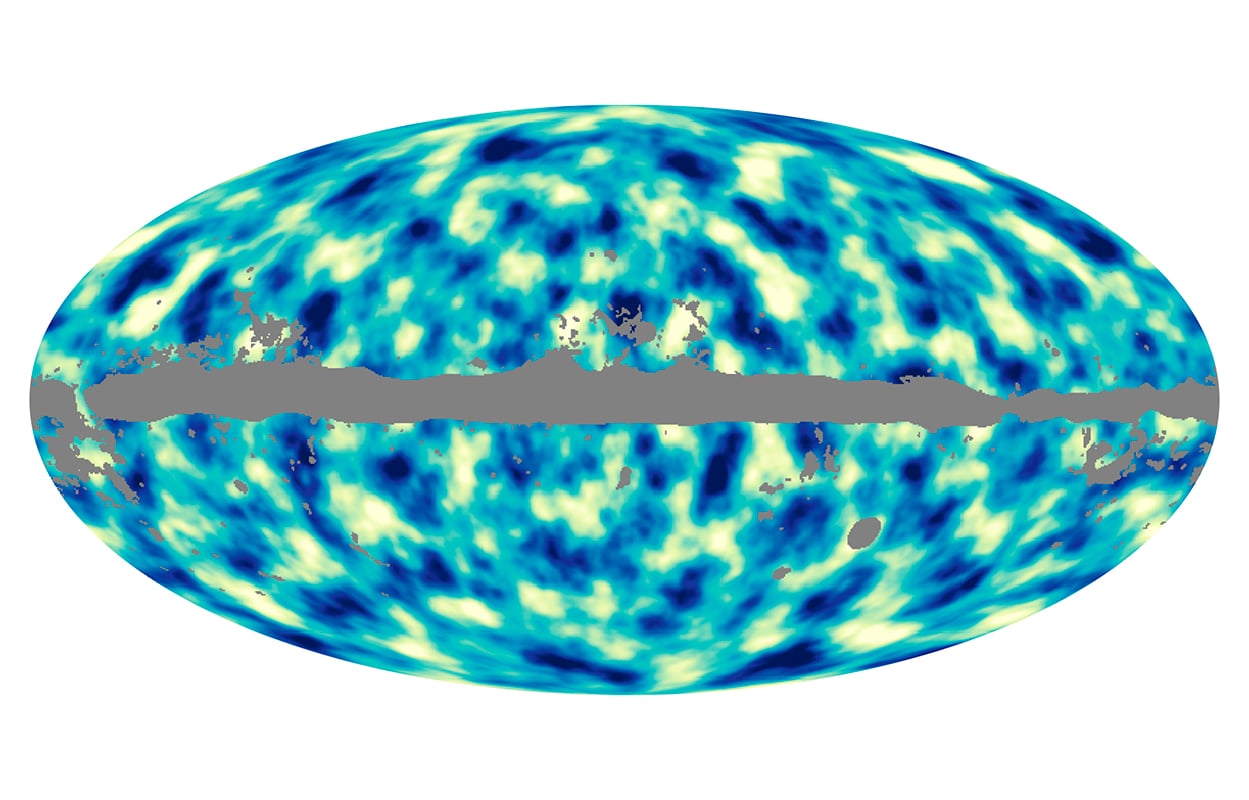 An all-sky image showing the distribution of dark matter across the entire history of the universe, as seen projected on the sky. The gray portions respond to sky patches that were too bright for researchers to analyze. Credit: ESA / Planck Collaboration
Yes, I’m being serious. The whole premise of dark matter starts from the missing 85% of mass in the entire universe. Ordinary matter—so anything we can see, like planets and stars and people—makes up just around 15%, so not even half.
This informs much of how and why scientists assume dark matter explains the other items on this list. If dark matter makes up 85% of the universe’s mass, it would exert roughly that much gravitational influence on visible matter, meaning it’d be hard to find anything not being jostled around by this invisible force.
2. Spiral galaxies 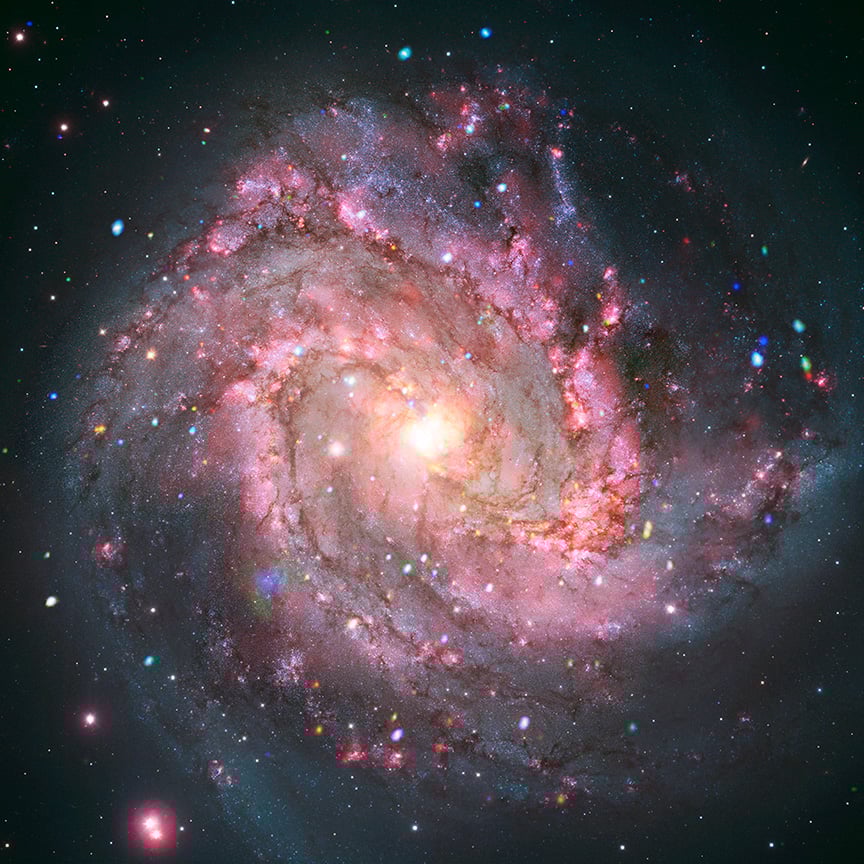 A composite of the spiral galaxy M83 faced toward Earth. Credit: NASA/CXC/SAO (X-ray); NASA/ESA/AURA/STScI, Hubble Heritage Team, W. Blair (STScI/Johns Hopkins University) and R. O’Connell (University of Virginia), (Optical); NASA/CXC/SAO/L. Frattare (Image Processing)
As NASA says, “While not all astronomers agree on what dark matter might be, its existence is widely accepted.” Dark matter became the mainstream consensus in the 1970s, when American astronomer Vera Rubin demonstrated how, without dark matter, spiral galaxies like our Milky Way behave in ways that don’t match existing laws of physics.
According to old astronomy wisdom, the faster a star’s orbit, the more mass—gravity—there should be in any section of a galaxy. Based on the visible content of some 60 galaxies Rubin studied, she expected to see fast-spinning stars only at the center, where starlight was concentrated.
But in fact, stars at the fringe were moving just as fast. That made no sense, since the combination of visible matter dictated that, if these velocities were true, the galaxy should have torn itself apart—unless some invisible mass, like dark matter, held the galaxies together.
3. The Galactic Center
Astronomers believe dark matter may be responsible for more than just the Milky Way’s shape. Some studies have suggested we overestimate how much dark matter is in the Milky Way. Still, astronomers believe the general abundance of the stuff could help investigate our galaxy’s undefined traits.
Last year, for example, a team from Johns Hopkins University proposed that a mysterious excess of gamma rays at the Galactic Center was produced by dark matter particle collisions. Just this month, a study from Argentina’s Institute of Astrophysics La Plata argued that, statistically speaking, it’s surprisingly sensible to assume a massive “dark matter core” at the Galactic Center controls the local stellar populace.
4. Gravitational lensing
According to general relativity, gravity is the distortion of spacetime. Heavyweight cosmic entities like stars or galaxies generate enough gravitational force to bend spacetime. When light travels along these warped paths, light appears bent to Earthbound observers.
Since dark matter also has mass—and a hefty amount at that—it often shows up in gravitational lensing observations. This phenomenon, which astronomers use as a convenient visualization technique, uses gravity’s light-bending properties to observe celestial objects that typically would be difficult, if not impossible, to see. But when dark matter enters the scene, it creates apparitions that make spacetime look like it’s glitching to astronomers—like this odd five-point Einstein Cross.
5. The Bullet Cluster 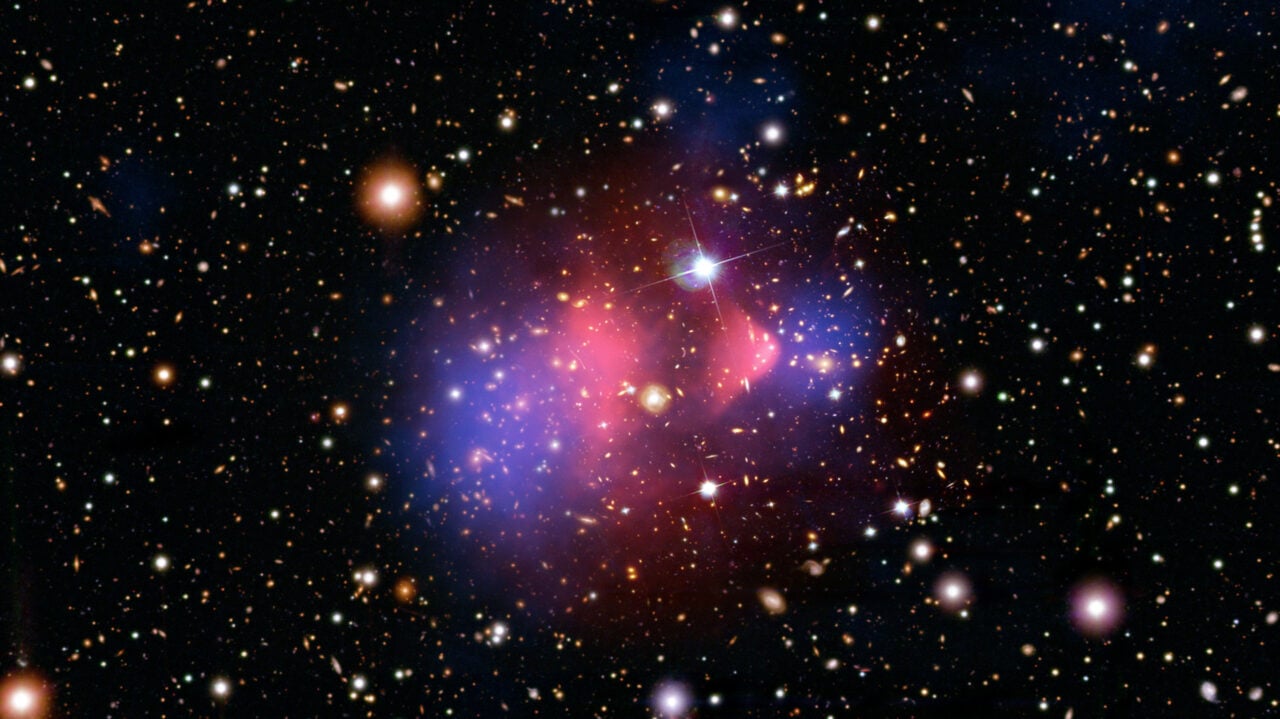 This composite image shows the galaxy cluster 1E 0657-56, also known as the “bullet cluster. Credit: NASA/CXC/CfA/M.Markevitch et al. (X-ray); Optical: NASA/STScI; Magellan/U.Arizona/D.Clowe et al. (Optical); NASA/STScI; ESO WFI; Magellan/U.Arizona/D.Clowe et al. (Lensing Map)
In 2006, NASA’s Chandra X-ray Observatory released a striking composite of the galaxy cluster 1E 0657-56, nicknamed the Bullet Cluster, formed by one of the most energetic events humanity has observed since the Big Bang.
The hot gas produced during the collision interacts electromagnetically, so we should be able to track how and where it moves. But gravitational lensing revealed that most of the cluster’s mass (shown in blue) lay around the galaxies—not at the center, where the gas was (shown in pink).
Following Rubin’s foundational work in dark matter astrophysics, the Bullet Cluster image became one of the strongest demonstrations of dark matter’s influence on the universe.
6. Supersymmetry
Particle physicists have a hunch that dark matter and supersymmetry may be closely connected. This idea predicts that force-carrying particles (like photons) and matter particles (like protons) should come in pairs, which could help clear up the few yet crucial discrepancies in the near-perfect Standard Model of particle physics.
According to CERN, many supersymmetric theories hypothesize that these partner particles would be stable, electrically neutral, and weakly interacting with visible matter—the exact criteria in the search for dark matter. CERN’s own LHC has found no direct evidence for supersymmetry, but physicists are still hoping the connections between supersymmetry and dark matter are there.
7. Quirks in the cosmic microwave background 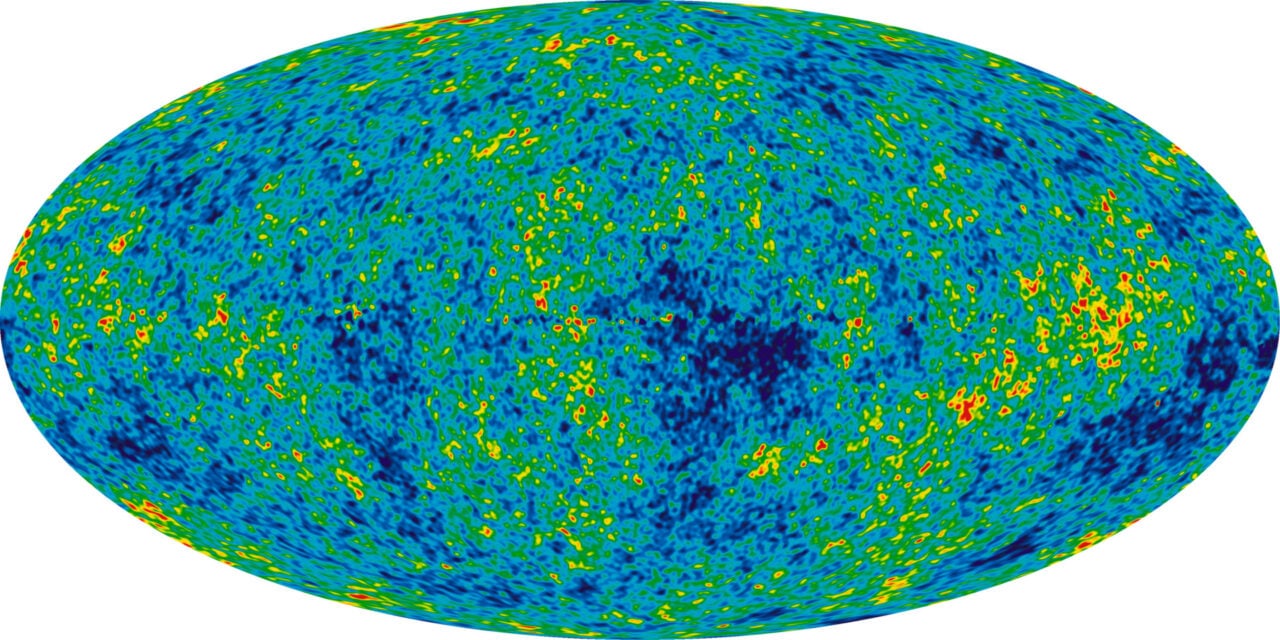 A full sky image of the cosmic microwave background. Credit: NASA/WMAP Science Team
The cosmic microwave background is a relic of the explosive birth of our universe—the Big Bang. It’s a near-uniform glow of radiation that acts as a record for astronomers to track and study how matter evolved over time in the universe.
But particularly sensitive detectors have caught odd variations in temperatures, which scientists believe represent imprints of dark matter. Although dark matter wouldn’t directly interact with radiation, the effect of its gravitational force would have left imperfections, or anisotropies, in the cosmic microwave background.
And the distribution of such anisotropies is how scientists were able to describe key physical properties of the universe’s shape—so as far as defects go, a fairly useful one.