
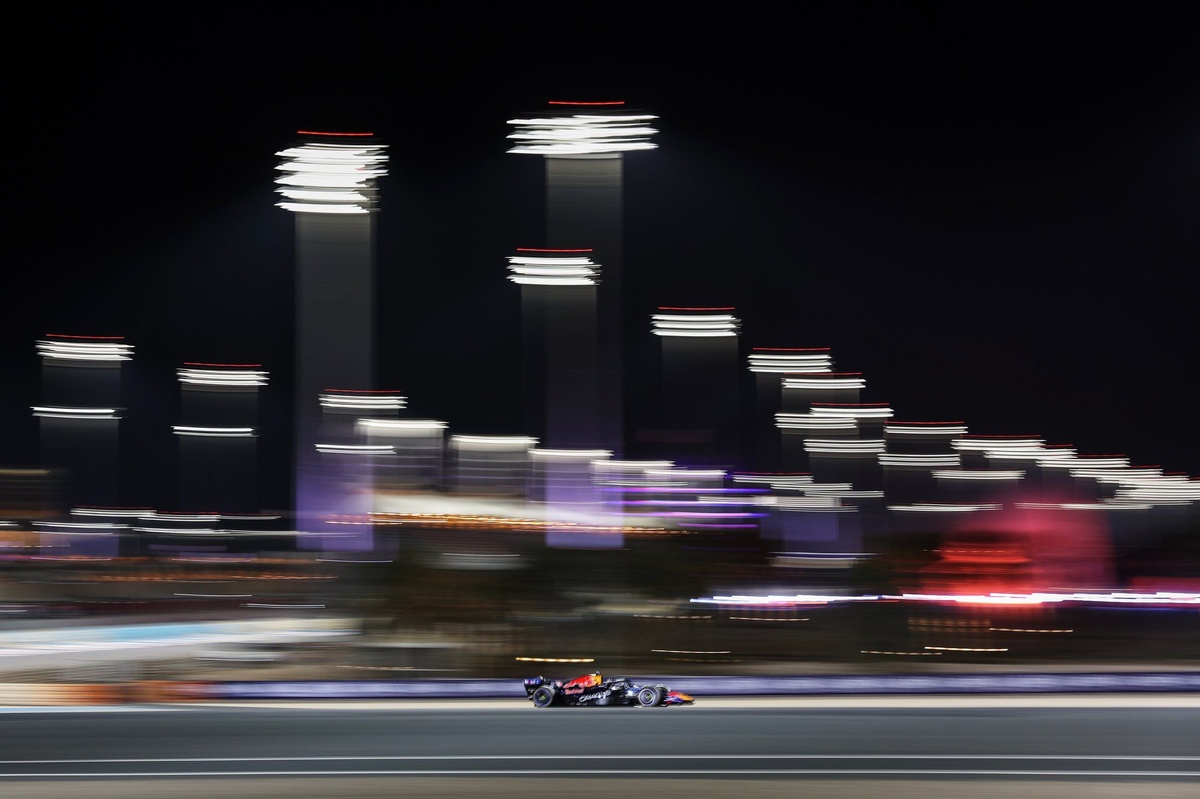
If Formula 1 testing was a picture, the image presented by Barcelona’s shakedown was nothing more than a pixelated, obfuscated mess. Without standing mere metres away from 2026’s brand-new machines, one could get neither the visual nor the audible sense of speed; still images present visual details of the car, but lend no clue to the actual driving experience.
Thankfully, Bahrain testing has started to layer a more detailed visage over that we’ve relied upon for the past couple of weeks, purely from the experience of being able to stand, observe, and listen to the cars perambulate around the Sakhir circuit. The cars are smaller. They’re lighter. That much is obvious on first viewing; the new chariots do not appear nearly as cumbersome as the 2022-25 generation of cars, which barely wanted to entertain any kind of steering input through the slower corners. But it’s also evident that the drivers have needed to adapt to the demands of the new cars, particularly owing to the new powertrains – Lewis Hamilton estimated that you’d need a degree to fully understand the whims of the 2026 machines.
Since it’s the first day where we’ve had all 11 teams on-track together, it’s probably a bit pointless doing any granular analysis into the times – and it will probably remain so until the final couple of days of next week’s running. We’ll get into the actual runs themselves shortly, in a breezy run-down of which teams ran reliably and which teams had reliability gremlins to overcome – but first, it might be more fun to offer some kind of perspective of what it was like to actually sit down (or lean against a wall) and watch these brand new cars in action.
Pushing the senses (except taste)
It’s evident that there’s a lot less aerodynamic grip compared to the previous rules, since the new cars are a lot more skittish going in and out of the corners. In the last era, it was mid-corner grip (i.e. at the slowest points) at which the ground-effect cars were more likely to buckle underneath the drivers’ inputs, but now there’s uncertainty into the corners due to experimentation with deployment – plus the side-effect of gusts – and more on the exit as the reduced traction creates a moment of lateral force. This was particularly evident at Turn 10.
“The feeling is you’re sliding a bit more, you have less downforce, but then the power out of the corners is quite nice,” Valtteri Bottas explained after his morning constitutional in the Cadillac. “It’s quite a lot compared to the grip we have. So, for example, the throttle application out of the corners is much longer now than it used to be. So it’s a different way of driving, especially when it comes to the qualifying mode or race mode, it’s quite a big difference when it comes to the deployment and stuff. But I like it. It’s fun. More sliding.
“Everyone is still getting grips on their deployment. We’re trying different things in different laps, and that brings quite a bit of variability on the braking points. So actually what had me over there was I had quite a lot more deployment on that lap into the corner, so I arrived there much faster, which is not something we had before.”
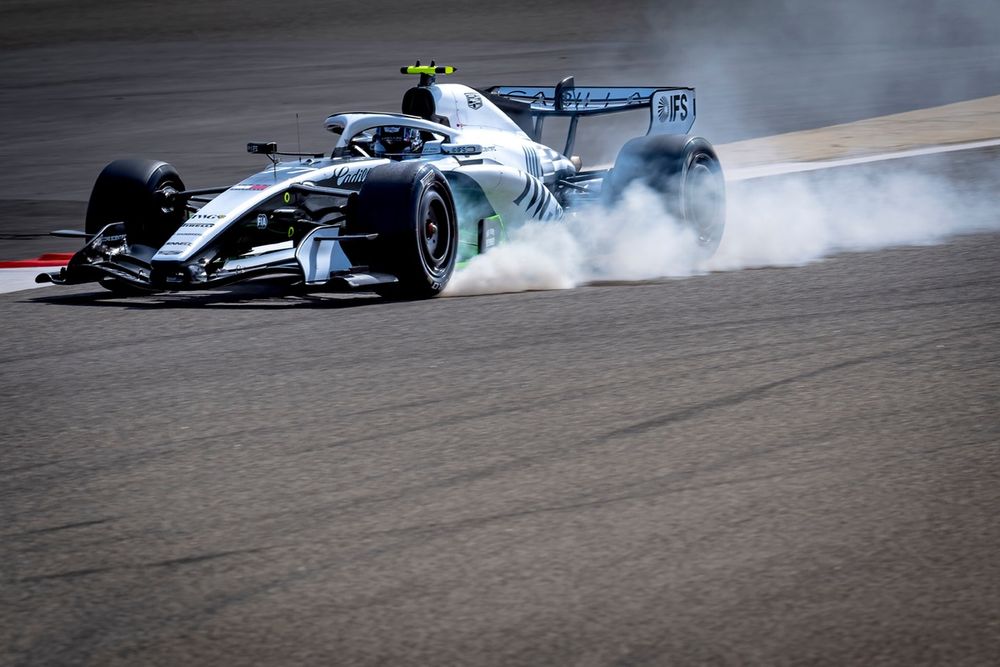
Bottas enjoyed the looseness of the new cars – but not the locking
Photo by: Marcel van Dorst / EYE4images / NurPhoto via Getty Images
Of course, nobody’s going hell-for-leather on a qualifying lap just yet – it doesn’t make sense to do so when the teams’ understanding of their set-up windows is still in the embryonic stage. When we get to that point, the cars should be able to generate the kind of mistakes that offer a bit of variance, an element that the previous generation lacked.
The sensory experiences don’t end there. Aston Martin’s new Honda powerplant delivered a hearty roar as Lance Stroll got on-throttle on the exit of Turn 11, while Audi’s new V6 turbo-hybrid unfurled a series of rattling raspberries when Gabriel Bortoleto lifted for the same corner. Growls and dismissive spits permeated through the Bahraini mid-day air, the result of teams mapping their engines to carry power through the corners to charge the battery.
Shut your eyes, and you can also hear how the drivers are responding to 2026’s unique challenge. At Turn 10, the drivers are exploring first and second gears to keep the revs high; this will ensure that the engine will put charge into the battery pack. In shifting up, it becomes clear that – on a race lap – the eighth gear in the ‘box is only slightly more useful than a vestigial organ as the drivers stay in seventh. You can watch the top speed drop at the end of the straight without lifting-and-coasting – the car hits the rev limit and the speed drops as the MGU-K starts to derate before the current switches direction entirely. It’s not just about harvesting, but saving – the battery pack can be charged with a maximum of 4MJ per lap, and thus those behind the wheel must be sparing.
“At the moment we’re really trying to understand the characteristics of the car without trying to dial it in, just how do you get the best out of them” Rob Marshall
While the soundscape is a little more varied (and raucous) than that of the previous generation of power units, the smell is less salubrious. The new sustainable fuels carry a bit of a pong, a combination of vegetal and burned-plastic notes smack one’s nasal passages – as if someone passed you on the street while chugging away on a burned-out vape. I don’t remember the previous engines carrying quite the same ‘musk’ – but to be honest, I don’t remember having a good old whiff at the fumes either.
How did Day 1 unfold?
That the reigning champion ended the first day of “proper testing” in Bahrain on top is probably quite inconsequential. Lando Norris ended the day with a 1m34.669s on the C3 tyre after stepping in for the afternoon/evening session, as Oscar Piastri held the reins before lunch. With 102 laps on the board for McLaren, it was a decent return – but, as chief designer Rob Marshall explained, it was only ever about trying to continue its learning with the new Mercedes power unit.
“I think it’s fair to say we’re still very much exploring at the moment,” Marshall mused after the session. “Understanding how to operate the power unit is very challenging and the car is behaving differently here than it did in Barcelona. Obviously we’ve got warmer temperatures, so getting on top of that is important and understanding that is important, but really at the moment we’re really trying to understand the characteristics of the car without trying to dial it in, just how do you get the best out of them.”
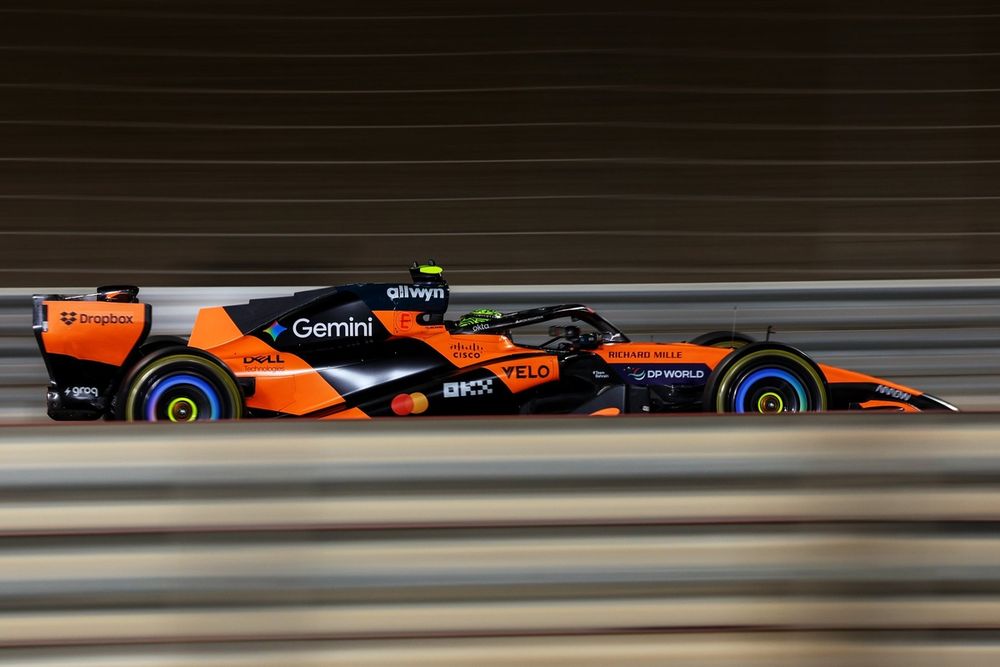
Norris topped the charts – but the day was dedicated to learning more about his MCL40
Photo by: Glenn Dunbar / LAT Images via Getty Images
Max Verstappen was in the car all day for Red Bull and gathered 136 laps, setting a session-best just 0.129s off Norris’ benchmark. The Red Bull-Ford powertrain has proven reliable thus far and, per Toto Wolff, has been able to tap into a node of energy deployment that has Mercedes looking over its shoulder. While it might not paint the established manufacturers in a particularly good light if that purported advantage carries over, Red Bull does have a wealth of top-line staff running its Powertrains division – plus, at least the brand is in the business of energy boosts…
Read Also:
With third in the times, Charles Leclerc added to Hamilton’s morning total of 52 laps to bring home a total of 131 tours for Ferrari, while Esteban Ocon did 115 laps en route to fourth overall for Haas.
Mercedes, by contrast, had not enjoyed the heights of Barcelona; George Russell was sixth after running in the morning and got 56 laps, but Andrea Kimi Antonelli struggled with a set-up issue that only offered him the chance to do 30 laps as the sun began to dip.
Arvid Lindblad endured a more terminal issue, as a fluid leak on board his Racing Bulls machinery hurt his running, while Franco Colapinto and Nico Hulkenberg stopped on track in the morning and afternoon sessions respectively to bring out the red flag. Stroll ‘s day was also truncated by a “data anomaly”, ensuring that Aston Martin managed just 36 laps throughout.
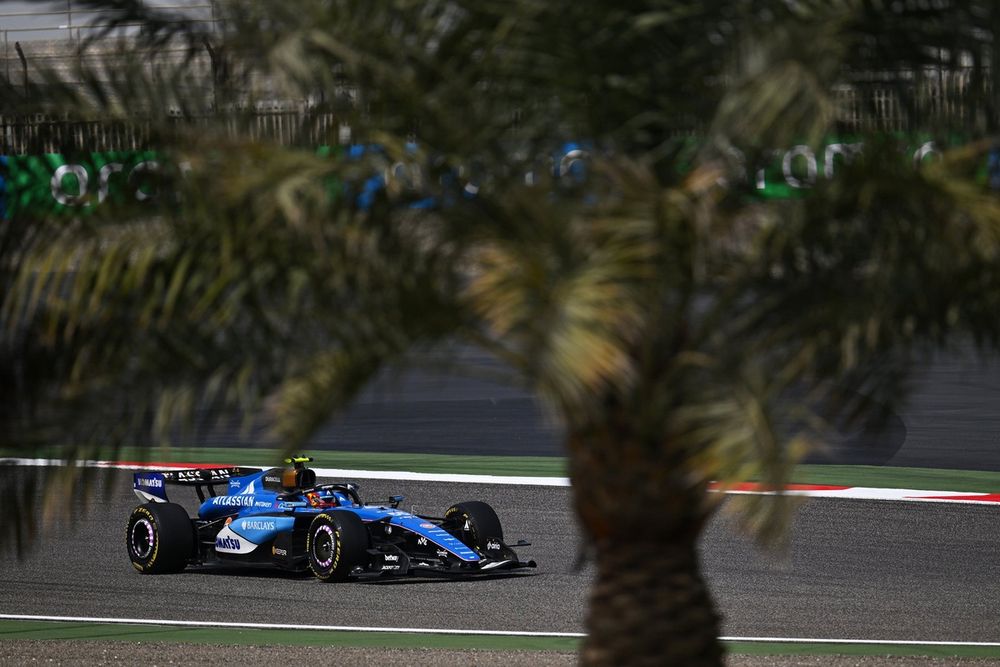
The opening day of Bahrain testing was also the collective test debut for Williams after missing the Barcelona shakedown
Photo by: Guido De Bortoli / LAT Images via Getty Images
We want to hear from you!
Let us know what you would like to see from us in the future.
– The Autosport.com Team