

Alex takes a look at the newly patched Resident Evil 4 on PC – and the user reports are right: there is an issue.
The Digital Foundry team recently received reports that the PC version of the Resident Evil 4 remake has ditched the controversial Denuvo DRM – but the good news was short-lived as it appears that Capcom has replaced it with what many believe is the Enigma Protector DRM, causing performance drops and issues with long-standing, highly regarded mods. We decided to take a look. Is performance impacted? And beyond that, what are the ramifications for switching DRM years after a game’s release? To put it simply, we think it’s a very bad idea, especially for a game that’s almost three years old.
First of all, let’s talk about performance in the most general terms. There are a couple of key performance bottlenecks that may impact any given gaming PC: primarily, the capabilities of the graphics card. Secondarily, the prowess of the CPU. In the case of DRM performance hits, it’s the CPU that is most impacted.
Alex took a look at the game running with a Ryzen 5 3600 paired with an RTX 4070 Super and compared the latest Steam release of Resident Evil 4 to a patched version courtesy of the “RESTORE PREVIOUS VERSION” mod found on Nexus Mods.
By ramping up settings while reducing GPU load as much as possible at 1440p via FSR 2 performance mode, we can isolate pure CPU performance. Looking at the game’s rendered intro, we found a circa 40 percent drop to CPU game throughput. Clearly, the CPU is being occupied with other tasks instead – and the new DRM is the most likely candidate. In this scenario, an average 1.9ms of CPU time is sucked out of the game – which is pretty shocking. Immediately after the intro, we move into gameplay where the deficit shifts to a 20 percent drop in performance.
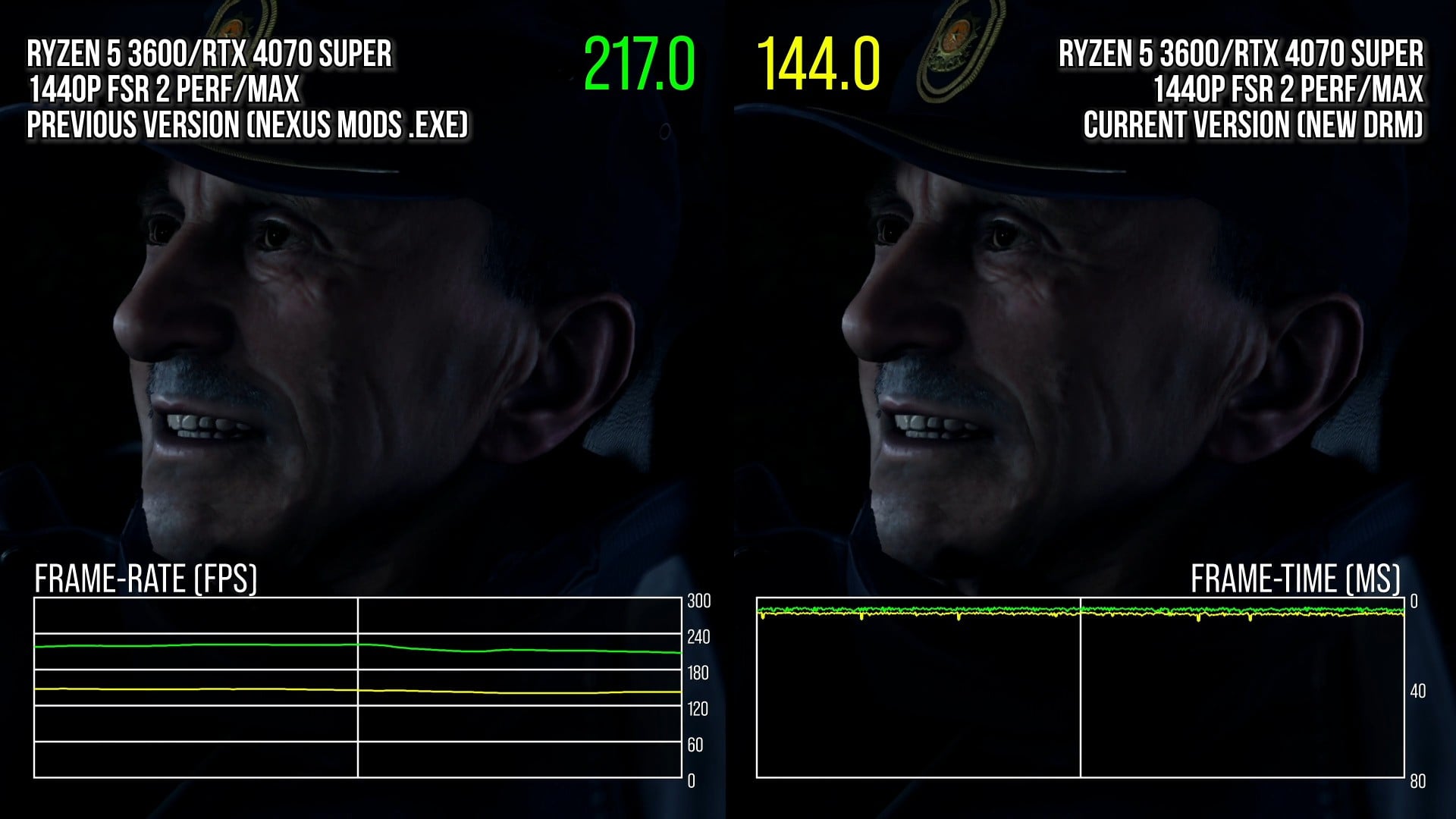 In CPU-light areas of the game – like the initial cutscene, for example – the impact to CPU performance from the new patch is extremely high.
However, moving further into the game sees something curious happen. Once we reach the village, populated by zombie AI, CPU performance between old and new versions can stabilise with almost entirely like-for-like frame-rates. That said, once the zombies move out of camera view, a performance variance opens up again in favour of the older version of the game. In short, CPU performance seems to have various bottlenecks – zombie AI can supersede the impact of DRM, but where there are no zombies, the DRM can really make itself known in terms of depressed frame-rates.
As things stand, a mod is available to restore the game to how it was before the new DRM was added – a makeshift measure while creators of mods like the excellent REFramework aim to get the new version of the game fully working (right now, there are still some crashing issues) but there really is a much larger point we can’t ignore.
The use of intrusive DRM changes the performance profile of a game that was reviewed three years ago – the goalposts have shifted in terms of how well a user can expect the game to run and initial performance testing on the CPU side is now void. Ideally, performance should improve over time with bug fixes and optimisations. It shouldn’t get markedly worse in any dimension at all. Is there any other industry where you can buy a product and then arbitrarily have its function diminished without consultation?
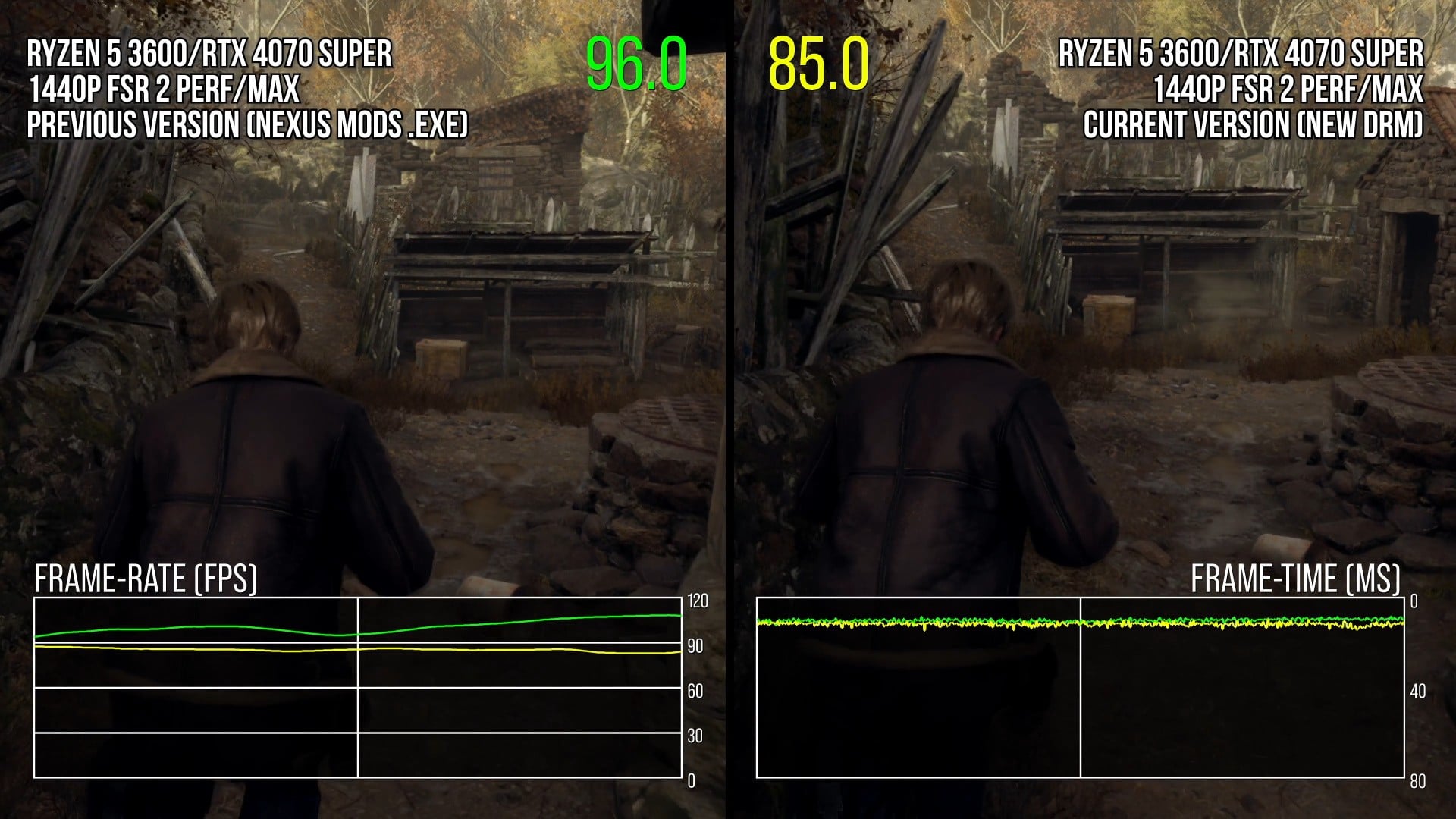 Within gameplay, the CPU is occupied with a range of tasks so the impact of the DRM is less impactful – but it is still there and still measurable.
Worse still, as Oliver mentions in this week’s DF Direct, there’s the sense that publishers are treating PC builds as mutable testbeds, where aggressive DRM experiments and platform controls are added over time, sometimes at the expense of stability, performance and modding. Capcom is on the record as recognising the positive impact of mods but at the same time worries about how unchecked mods can lead to “reputational damage”.
At this point in Resident Evil 4’s lifecycle, mods are adding features the game arguably should have had at launch – like DLSS support via REFramework- and it’s hard to see any negative impact at all. Meanwhile, if we’re talking “reputational damage”, the impact of the new DRM is, we’d say, far more disadvantageous to Capcom. Realistically, there are no winners in releasing this patch.
Our take on this is that if a game must ship with DRM, the process needs to be done in a transparent manner with consumers, the goalposts shouldn’t shift post-launch and – crucially – DRM should be budgeted into game performance targets. Resident Evil 4 Remake remains a great game, but on PC, it’s now a worse version of itself than the one reviewers and early adopters played. From that perspective alone, this retrofitted downgrade is difficult to defend.