
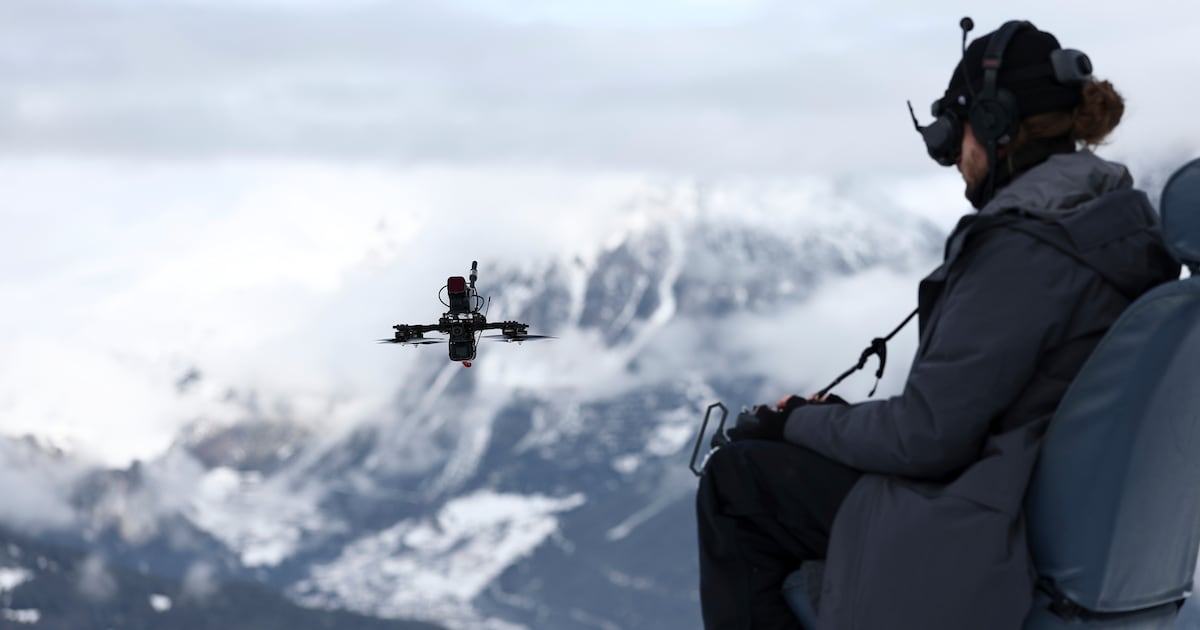
Zeno Mercer, senior research analyst at VettaFi, joins BNN Bloomberg to share his Hot Picks in robotics.
Robotics stocks are drawing renewed investor interest as advances in artificial intelligence expand real-world applications, from drone defence systems to surgical robotics. Growing adoption of hybrid autonomy and increasing focus on national security are helping reshape the sector’s growth narrative.
BNN Bloomberg spoke with Zeno Mercer, senior research analyst at VettaFi, who discussed opportunities in drone services, AI-enabled robotics and enabling technologies, as well as the potential for increased mergers and acquisitions across the space.
Key TakeawaysExpanding use of hybrid autonomy — systems that combine AI-driven functions with human oversight — is broadening commercial and defence robotics applications.Counter-drone and border-security technologies are emerging as key growth areas as governments and event organizers prioritize airspace protection.Demining and other humanitarian defence applications highlight how robotics is being deployed beyond traditional military use.Investment in AI chips, data infrastructure and energy systems is reinforcing the link between artificial intelligence and physical-world robotics.Suppliers of precision motion control, machine vision and sensing technologies may benefit as surgical, industrial and humanoid robotics markets expand. Zeno Mercer, senior research analyst at VettaFi Zeno Mercer, senior research analyst at VettaFi
Read the full transcript below:
ANDREW: It’s time for Hot Picks, and we’re zeroing in on robotics stocks. Our guest has Ondas as his top selection. A look at its website can be striking — the company is involved in military drones, among other areas — but he sees growth driven by demand for commercial drone services as well. We’re joined by Zeno Mercer, senior research analyst at VettaFi. Thanks for being with us. Ondas is also involved in counter-drone technology. Where do you see growth?
ZENO: Ondas is a company we’ve been following with ROBO Global and VettaFi for many years. I’d like to ease any fears around the more intimidating elements of its business. The company is more focused on defence in the sense of protection, not traditional offensive systems.
As technology evolves and we see more AI and robotics applications, new addressable markets are emerging, along with new attack vectors. Ondas has built a mix of products over roughly the past five years through acquisitions. It provides communications and inspection solutions, including monitoring for rail inspections, and also offers counter-unmanned aerial vehicle systems — so not attack drones, but systems designed to defend against drone threats.
As an example, it recently secured a contract tied to the Israeli border. That is one of many potential border-security opportunities globally. It is also bidding on contracts related to major global events such as the World Cup and the Olympics to help protect assets including airports and stadiums. It has a mix of ground and aerial robotics and control systems. It is still a smaller company, but we see opportunity for it to grow within the broader autonomous robotics-as-a-service market.
ANDREW: So these drones would be largely self-directed?
ZENO: They offer a mix of autonomous drones that can sense, analyze and respond to potential threats. But they are supervised systems. They are connected to networks that allow the purchaser to manage and oversee the assets. We are entering an era of what I would call hybrid autonomy, where robotics systems are increasingly capable but still overseen by humans.
The company also has a demining division. It is focused on removing landmines in regions such as Israel and potentially other conflict areas once wars end. That is another application of robotics technology in the defence space.
ANDREW: I was watching a spy show recently and wondered whether facial recognition will change intelligence work. I imagine that kind of technology is already being integrated into drones.
ZENO: Facial recognition and related computer-vision technologies have been implemented for some time. Law enforcement uses license plate scanners and facial recognition systems today. That is a broader discussion around advances in computer vision and AI.
ANDREW: Let’s turn to SoftBank. We often think of it as a major technology investor. What is the robotics angle?
ZENO: Historically, SoftBank has had a telecom and venture capital focus. Over the past couple of years, we’ve seen a clearer vision around artificial intelligence. Its position in Arm is a major part of its valuation and provides exposure to AI chips.
As AI becomes more distributed in the physical world, we are hearing more about “physical intelligence,” meaning AI acting on real-world objects — essentially robotics. SoftBank has expanded its exposure to robotics through investments and partnerships. It has interests across AI chips, robotics, data centres and energy. Many would argue those are foundational pillars of future economic growth.
ANDREW: And finally, Novanta. What is its robotics angle?
ZENO: I wanted to highlight a company that sits more on the enabling-technology side. Novanta provides precision motion control, machine vision, photonics and tactile sensing technologies. It is often described as a “picks and shovels” supplier to robotics and physical AI.
Its largest customer segment is in surgical robotics. If it continues to grow there and robotics applications expand more broadly — including in humanoid robots and drones — it could benefit from underappreciated upside. It has also been involved in safety standards discussions related to humanoid robotics. While that opportunity is not yet reflected in its financial results, we believe it could develop over time.
ANDREW: Fascinating. It really does seem like a rapidly expanding area. Some of these companies — perhaps not SoftBank, but others — could even become takeover targets for firms looking to expand their robotics exposure.
ZENO: We expect more mergers and acquisitions in the coming years. Robotics is in the spotlight. Large technology companies and policymakers are increasingly focused on it. There has even been bipartisan discussion in the United States around developing a national robotics strategy. We are at a pivotal moment, driven by the convergence of AI chips, new hardware form factors and advances in AI models that improve coordination and capability in robotic systems.
ANDREW: A pivotal moment indeed. Thank you very much for your insights.
ZENO: Thank you.
ANDREW: Zeno Mercer, senior research analyst at VettaFi.
DISCLOSUREPERSONALFAMILYPORTFOLIO/FUNDONDS NASDAQNNNSFTBY TYONNNNOVT NASDAQNNN
—
This BNN Bloomberg summary and transcript of the Feb. 11, 2026 interview with Zeno Mercer are published with the assistance of AI. Original research, interview questions and added context was created by BNN Bloomberg journalists. An editor also reviewed this material before it was published to ensure its accuracy and adherence with BNN Bloomberg editorial policies and standards.