
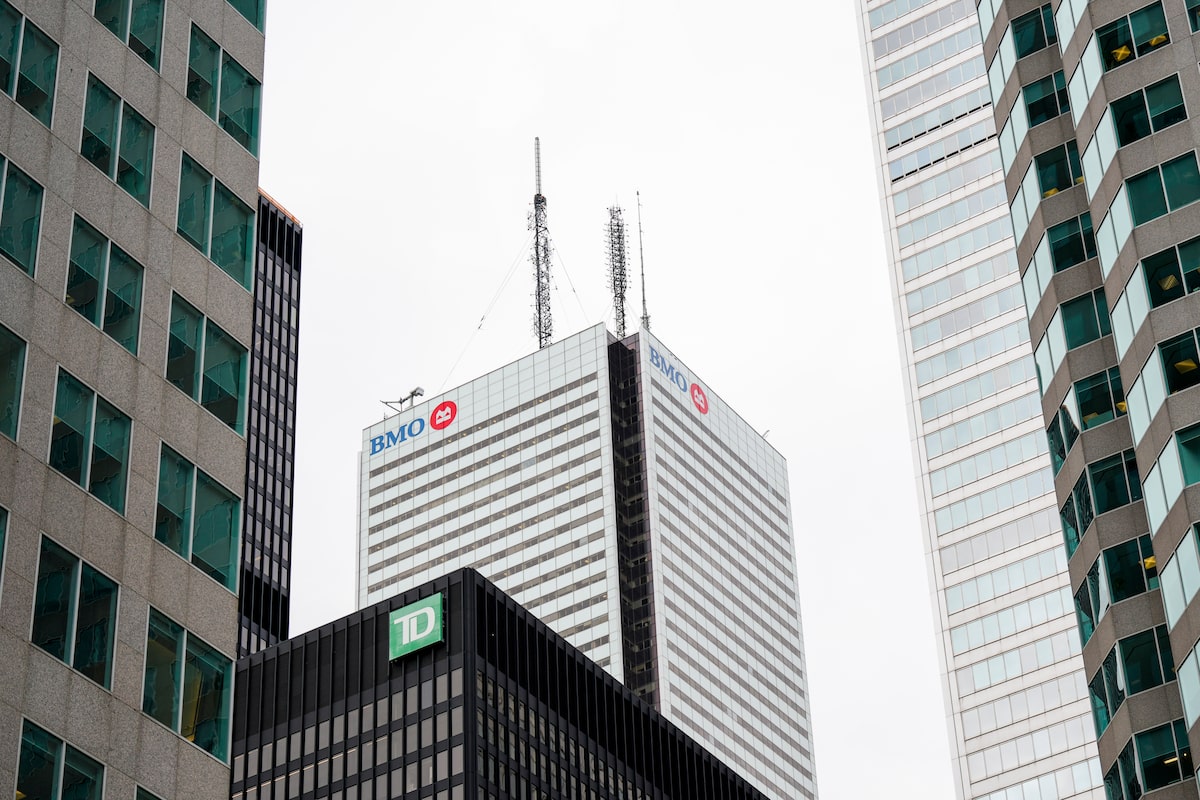
Toronto-Dominion Bank and Bank of Montreal buildings in Toronto. BMO is the last of Canada’s big banks to declare its support for the Defence, Security and Resilience Bank.Andrew Lahodynskyj/The Canadian Press
All six of Canada’s major banks have signed on to support a new multinational defence bank, which the country is helping to spearhead among a group of NATO members and their allies.
Bank of Montreal BMO-T is the last of Canada’s big banks to declare its support for the Defence, Security and Resilience Bank, after announcements by its main competitors last week.
The bank is being established by a group of 13 leading nations and is expected to have as many as 40 member countries. It will be dedicated to financing defence projects in participating countries through low-interest loans.
Royal Bank of Canada RY-T was the first Canadian bank to sign on as a partner of the DSRB late last year, joining other international institutions such as JPMorgan Chase & Co. JPM-N, ING Group NV ING-N, Deutsche Bank AG DB-N, Commerzbank AG CRZBF and Landesbank Baden-Württemberg.
Bank of Nova Scotia BNS-T, Canadian Imperial Bank of Commerce CM-T and National Bank of Canada NA-T announced their support shortly after the federal government officially endorsed the DSRB on Jan. 30, and Toronto-Dominion Bank TD-T joined the group late last week.
Canada officially endorses leadership role in new defence bank
The Canadian institutions stand out on the multinational bank’s website, outnumbering those from any other country.
Canada has assumed a leadership role in the establishment of the bank, which is being carried out by the DSRB’s development group. On Jan. 30, Canada hosted a meeting with 12 other countries to discuss the future of the bank. On Feb. 9, Prime Minister Mark Carney also discussed the bank with the Prime Minister of Luxembourg, as part of a wide-ranging discussion between the two leaders.
Negotiations to decide the location of the bank’s headquarters and charter are expected to begin in March. Isabelle Hudon, chief executive officer of the Business Development Bank of Canada, will represent Canada at the table as chief negotiator for the country.
It’s yet to be decided which country will headquarter the bank, but several Canadian cities have already made their case for why they’re the best place for it to locate.
Ottawa, Toronto, Montreal, Halifax and Vancouver have all been vocal about their desire to host the bank and the various attributes each city brings to the table. Most recently, B.C. Premier David Eby added his endorsement of Vancouver to the discussion.
On Monday, Mr. Eby said British Columbia’s ports and robust relationships with NATO and its allies makes the province a strong candidate to headquarter the bank. And to add the 3,500 jobs in defence finance that are expected to come with it.
Meanwhile, Toronto’s pitch focuses on its financial sector, while Ottawa’s appeal is rooted in its role as Canada’s capital, as well as its hub of defence companies.