

As foretold, the Relativistic Heavy Ion Collider—among the most powerful heavy-ion colliders in the world, second only to CERN’s LHC—ran its final particles and ceased operations last Friday.
This is actually good news. Don’t worry, the shutdown doesn’t have much to do with the recent, general turmoil science has endured in the U.S. The RHIC is actually going on a “break” while the Brookhaven National Laboratory, its operator, prepares to make room for its successor, the Electron-Ion Collider (EIC). This is exciting, as Brookhaven’s communication on the EIC’s progress had been rather vague in the past couple of years.
But news of the RHIC’s final run was accompanied by a slew of important announcements that the EIC is definitely coming and continues to have decent government support, meaning that particle physics in the U.S. is not dead. If all goes well, by the mid-2030s, physicists will be better equipped to push the limit of physics.
“It’ll be good to sleep well for a while,” Travis Shrey, a scientist at Brookhaven who coordinated RHIC’s final run, told Scientific American. “I’m excited to reach the finish line.”
The “Big Bang machines” say goodnight 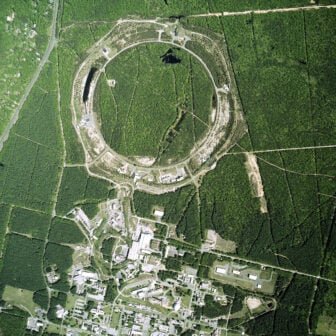 An aerial view of the RHIC. Credit: Brookhaven National Laboratory
Located in Upton, New York, the RHIC began operations in the year 2000. Its primary goal was to probe the internal structure of atoms, or more specifically, the strong force holding quarks together.
That said, it’s worth noting that the U.S. actually has many more active particle accelerators—Fermilab in Illinois has several, for instance. In fact, so does Brookhaven, and a good number at that.
What makes the RHIC different, however, is that the collider packs enough power to ram relatively heavier particles, like gold ions, into each other. In contrast, most particle accelerators point the particle beams at specific targets or zap particles with X-rays. In short, colliders are a specific subset of accelerators that are both tricky to build and manage.
Before the RHIC shut down, it was the only operational particle collider in the U.S. and one of two heavy-ion colliders in the world, the other being the Large Hadron Collider at CERN in Switzerland. Incidentally, the LHC will also go on break this summer for the same reason: to prepare for its own successor, the High-Luminosity LHC.
Looking to the future of physics
During its run, data from the RHIC allowed physicists to arrive at several groundbreaking discoveries. For instance, it was the first facility to reproduce quark-gluon plasma, an amalgam of quarks and gluons hypothesized to have filled the early universe. More recently—just two days before the shutdown—it characterized how certain particle spins transform into visible matter from a quantum vacuum.
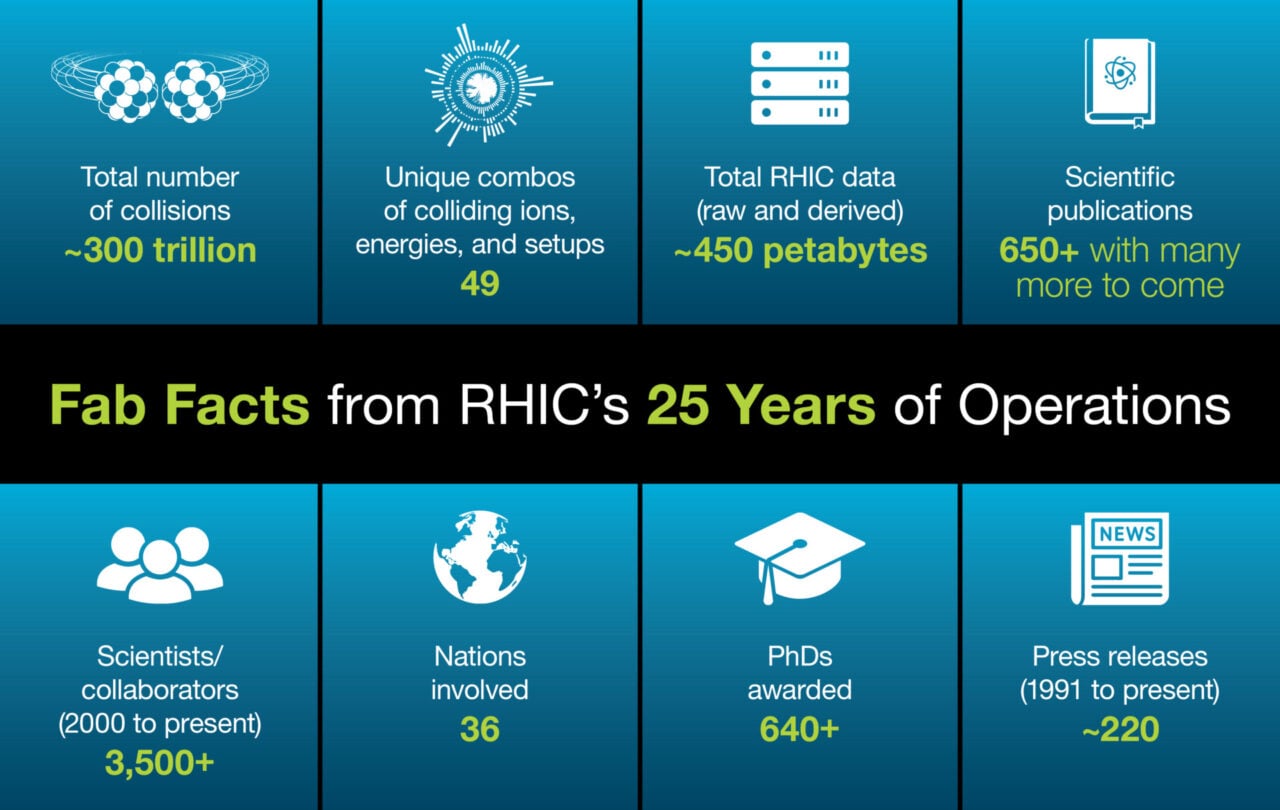 An infographic summarizing key statistics from the RHIC’s history. Credit: Jen Abramowitz/Brookhaven National Laboratory
What’s more, RHIC’s final run actually was its longest, meaning the machine collected more data than it ever had. Analyzing all that will keep physicists occupied for at least another decade, so RHIC’s science will “continue until we analyze all the data and publish all the papers,” Abhay Deshpande, Brookhaven’s associate director for nuclear and particle physics, said in a statement.
The EIC will be literally, in part, built from the remnants of the RHIC, including its ion sources and superconducting magnets. The finished collider will be furnished with giant accelerator rings with a circumference of 2.4 miles (1.8 kilometers) and a house-sized detector to capture and produce 3D images of electrons, protons, and ions traveling nearly at the speed of light.
“We’ll learn how quarks and gluons generate mass, how their interactions contribute to proton spin, and much more that will revolutionize our understanding of matter—much as the science we’ve explored at RHIC has,” Deshpande said.