
DAYTONA BEACH, Fla. — Thinking back to the days leading up to the 2025 Daytona 500, Sarah Turner Wells shakes her head in astonishment. With the clock ticking down, she was racing against time in trying to help Legacy Motor Club accomplish the Jimmie Johnson-owned team’s preparation for NASCAR’s biggest race.
But whereas the majority of team members within Legacy sought to find the slightest performance advantage they could find for their three cars entered in the Daytona 500, Wells’ focus was on another component, one central to helping provide the lifeblood to any NASCAR team: the sponsorship side. In Wells’ case, this meant figuring out how to adequately provide hospitality to an array of Legacy’s corporate partners and potential partners.
On the surface, this is a seemingly straightforward task. After all, nearly every premier Cup Series team has hospitality of some sort for most NASCAR races, and certainly the Daytona 500. There were, however, two distinct challenges Wells had to overcome.
First, she was tasked with this role at the end of January, a mere three weeks before Daytona. Time was of the essence. Second, Johnson had a high standard. This was not to be some run-of-the-mill offering like many others present with basic fare like chicken tenders and sandwich platters. Johnson insisted Legacy differentiate itself by leaving a different impression. He envisioned something grander, something like how Formula 1 rolls out the red carpet for its important guests.
“When you look at F1, they’ve created an experience where influencers and celebrities have attended, and pop culture has responded, and they say, ‘Wow, what’s that I want to see more of, that I want to be a part of — I want to go to these events,’” Johnson said. “It’s not exactly what I think this opportunity is about, but sports fans far and wide are curious about motorsports. We now have a motion picture out with Brad Pitt in it. There are rumors of ‘Days of Thunder 2′ coming out. There are these elements where our sport has this momentum and interest.
“I’ve been bummed it hasn’t come sooner. I’ve been bummed that other teams haven’t leaned into it. But ownership here at Legacy really believes in it, and it’s something we’re betting on.
“I’m not aspiring to have an F1 experience. That’s not what this is about. This is about an experience that serves our core fan base, serves our partners’ ownership at the same time.”
To be the game-changers Johnson wanted them to be required thinking beyond the boundaries of the sport’s norms. The job fell on Wells to figure out how to make it happen. How, though?
Putting together any hospitality event designed for C-level executives is a challenge, let alone at a racetrack — even one as state-of-the-art as Daytona International Speedway — where her crew wouldn’t have kitchens or other common appliances in the infield to utilize but only a singular stove-top griddle.
Tapping into her contacts, Wells, who has spent a career in hospitality, reached out to two Los Angeles-based, Michelin-rated chefs to come to Daytona to execute Legacy’s hospitality plan. They agreed.
Once the chefs arrived in Daytona Beach, what ensued was something you’d see on a Food Network show. Because Legacy would be hosting hundreds of people, a lot of food was needed. Armed with a shopping list consisting of 60-plus specific items (and needing as much as 10-plus pounds of items like white onions, ribeye, chicken breasts, tomatoes, etc.), they needed to buy in bulk.
“They raided Costco for the best items possible,” Wells said. “Magic, gritty creativity. Truly, their ability to pull a rabbit out of a hat that weekend is something that I’ll never forget.”
As the chefs shopped and planned the menu, Wells figured out where to cook and prepare. With Daytona’s facilities not an option, most of the preparation would need to occur off-site, then be transported inside. Could they rent a kitchen somewhere? This was deemed not feasible.
What they did have in their favor was that Club Wyndham was a major team sponsor, and they were staying in a Wyndham timeshare property not far from the track. The only hitch was that these units were equipped with residential-sized kitchens, meaning limited counter space and small refrigerators and freezers. Again, they would improvise and make do.
If you were a Legacy team member and staying at the Wyndham, your kitchen and refrigerator were commandeered. No room was exempt, including that of Legacy CEO Cal Wells, Sarah’s father, whose room she sometimes had to sneak into during the middle of the night.
“Everybody’s fridge was packed — everybody’s,” Sarah Wells said. “I remember taking food up to Cal’s fridge, and it’s like 2 a.m., and he’s trying to sleep, and I’m like, ‘I’m so, so sorry.’”
The menu fulfilled Johnson’s vision. Over smashburger sliders, bourbon milkshakes, sirloin cheesesteaks with provolone, three types of tacos, various mini desserts and so much more, Legacy leadership and drivers chatted up existing partners and forged relationships with potential partners.
A business-to-business deal between two of Legacy’s big sponsors also emanated from the event. Adding to the flair, Legacy’s three pit crews helped serve food — not because they were short on catering staff but because it was a conduit for them to chat up the VIP guests and share knowledge about a sport many of the guests knew little about.
By any measure, it was a success, prompting a natural question: What if this was not a one-off but a beta test for what the team could do at other NASCAR races?
Like most things within the sport, the decision to expand the concept came down to dollars and cents. Although upscale hospitality is not inexpensive, the benefit of helping retain and cultivate new sponsors offered too much upside not to continue forward.
“When I look at Hendrick Motorsports, Team Penske, Joe Gibbs Racing (NASCAR’s big three teams), the way they have sponsor origination and then sponsor retention, they all have their own way that they do it,” Johnson said. “So how are we going to do that differently? I can’t afford to write checks to stay at the front of the field; we need to create revenue. And I truly believe that there is an experiential piece missing, an experience at the track that we can offer to bring in new fans and help people see and understand what the world of motorsport is about.”
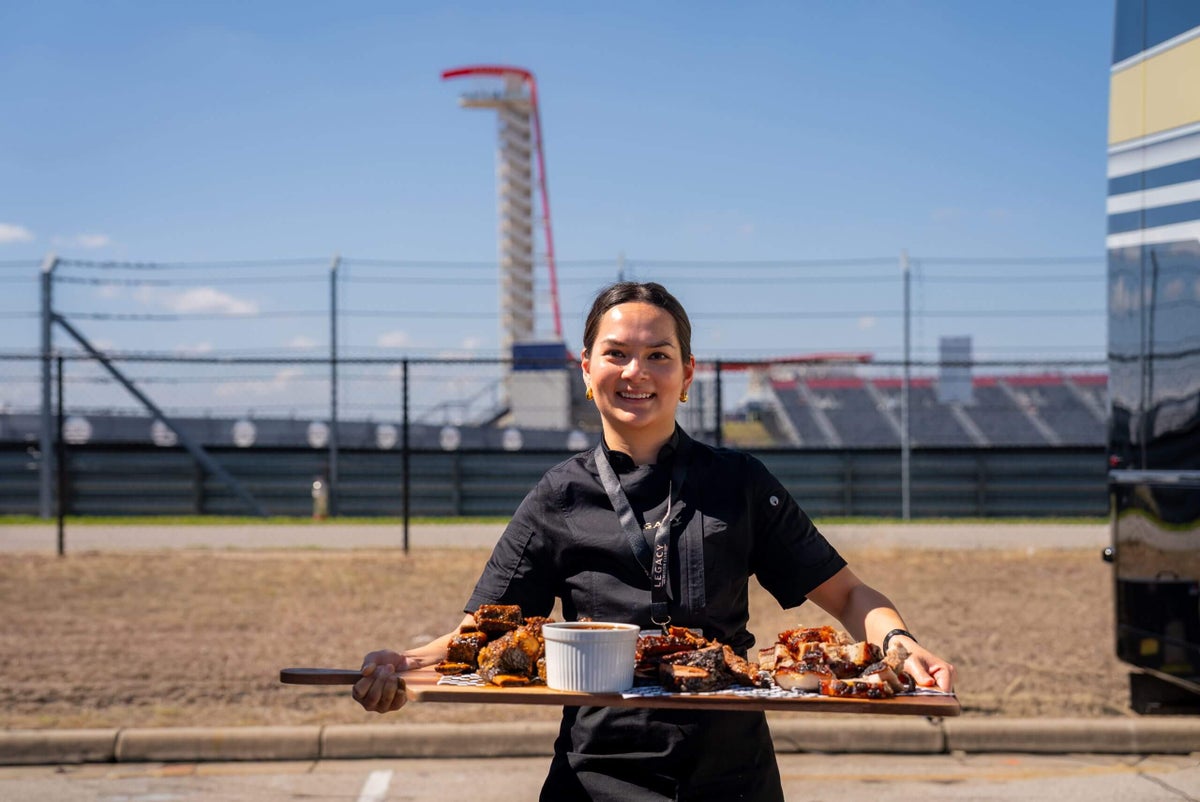
A similar-style hospitality event was planned for two weeks after Daytona, at the Circuit of the Americas road course in Austin, Texas. But wanting to take things further necessitated something even more unique to NASCAR: hiring a chef to oversee the culinary operations. Once more, Wells tapped into her list of contacts.
Enter Duyen Ha, also a Michelin-trained chef, with experience in some of Europe’s finest restaurants. What further separated her from other candidates was that she had competed and won on “Chopped,” a cooking competition television show in which chefs are tasked with cooking gourmet meals in a limited amount of time and with a sparse set of ingredients. Considering the limitations she’d be facing at the racetrack, Ha wouldn’t be fazed by various challenges she’d encounter.
“When I was looking for a chef, I knew that I needed the characteristics of a researcher, somebody who’s willing to look into what that is to regionally express a place,” Wells said. “I knew I needed somebody with insane grit, because it’s exhausting due to the physical labor. And then, someone talented — their food needs to be good — but also somebody who’s personable. We’re not hiding our chefs in the trailer; she’s serving, she’s demoing, she’s talking about the food.”
For Ha, a contestant in the upcoming season of “Top Chef,” the world of NASCAR was one she had little familiarity with. This was seen as a positive, however, as she came in with a fresh perspective not tied to any conventional norms regarding how NASCAR teams typically handled hospitality.
“It is very different,” Ha said. “I used to work at Google, and I’ve learned that I’m a terrible employee; I’m better at building things. And so it was like the perfect time to come in here and to start building this whole program from the ground up. Every race is a little bit different; intentionally, the menu changes for every race, trying to pay homage to each city.”
With Austin also successful, Legacy added nine other hospitality blowouts last year. These events targeted key races for Legacy or its partners, including both Las Vegas races, Nashville, the season finale in Phoenix and the crown jewel Coca-Cola 600 at Charlotte. Staying true to Johnson’s ethos that Legacy continually raises the bar, each of these events was distinct in its own right, with menus tailored to reflect the track and area for that particular race weekend.
Pushed to be creative, Ha flourished. For the spring Talladega race weekend, Jack Link’s was one of Legacy’s primary sponsors, compelling Ha to incorporate beef snacks into her menu by crumbling them atop grits. Another instance involved crushing Fritos, another Legacy sponsor, to bread chicken cutlets. She also slow-roasted an entire pig at Charlotte to make North Carolina barbecue pork.
“I’m the first one in the hospitality program that gets here (at the track),” Ha said. “I get here about a day or two early, and I start eating everywhere, as local and as regional as I can. From there, I’ll kind of get an idea and start tweaking something. I’ve done fine dining, and now it’s like, ‘How do I cook bacon for, like, 100 people?’
“It’s been one hell of a learning curve.”
With Ha remaining in place as executive chef, Legacy’s upscale hospitality is returning for the 2026 NASCAR season, with 15 races currently scheduled. Tentative menus for this year include breakfast burritos, pot roast sliders, truffle butter grilled-cheese wedges, mini tuna poke tostadas and caviar waffles.
Taking things a step further, Sunday’s Daytona 500 will also see Legacy debut a Evolve luxury hospitality coach to help negate some of the facilities challenges it encountered last year, such as a lack of kitchen appliances, storage and food-prep space. The 53-foot, two-story coach was specially designed so an outdoor entertainment area could be constructed around it.
A team having a hauler designated just for hospitality is commonplace in many other forms of motorsport, though to a lesser degree in NASCAR. But to blend fine dining and a love of NASCAR is the combination Johnson seeks. And if it allows Legacy to have a brand that is unique unto itself while also not deviating much from NASCAR’s roots, all the better.
“We have seen a lot of interest from our partners in using assets at the track, and we’ve been able to accomplish a lot in testing our philosophy and then investing in very elevated hospitality rigs,” Johnson said. “So, it’s working. Our partners are a big part of it, but creating the experience at the track is going to bring in new fans, and the new fans are going to bring in new partners.
“Why can’t we just have awesome barbecue and great craft beer and some Frank August bourbon being poured? There are ways to have a smart, premier offering that’s affordable and well represented and true to our sport. I don’t want to get outside of the realms of our markets, our partners, our sport, but there’s really a cool way to offer moonshine and Kobe burgers and whatever you want it to be. There’s a cool way to do it.”