
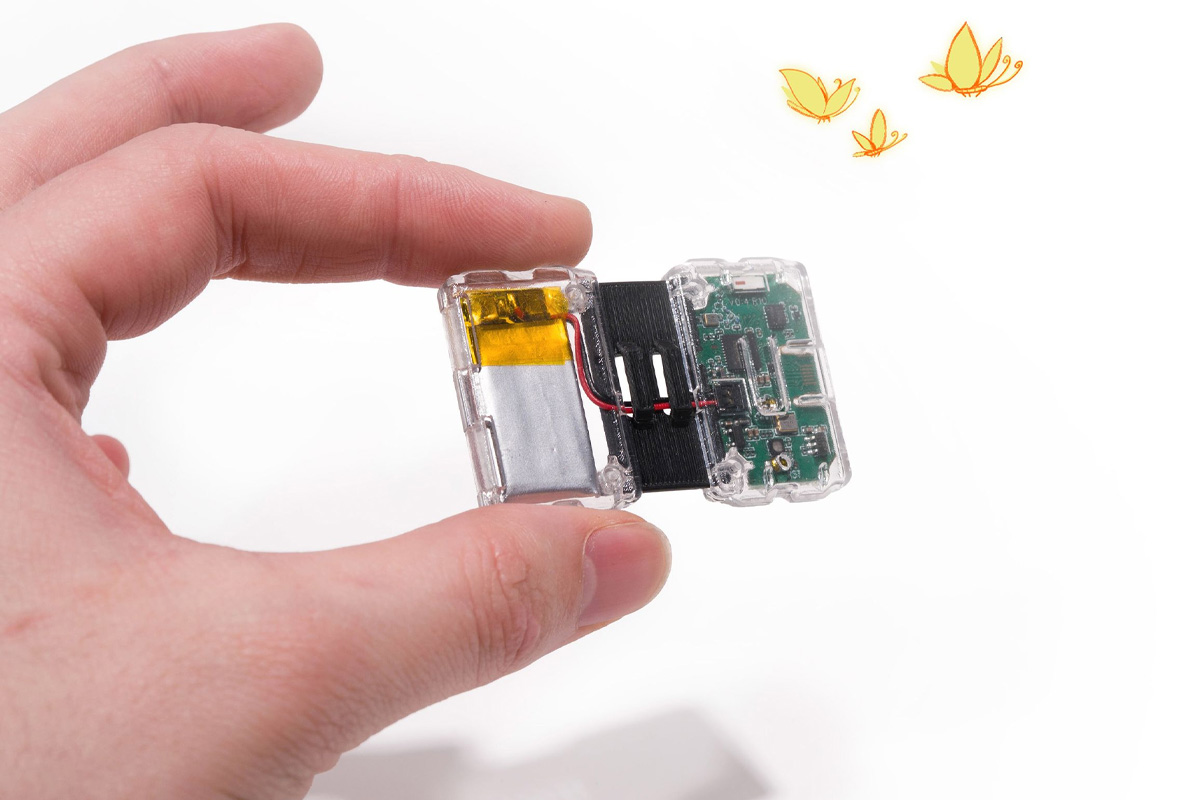
Designed by SlimeVR in Rotterdam, Netherlands, the SlimeVR Butterfly Trackers are open-hardware, IMU-based, ultra-slim, full-body VR trackers designed for virtual reality gaming, motion capture, VTubing, and more. The trackers provide full-body positional tracking without base stations, cameras, Wi-Fi, or Bluetooth.
Each tracker uses an IMU to measure absolute rotation and transmits data over a custom 2.4 GHz ESB protocol via a dedicated dongle supporting up to 10 trackers, eliminating occlusion issues and router setup. Based on Nordic Semi’s nRF52833 wireless MCU, the split “butterfly” design places the PCB and 90 mAh battery side-by-side to achieve a thickness of under 7 mm and a weight below 10 grams, while a flexible interconnect improves comfort when worn under clothing. The system offers a 100–200 Hz refresh rate, <15 ms latency, over 48 hours of battery life with USB-C charging and OTA firmware updates.

SlimeVR Butterfly Trackers specifications:
Wireless MCU – Nordic nRF52833
CPU – Arm Cortex-M4F microcontroller @ 64 MHz
Memory – 128 kB RAM
Storage – 512 kB flash
Wireless Connectivity
2.4 GHz proprietary wireless via Enhanced ShockBurst (ESB) protocol (requires a dedicated USB dongle on host)
Up to 10 meters of range
100 Hz to 200 Hz refresh rate
< 15 ms latency
USB – USB Type-C port for charging and firmware upgrade
Sensor – 6-axis IMU for absolute rotation tracking (TDK ICM-45686)
Misc – RGB status LED
Power
5V from USB-C is used for charging
90 mAh battery with 48+ hours of active use
Deep sleep support for extended standby
Optional 10-tracker charging dock
Dimensions – 56 x 35 x 7 mm
Weight – < 10 grams per tracker
Certifications – FCC, CE (WIP)
Mounting– Hook-and-loop (Velcro-compatible) strapping option, straps included in sets
Enclosure – Injection-molded polycarbonate with flexible butterfly bridge for body contouring
 SlimeVR Butterfly Trackers with Strap
I noticed that this is not the first VR tracker they have launched; the original SlimeVR trackers (for which they raised over 9 million dollars) were based on Espressif ESP32/ESP8266 modules, which were great for DIY users, but they were very power-hungry due to Wi-Fi overhead. The new Butterfly Trackers are based on the Nordic Semiconductor nRF52833 SoC, and instead of Wi-Fi, they use Enhanced ShockBurst (ESB), a low-latency, low-power 2.4 GHz protocol. This allows the trackers to run for over 48 hours on a tiny 90 mAh battery. The trade-off is that they now require a dedicated USB dongle (included in sets) rather than connecting directly to your home router.
Another interesting fact about this is the 7mm thin design; the team placed the PCB and the battery side-by-side rather than stacking them. The two halves are connected by a flexible bridge, allowing the tracker to contour to the user’s body, which makes them more comfortable when lying down in VR or wearing them under tight clothes.
The software is where things get interesting and confusing at the same time. While the hardware is simple sensors on your body, the software stack involves firmware, a central server, and third-party integrations.
The Butterfly trackers run on the Smol Slime firmware. Smol Slime was originally a community-led experimental project designed to manage the power limitations of the original ESP32-based hardware. The Smol Slime Firmware and Smol Slime Dongle Firmware are available on GitHub.
The SlimeVR Server is a cross-platform application (Windows, macOS, Linux, and even Android) that acts as the “brain” of the operation, and it’s designed by SlimeVR B.V. (the Rotterdam team). It receives raw rotation data from the dongle and uses Forward Kinematics and a virtual skeleton model to calculate where your limbs are based on your height and proportions. This is where advanced algorithms like Autobone (automatic skeletal calibration) and Stay Aligned (drift compensation) live. The company also mentions that the software can handle up to 20 trackers for extreme precision (including fingers/toes in the future).
 SlimeVR Desktop Window
 Motion Capture with Blender
To actually see your legs move in a game like VRChat, Blade & Sorcery, or Minecraft, the Server needs to talk to the game. It does this in two ways: first, you have the OpenVR Driver, which is a custom driver that makes SteamVR think you have official HTC Vive or Tundra trackers attached. There is also support for OSC (Open Sound Control) protocol, which is designed primarily for Standalone Quest users. The server sends data directly to the headset over your local network, bypassing the need for a PC link. For more information, documentation, and source code, you can visit the official website and GitHub repositories.
 10 SlimeVR Butterfly Trackers Charging Dock. Production version will be injection molded, the color is not final
The SlimeVR Butterfly Trackers are currently available on Crowd Supply in several bundle options, starting from the the $279 Core Set (6 trackers + dongle) up to the $788 17-tracker Motion Capture Set. There is also a $499 Sakura Edition, which includes a charging dock. You also have the option to purchase upgrade packs, individual trackers, a $19 dongle (supports up to 10 trackers), and accessories like a $49 charging dock, straps, patches, and belt clips. Shipping is scheduled to start on August 31, 2026.

Debashis Das is a technical content writer and embedded engineer with over five years of experience in the industry. With expertise in Embedded C, PCB Design, and SEO optimization, he effectively blends difficult technical topics with clear communication
Support CNX Software! Donate via cryptocurrencies, become a Patron on Patreon, or purchase goods on Amazon or Aliexpress. We also use affiliate links in articles to earn commissions if you make a purchase after clicking on those links.