
The Transportation Safety Board of Canada says that it still ‘too early to draw conclusions’ about the cause of a fiery Delta Air Lines plane crash.
The Transportation Safety Board of Canada says that it still ‘too early to draw conclusions’ about the cause of a fiery Delta Air Lines plane crash at Pearson International Airport nearly one year ago.
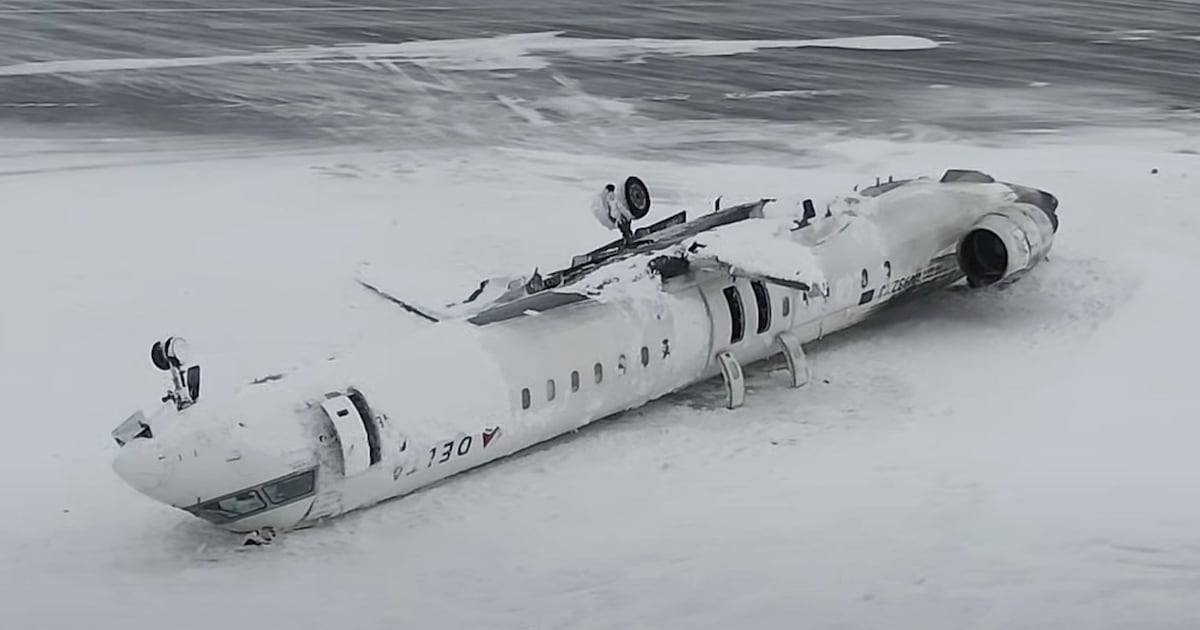
On Feb. 17, 2025, an Endeavor Air flight from Minnesota crashed at Pearson, sliding across the tarmac belly-up.
When the plane landed, parts of the aircraft fractured—the wing and tail section of the plane—and a fire ignited on the runway. Twenty-one passengers out of 80 people on board were sent to the hospital.
“This is a Class 2 occurrence and the investigation remains ongoing, therefore it is too early to draw conclusions as to the causes and contributing factors of the accident,” the TSB said on Thursday.
As of Thursday, Feb. 12, the TSB says a thorough metallurgical examination of the aircraft wreckage has been completed and a detailed analysis is underway. They also add the on-board recorders, including those recording audio from the cockpit and tracking the flight, have been downloaded and analyzed.
The national agency says it also examined data from NAV Canada and the closed-circuit television systems from the Greater Toronto Airports Authority to also support the investigation by reviewing the aircraft’s descent, as well as the evacuation efforts and emergency response.
A comprehensive review of the weather conditions at the time of the crash has also been completed, the TSB said.
What remains to be completed is an examination into the emergency response that day, which the TSB said includes analyzing the emergency egress routes, crew coordination, firefighting response as well as aircraft rescue. Investigators are also comparing what happened at Pearson with other similar occurrences worldwide on various aircraft.
The TSB published its preliminary report a month after the crash, after they brought the CRJ-900’s wreckage to a nearby airplane hangar.
Ken Webster, the TSB’s lead investigator, explained how they simulated crash conditions to understand what happened. From that, it was preliminarily determined the plane was operating within its allowable weight, which means it wasn’t flying in a way that would have hindered the structural integrity of the aircraft.
In the early stages of the investigation, the TSB determined “several things” happened when the aircraft struck the tarmac, including the fracturing of two pieces of the aircraft: the side-stay attached to the plane’s right side and the wing root, the central body portion of the plane.
The cockpit door “jammed shut,” an explosion erupted by the left wing, and the emergency locator transmitted also did not emit a sound, the TSB adds.
The preliminary findings also looked at the years of experience of all Endeavor Air personnel on board that day, from pilots to flight attendants.
A final incident report will be published as soon as the investigation wraps up, the TSB said, adding it will inform regulators and industry leaders should there be any “significant safety deficiencies” needing immediate attention. It is unclear at this time when the investigation will be concluded.