
By the time Dawn Smith’s flight arrived from Mexico, it was too late in the evening for her to go to her doctor’s office. It was December 2024. Smith, who at the time was living in Kitchener, Ont., had returned home from her travels with what she described as a “raging” urinary tract infection, and her symptoms grew worse as the evening wore on.
“I was like, ‘This is a serious infection, and I should probably see someone sooner than later,’” recalled Smith, who now lives near Collingwood.
She knew that it would be a long wait if she went to the hospital emergency department, and it wasn’t as though her condition was life-threatening. Still, she wanted some advice about how serious it was, and whether she should go to the hospital that night or wait until morning to seek treatment when her doctor’s office reopened. So, she turned to Health811, the provincial service formerly known as Telehealth Ontario that provides free and confidential advice over the phone or online from a registered nurse, 24 hours a day.
Through a live chat on the Health811 website, Smith was told that a registered nurse could call her back, but that the wait time could be more than 11 hours. By Smith’s calculations, her doctor’s office would be open before then, or she could go to the hospital and be treated there.
“It was just obscene. I was like, ‘How is that even possible?’” Smith said. “For a service that’s supposed to help keep people out of the ER, to have wait times that are actually longer than the ER, like, what’s the actual point?”
Smith’s experience with Health811 is not an isolated incident. In recent years, as Ontario’s health care system has come under serious strain, various authorities—from the Ministry of Health to regional health teams to overburdened hospitals—have encouraged Ontarians to turn to Health811. In theory, the service is meant to ease the pressure on the rest of the health care system, reducing unnecessary visits to hospital emergency departments and offering guidance to patients who need help for non-urgent health issues, like fevers or rashes or advice for post-surgical care.
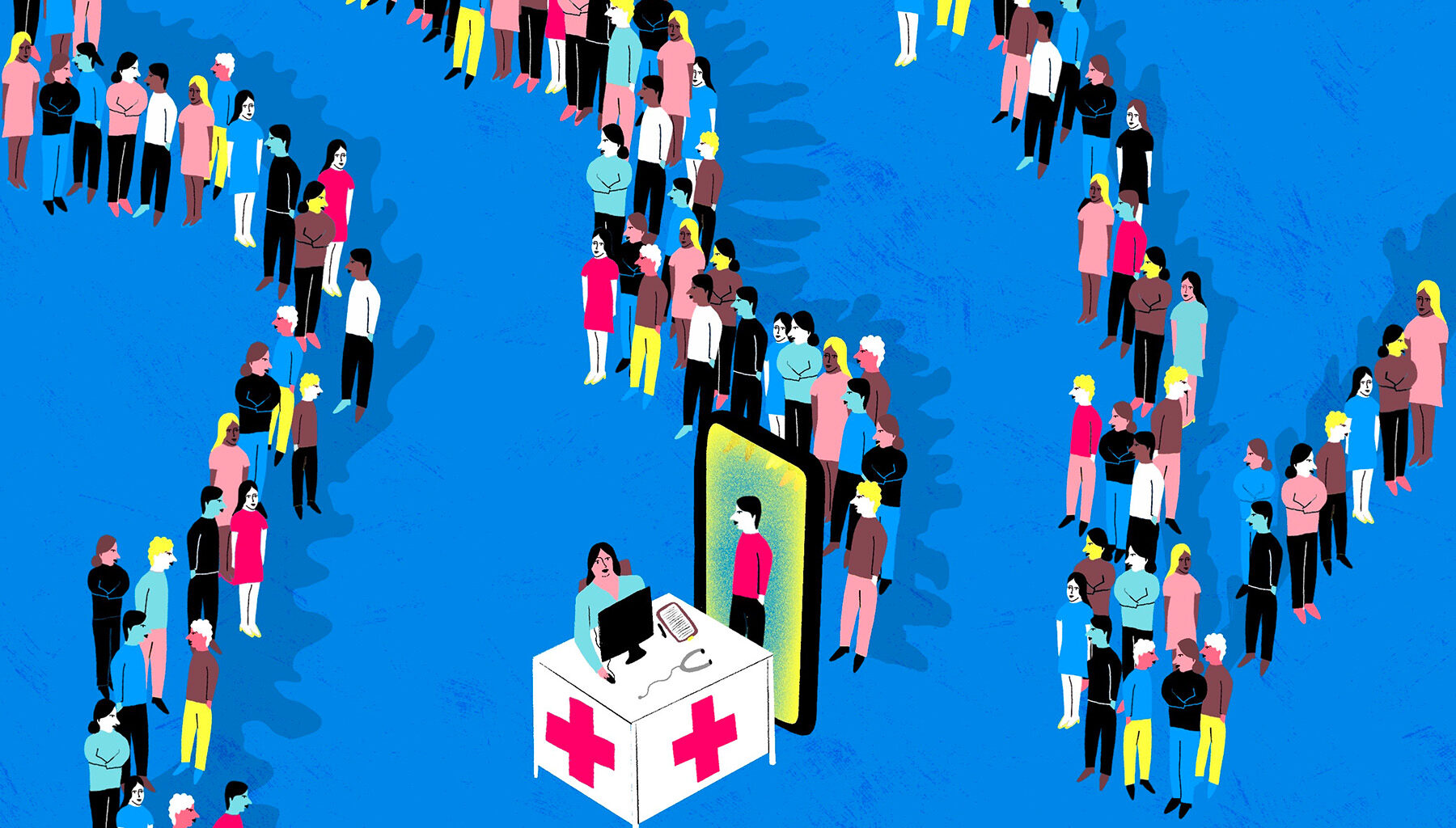
In reality, however, records suggest Health811 itself is overwhelmed. According to data from the Ministry of Health, which The Local obtained through freedom of information requests, those who seek advice from Health811 often wait hours to speak with a registered nurse if their cases are deemed “lower priority,” with average monthly wait times peaking at nearly 11 and a half hours. The wait times are, notably, far longer than they were through the former Telehealth Ontario service, and it’s unclear where callers go once they do speak with someone. Even though Health811 is promoted as a “digital front door” for health care—a portal to access health information and advice and to connect with services—it appears, at times, to act more as a bottleneck.
Data from the Ministry of Health shows that between April 2022, when Health811 was first launched, and July 2025, the most recent month for which numbers were provided, lower priority callers and users of the service’s live chat often waited hours to receive a call back from a nurse. The average monthly wait ranged from 59 minutes to a high of 11 hours 22 minutes.
Both the Ministry of Health and Ontario Health, the provincial agency responsible for Health811, did not answer multiple requests from The Local for an interview to discuss this data and the internal operations of the service. Thus, it’s unclear, for example, how Health811 determines which calls and chat users are “lower priority” versus “higher priority.” The latter had a much shorter average wait—ranging from approximately 8 to 27 minutes.
And while the data shows most calls and chat users are directed away from hospital emergency departments, as intended, it’s unclear without answers from the ministry and Ontario Health where those individuals actually go.
Less than 10 percent of callers and chat users were specifically told to call 911 or go to the emergency department. The majority, however, were advised to seek care promptly, including from their primary care provider, a walk-in clinic, an urgent care clinic, or a pharmacist.
But if those avenues aren’t available to patients—the Ontario Medical Association estimates more than 2.5 million Ontarians don’t have access to a family doctor, for example—it’s possible at least some of those callers and chat users may resort to seeking care from hospital emergency departments.
“If you’re told, ‘See a doctor urgently,’ but you don’t have one, and some communities actually don’t even have access to walk-in clinics and urgent care centers…then your default is to end up back in the emergency department,” said Zainab Abdurrahman, doctor and president of the Ontario Medical Association.
Without answers from the ministry and Ontario Health, it’s hard to tell from the data alone if and how Health811 is helping the province achieve its stated aim of making sure Ontarians are, as Ontario Health put it in its 2024/25 annual business plan, “getting the right care, when and where they need it.”
Until 2022, the old Telehealth Ontario service was a nurse-staffed, 24-hour, toll-free telephone helpline. The service was delivered by a private company, Sykes Assistance Services, which was contracted by the Ministry of Health.
In April 2022, the ministry and Ontario Health announced they were replacing Telehealth Ontario with a new resource, which has since been renamed Health811, that offered expanded options. Ontarians could call 8-1-1 or use an online chat to connect with a registered nurse, 24 hours a day. Users could also visit a website to find local health services, use a symptom checker, get help finding a primary care provider, and find other information.
“This will help Ontarians avoid unnecessary visits to emergency departments and unneeded delays in accessing care, helping to preserve hospital capacity for when it is needed most so that the province can stay open,” the government wrote in a press release.
That press release stated that a consortium, led by the company Orion Health, was the successful bidder to help develop the resource.
The Local’s requests for an interview with Orion Health were referred to Ontario Health, which did not respond.
In official messaging, Ontario Health and government representatives mention Health811 in glowing terms.
“Through Health811, we are providing more access to more features than ever before,” Ontario Health stated in its 2024/25 Annual Business Plan. It said more than 95 percent of calls and chats were answered in less than 60 seconds, and more than 90 percent of users reported a high customer satisfaction rating.
Speaking in the Legislative Assembly in May 2024, MPP Nolan Quinn, who at the time was parliamentary assistant to the health minister, also referenced Health811’s response time, stating 95 percent of the calls and chat requests Health811 receives—up to 90,000 each month, he said—“are directed to an adviser or clinical staff member in less than one minute.”
It’s unclear what response rates Quinn was referring to.
The data we obtained through our freedom of information requests shows that Health811 recorded a total 113,858 inbound calls and chats in the first month it was launched, and managed to handle 62 percent of them. (A definition was not provided for what “handled” entailed.) But over time, those call and chat volumes declined considerably, suggesting fewer Ontarians are now relying on the service. In May 2024, when Quinn was addressing the Legislative Assembly, Health811 recorded only 61,245 inbound chats and calls for the month, and handled 87 percent of them. In July 2025, the last month for which data was provided, there were even fewer inbound calls and chats—51,274 of them, of which they handled 92 percent.
And while it may be, as both Quinn and the Ontario Health report stated, that over a certain period, 95 percent of calls and chats were answered by someone in less than a minute, the data we obtained shows it generally takes much longer to speak with a registered nurse. In February 2025, for example, amid cold and flu season, it took an average of 16.4 minutes for a call back from a nurse for higher priority calls and chats, and an average 5.6 hours for lower priority calls and chats.
By comparison, data we obtained for Telehealth, from 2018-19 to 2021-22, shows average wait times were mostly in the seconds or minutes, not hours. Unlike for Health811, there were no separate metrics for higher and lower priority calls to Telehealth—all are grouped together. And the call volumes and wait times for Telehealth did surge during the early waves of the COVID-19 pandemic.
Yet prior to the pandemic, callers could speak with a Telehealth nurse within a few minutes. In May 2018, for example, it took an average of 10 seconds for calls to be transferred from an automated attendant to a nurse or receptionist, and less than 3.5 minutes, on average, to be transferred from a receptionist to a nurse.
And even in March 2022, the month before Telehealth was replaced by Health811, those average wait times were 1 minute 45 seconds and 5.5 minutes respectively. (The average wait for voice messages to be returned by a nurse was considerably longer, though, at just over two hours.)
For higher priority callers and chat users of Health811, the fact that the average wait time was as low as under 10 minutes is reassuring, said Adil Shamji, an emergency doctor and MPP for Don Valley East, who is the Liberal health critic.
But if people seeking advice about less urgent health matters have to wait five to 11 hours for a call back, and are then advised to go to see a pharmacist or walk-in clinic, those places may no longer even be open for the day, Shamji said.
Moreover, he added, the longer people wait, the worse their conditions could get.
“For issues that may be prioritized as less urgent, a five to 11 hour wait can turn them into an urgent issue and can defeat the purpose of the line in the first place,” he said.
To Abdurrahman, the president of the Ontario Medical Association, the Health811 data reflects what she described as a “family medicine crisis.” The effectiveness of Health811 depends on timely access to family doctors and community services. But without that timely access, the service acts more as a “holding area” for patients, she said. Instead of helping direct people to the right level of care as it’s designed to do, it’s merely redistributing the pressure on the health care system, not resolving it.
“In medicine, none of us work in isolation,” Abdurrahman said. Family doctors are needed to reduce the strain on emergency departments, she explained, while community services are needed so that hospitals can discharge patients into the community. “When we have a crisis in one area, you see a backlog across all the areas” in the health care system, she said.
Earlier this year, Health Minister Sylvia Jones announced that around 275,000 Ontarians were enrolled with a primary care provider in the early stages of the government’s plan to ensure everyone in the province has a primary care provider by 2029.
That’s a significant number, Abdurrahman said, but it isn’t enough, given the pace of population growth in the province.
Newsletter
Never Miss a Story
Sign-up to our free newsletter to receive the next story in the Cost of Care issue—publishing throughout January and February 2026.
“*” indicates required fields
Bridve Sivakumar is a postdoctoral fellow at Women’s College Hospital who evaluates digital health tools. As an applied scientist, she sits in on meetings of representatives of Health811 and similar programs in provinces and territories across the country.
Sivakumar emphasized that Health811 is meant for episodic health care needs, like minor aches and pains, and does not replace continuous care by a primary care provider, or emergency care for serious issues like chest pains.
She pointed out that while the data we obtained shows callers’ and chat users’ average wait times, it does not capture the quality of advice they receive. Even if someone may wait five hours for a callback, there is more to the story, she said.
“They’re getting the advice that they need, and maybe being directed to the appropriate care or information that they need,” she said.
Given the limited data we obtained, there is, indeed, more to the story. How many people didn’t bother to wait for a call back? For those who did, how many followed the advice they were given? What were their outcomes?
Doris Grinspun, chief executive officer of the Registered Nurses’ Association of Ontario, said there needs to be public reporting on Health811’s website that provides clear, easy-to-understand metrics on how the service is faring. That could include a dashboard with information like real-time wait times, the most common questions from callers and chat users, and their satisfaction scores.
“Those are the types of things that will truly improve the system, in my view, going forward,” she said.
As it stands, patients like Dawn Smith are left with a system that promises 24-hour access but can’t provide timely help.
That night, back in December 2024, she ultimately gave up on Health811. Instead, she waited to call her doctor’s office when it opened the next morning, and saw a primary care provider within their family health team. She said she’s not sure she’d ever bother contacting Health811 again.
“I’m lucky that I do have a doctor,” said Smith, relieved she didn’t end up having to wait more than 11 hours for a call back from Health811. “If that was my only option, that’s ridiculous.”