
Introduction
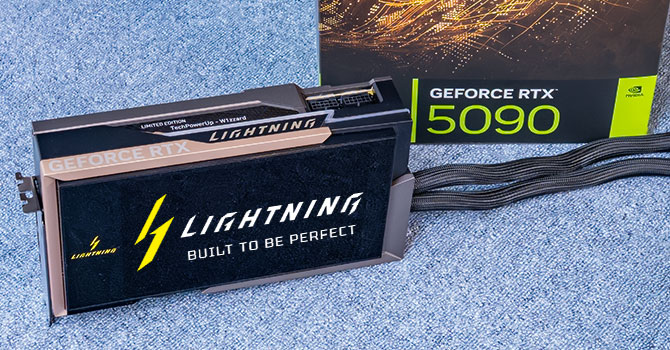
MSI GeForce RTX 5090 Lightning Z is designed to be a paragon of enthusiast-class PC hardware, appealing to professional overclockers and gamers for whom money is no object when seeking out the very best the market has to offer. This card, produced in very limited quantities, comes with one of the industry’s strongest graphics card VRM solutions that can handle continuous loads of up to 1000 W, using two 600 W power inputs; making for a top-binned GeForce RTX 5090 GPU that can sustain the highest clock speeds with minimal effort; and a host of segment-first features.
MSI positions the GeForce RTX 5090 Lightning Z several notches above its current flagship graphics card, the RTX 5090 SUPRIM Liquid SOC. The Lightning Z brand dates back nearly 15 years, when MSI designed special graphics card SKUs targeting professional overclockers. Fast-forward to 2026, and the RTX 5090 Lightning Z is trying to do the same thing, but with most of its capability out of the box, not needing aftermarket cooling. MSI overclocked the RTX 5090 to 2730 MHz, compared to 2527 MHz of the SUPRIM Liquid SOC, and 2407 MHz NVIDIA reference. That’s not all, while the SUPRIM Liquid SOC comes with a power limit of 575 W that can be extended to 600 W via software, the new Lightning Z supercharges this to 800 W, with a power limit unlock that takes it all the way to 1000 W, provided both 12V-2×6 connectors are in place and each are capable of 600 W. Extreme overclockers can optionally use a 2500 W BIOS that pushes the power limits even further, but this will likely require cooling modifications.
NVIDIA GeForce RTX 5090 represents the apex of the GeForce RTX Blackwell generation. At its heart is the huge GB202 chip, a 750 mm² slab of silicon with over 92 billion transistors, and 192 streaming multiprocessors (SM). The GPU introduces several firsts-to-market features, including the PCI-Express 5.0 x16 host interface, ATX 3.1 + PCIe Gen 5 power architecture, DisplayPort 2.1b UHBR20, and the new GDDR7 memory standard. The GPU features a broad 512-bit GDDR7 memory interface driving 32 GB of 28 Gbps GDDR7 memory for a jaw-dropping 1,792 GB/s memory bandwidth. The GPU needs this for neural rendering, DLSS 4 multi frame generation, and other new technologies to work. The RTX 5090 enables 170 out 192 SM, and 96 MB out of the 128 MB L2 cache physically present on the silicon. It also gets 3 out of 4 NVENC accelerators, and 2 out of 4 NVDEC. This works out to 21,760 CUDA cores, 680 Tensor cores, and 170 RT cores, across 11 GPCs.
The Blackwell graphics architecture, now in its second year, introduces Neural Rendering. You’ve already seen the awesome power of generative AI in creating photorealistic images and video. NVIDIA figured out a way for the GPU to run a generative AI model and render graphics in tandem, thanks to a new component called AMP (AI management processor). The GPU combines 3D objects created by the generative AI model with raster 3D graphics much in the same way that it combines real-time ray traced objects. The result is a technological leap in photorealism and geometric detail. We were blown away by the tech demos NVIDIA showed us at CES, and we can’t wait to see game developers pick up on the tech. On its part, NVIDIA collaborated with Microsoft to standardize the tech, by making it possible for 3D applications to directly address Tensor cores. The shader execution reordering engine supports neural shaders.
The new 4th Generation RT core has added hardware for Mega Geometry, the ability to give ray traced object exponentially higher poly counts, and for all those added surfaces to accurately interact with rays. Then there’s DLSS 4. NVIDIA replaced the convoluted neural networks (CNN) based AI model powering the various components of DLSS, with a new transformer-based model that is more accurate, and provides higher image quality at every performance preset. This works not only on the RTX 40-series Ada and RTX 30-series Ampere generations, but even the RTX 20-series Turing cards, what’s exclusive to Blackwell, though, is Multi Frame Generation. NVIDIA created a way for the frame generation AI model to create not just every second frame following a conventionally rendered one, but up to three such AI generated frames, which take into account motion vectors and other relevant information. When combined with super resolution, it takes the rendering power of 1 pixel to create up to 16 pixels. This feature relies on a crucial hardware component found in the display engine of Blackwell—hardware flip-metering—for smooth frame pacing, which is why Multi Frame Generation is exclusive to Blackwell.
MSI GeForce RTX 5090 Lightning Z is part of a recent new wave of premium overclocked RTX 5090 graphics cards that have been announced between late-2025 and early-2026. In the year since its announcement, board partners have been able to accumulate sufficient numbers of high-binned GB202 silicon, which they’ve combined with their learnings from the RTX 5090 over the year, to design these new enthusiast-segment cards. The Lightning Z is designed to fiercely compete with the likes of the ASUS ROG Matrix RTX 5090 and GIGABYTE RTX 5090 AORUS Infinity.
The card comes with a custom-designed all-in-one liquid cooling solution that uses a full-coverage copper baseplate, with the coolant channel pulling heat form not just the GPU, but also the VRM and memory. This is then dissipated by a large 360 mm radiator with a trio of high performance fans. There are several enthusiast-segment touches such as a dual 12V-2×6 input that reduces load per connector (thus connector pins run cooler), a powerful VRM solution capable of in excess of 1000 W, and several overclocker-friendly features. There’s a true-color display on the card itself, which when paired with the company’s Afterburner software, can be made to display just about anything, including real-time monitoring stats. MSI did not design this card for those who just want an RTX 5090, but those who want the very best RTX 5090. It is hence priced at $5,090.
NVIDIA GeForce RTX 5090 Market Segment Analysis PriceCoresROPsCore
ClockBoost
ClockMemory
ClockGPUTransistorsMemoryRTX 4070$5005888641920 MHz2475 MHz1313 MHzAD10435800M12 GB, GDDR6X, 192-bitRX 7800 XT$4703840962124 MHz2430 MHz2425 MHzNavi 3228100M16 GB, GDDR6, 256-bitRTX 4070 Super$6007168801980 MHz2475 MHz1313 MHzAD10435800M12 GB, GDDR6X, 192-bitRX 7900 GRE$55051201601880 MHz2245 MHz2250 MHzNavi 3157700M16 GB, GDDR6, 256-bitRTX 4070 Ti$7007680802310 MHz2610 MHz1313 MHzAD10435800M12 GB, GDDR6X, 192-bitRTX 5070$5406144802325 MHz2512 MHz1750 MHzGB20531100M12 GB, GDDR7, 192-bitRTX 4070 Ti Super$7508448962340 MHz2610 MHz1313 MHzAD10345900M16 GB, GDDR6X, 256-bitRX 7900 XT$62053761922000 MHz2400 MHz2500 MHzNavi 3157700M20 GB, GDDR6, 320-bitRX 9070$53035841282070 MHz2520 MHz2518 MHzNavi 4853900M16 GB, GDDR6, 256-bitRX 9070 XT$60040961282400 MHz2970 MHz2518 MHzNavi 4853900M16 GB, GDDR6, 256-bitRTX 5070 Ti$7508960962295 MHz2452 MHz1750 MHzGB20345600M16 GB, GDDR7, 256-bitRX 7900 XTX$75061441922300 MHz2500 MHz2500 MHzNavi 3157700M24 GB, GDDR6, 384-bitRTX 4080$85097281122205 MHz2505 MHz1400 MHzAD10345900M16 GB, GDDR6X, 256-bitRTX 4080 Super$1000102401122295 MHz2550 MHz1438 MHzAD10345900M16 GB, GDDR6X, 256-bitRTX 5080$1000107521122295 MHz2617 MHz1875 MHzGB20345600M16 GB, GDDR7, 256-bitRTX 4090$1800163841762235 MHz2520 MHz1313 MHzAD10276300M24 GB, GDDR6X, 384-bitRTX 5090$2600217601762017 MHz2407 MHz1750 MHzGB20292200M32 GB, GDDR7, 512-bitMSI RTX 5090
Lightning Z$5090217601762017 MHz2730 MHz1750 MHzGB20292200M32 GB, GDDR7, 512-bit