
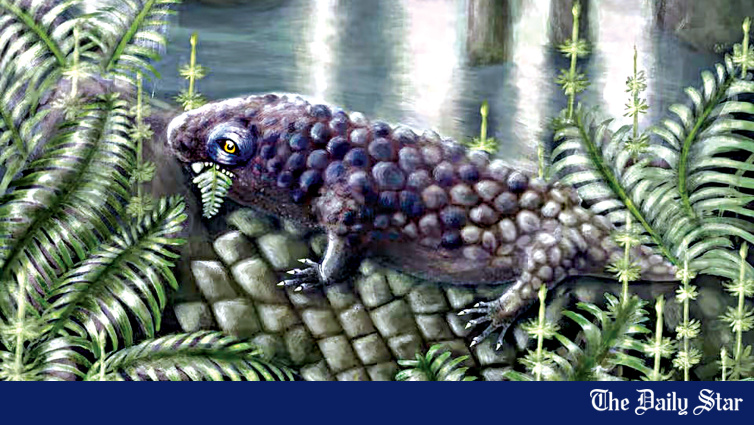
Scientists have unearthed in Canada’s province of Nova Scotia the skull of a creature dating to about 307 million years ago that is one of the oldest-known plant-eating land vertebrates, representing a pivotal juncture in animal evolution.
The creature, named Tyrannoroter heberti, possessed a somewhat triangle-shaped skull that facilitated large cheek muscles for eating tough plant material, with a mouth full of specialised teeth to crush, shred and grind vegetation.
Tyrannoroter looked like a reptile but is not actually included in that class of animals, instead categorised as part of a group called microsaurs. While the researchers have discovered only its skull, they estimate based on the anatomy of related animals that Tyrannoroter was about 12 inches (30.5 cm) long, with a stocky build akin to today’s blue-tongued skink.