
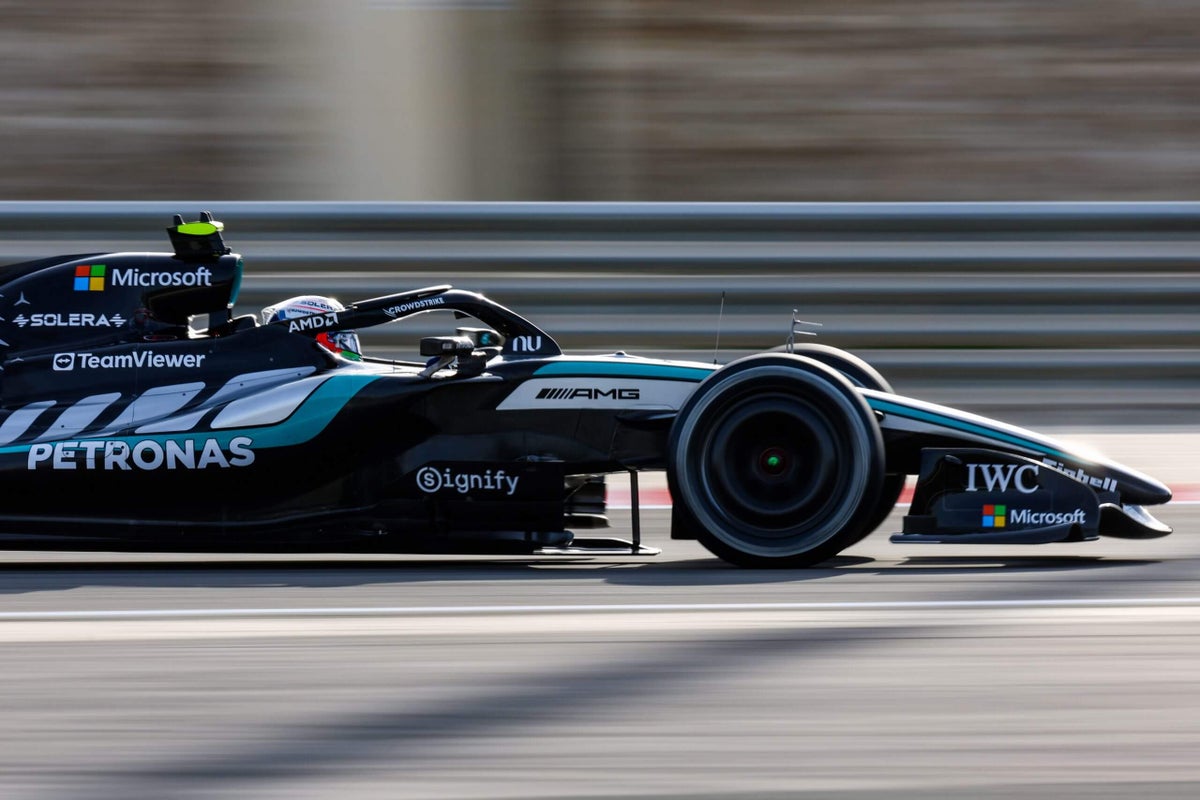
SAKHIR, Bahrain — Formula 1 kicked off its second preseason test of the year on Wednesday. But off-track paddock politics at the Bahrain International Circuit came into the spotlight instead.
While all 11 teams are making use of this track time before the season opens in Australia on Mar. 8, the argument over new engine designs continues to rumble away in the background.
The issue centers on how Mercedes and Red Bull have identified a potential performance advantage in the interpretation of the engine rules on cylinder compression.
F1’s 2026 rules set a 16:1 compression ratio limit for engine cylinders. This caps how much the engine can squeeze fuel before burning it — the more you squeeze, the hotter it gets and the more power you produce, although if you try and do this too much it becomes counterproductive.
But Mercedes and Red Bull are believed to have reached an 18:1 ratio when their engines run hot on track, while still complying with the rules when they are cool and stationary in the pits.
The gain could be worth a few tenths of a second per lap. This is significant: the F1 teams were very close in lap times by the end of the previous car design era last season. Toto Wolff, Mercedes’ F1 chief, downplayed the potential advantage on Wednesday, saying it was only worth “a few horsepower.”
This is because rival F1 engine makers (Ferrari, Honda, and Audi) have been trying to get motorsport’s governing body, the FIA, to close the compression ratio loophole by applying the 16:1 limit when engines are active and hot, not just cool. Following meetings last week, Red Bull suddenly shifted its position. It is now also calling for a rule change before the Australian Grand Prix, which is taking place in three weeks’ time.
With four of the five engine manufacturers now aligned, they could form a ‘super majority’ to push through the rule change if supported by the FIA and the F1 organization (Formula One Management).
But a late change to the engine regulations could lead to question marks over the legality of all cars running Mercedes engines for the Melbourne event, if it were to be pushed through. This includes customer squads McLaren, Williams and Alpine.
Speaking to Sky Sports ahead of the Bahrain test, Fernando Alonso, who drives for the Honda-powered Aston Martin squad, said, “It would be nice to all start with the same rules; the first year of the regulations is critical if you don’t want to give advantage for the next four or five years to one manufacturer. We want to have clarity on that.”
The final designs of all F1 engines for the season will be approved for use on Mar. 1, but any questions about legality of certain engines would open the door for rivals to protest race results. Other teams could potentially protest the eight cars running the Mercedes engine if the rules are kept as they are now.
“What do you do when you effectively change the rules to now mean if we are not legal, there are eight cars (potentially) not participating on the grid?” Williams team principal James Vowles told reporters in Bahrain on Wednesday. “We, as a sport, really have to think about the implications of these changes.”
Wolff had taken a dim view of the matter when speaking last week, making clear that Mercedes’ engine complied with the regulations. He suggested those rivals were potentially trying to find excuses “before they have even started,” as Mercedes had made a strong start during the first preseason test in Spain last month. Wolff told them to “just get your s— together.”
The matter is expected to be discussed again next week at an F1 Commission meeting, which will include all 11 teams, FOM and the FIA.
On Wednesday in Bahrain, Wolff addressed what Mercedes is now facing, with Red Bull having shifted its position. He said again that it had received assurances from the FIA that what it was doing with its engine was legal.
“I think all of our competitors got a little bit aggrieved, and lobbied the FIA for a long time,” Wolff told reporters, adding that this had “massively ramped up over the last few months.” He added that he was “confused” why the matter had changed from last Friday, when Red Bull joined the other three manufacturers in opposition to Mercedes.
Unlike Vowles, Wolff did not go as far as questioning whether the Mercedes-powered cars could race in Melbourne in the event of a rule change. But he did question how the FIA would account for the long lead times required to make design changes to the engines. “If you can’t adhere to the regulation (as engines take a long time to redesign), then the FIA needs to come up with some kind of invention (for) how to adjust for that. And that’s unclear to us.”
Wolff said Mercedes had to “respect the governance of the sport” and accept any action the FIA may opt to take.
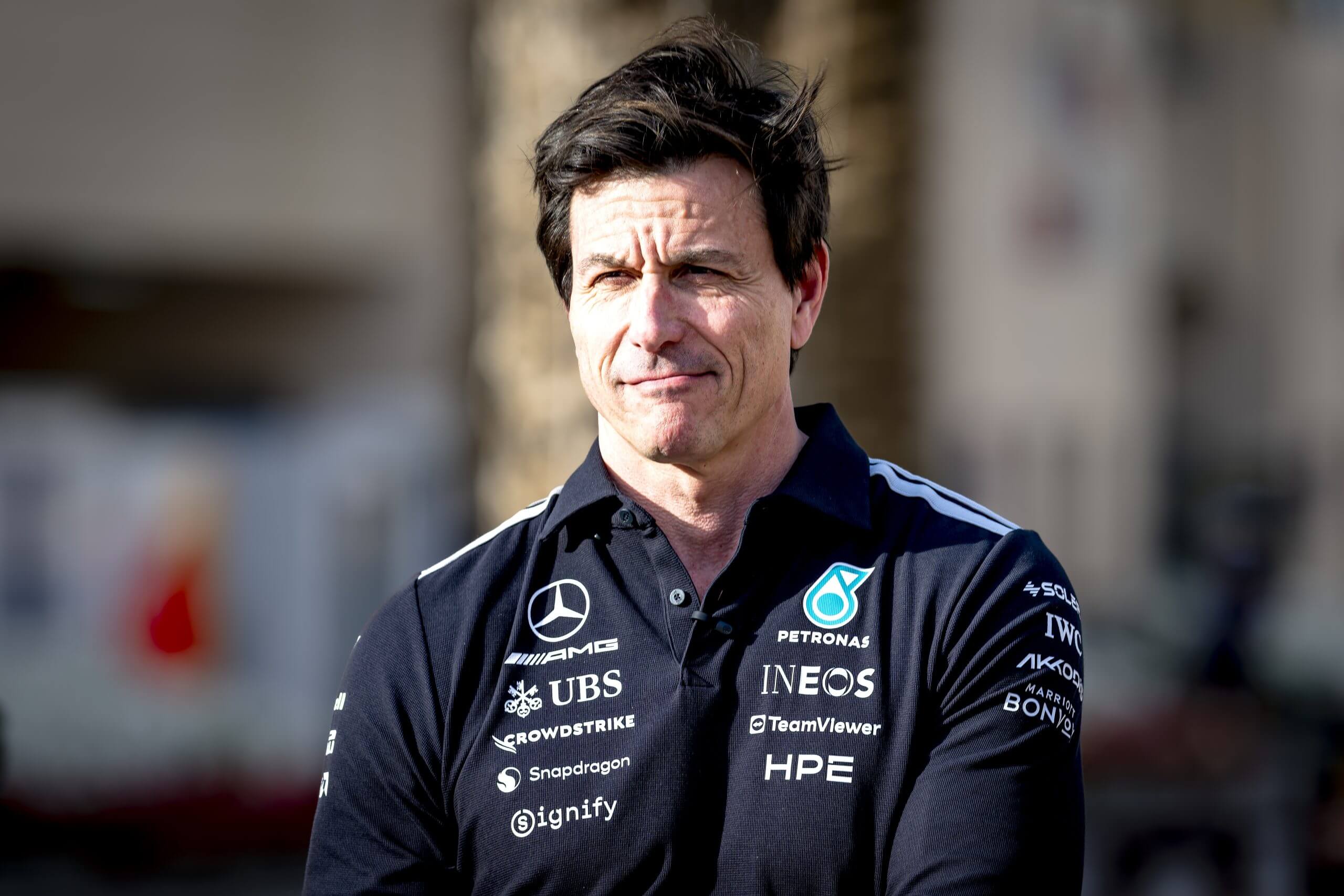
Wolff at preseason testing in Bahrain on Wednesday (Marcel van Dorst/EYE4IMAGES/NurPhoto via Getty Images)
Speaking in a video filmed at the end of January and released earlier this week, the FIA’s single-seater director, Nikolas Tombazis, said F1’s governing body intended to ensure this saga resolves before the new season begins.
“We don’t want to have controversies,” said Tombazis. “We want people to be competing on the track and not in the courtroom or in the stewards’ room. And that’s what we’re trying to do.”
But Vowles said the FIA should not be “punishing the best solutions” by considering such a late rule change, and that F1 had to remain “a meritocracy (where the) best engineering solution wins as a result.”
Vowles warned that F1 should not become a series that seeks to level competition among teams through complex rule systems that slow down those that are significantly faster than the rest. This practice is common in other motorsport categories, such as sports car racing, through a system known as Balance of Performance.
“I’m sure other teams are pissed off they weren’t able to achieve what Mercedes did,” Vowles said. “But we also need to take care.”
Wolff also thought making a change could influence the FIA’s new Additional Development and Upgrade Opportunities system. This assesses engine performance every six races, allowing trailing teams to catch up to rivals.
Wolff said that, because engine changes are permitted after the sixth race of 24 in 2026, Ferrari, Honda, and Audi already have a chance to significantly alter their engine development, particularly regarding the compression ratio. ”So the kind of unknown consequences are immense and unquantifiable,” Wolff said.
Overall, Wolff said he was more concerned that this push for a late rule change on engine design could stymie future innovation to equalize car performance.
“I think the very essence of Formula 1 is to find performance,” he said. “To attract the best engineers and the best people, give them freedom to develop regulations. One time it goes for you and another time it goes against you.
“But I believe that fundamentally the president of the FIA and Stefano (Domenicali, F1’s CEO) will look at it in a holistic way and avoid gamesmanship.”
Said gamesmanship is part and parcel of F1 politics, though. And Wolff knows that all too well.
Day one of testing in the books
Away from the off-track politicking, Wednesday’s running in Bahrain offered teams further opportunity to build on their learning from the Barcelona test.
The teams again ran with impressive reliability, with just two red flags due to stoppages — one for Alpine in the morning and one for Audi in the afternoon. Both teams were able to quickly get their cars back out on the track without any huge loss in track time for either squad.
Reigning world champion Lando Norris ended the day fastest for McLaren, completing 58 laps in the afternoon session after his teammate Oscar Piastri took the reins of their MCL40 car in the morning.
Max Verstappen wound up second-fastest for Red Bull after spending the full day at the wheel. This allowed him to complete more than two race distances.
Here, Wolff hailed Red Bull’s early showings with its first in-house engine. He went as far as calling Red Bull “the benchmark” of the new car designs.
“Look at their (engine) energy deployment,” Wolff said. “They are able to deploy far more energy on the straights than everybody else. (We’re) speaking a second per lap, over consecutive laps.”
It’s a big claim for Wolff to make, praising a rival engine manufacturer so strongly at such an early point when most are reserving judgment on performance. But it should also be considered against the backdrop of the engine row.
Amid the perception that Mercedes could have secured an engine advantage that other teams feel the FIA needs hold back, highlighting another manufacturer’s engine is an age-old counterattack.