
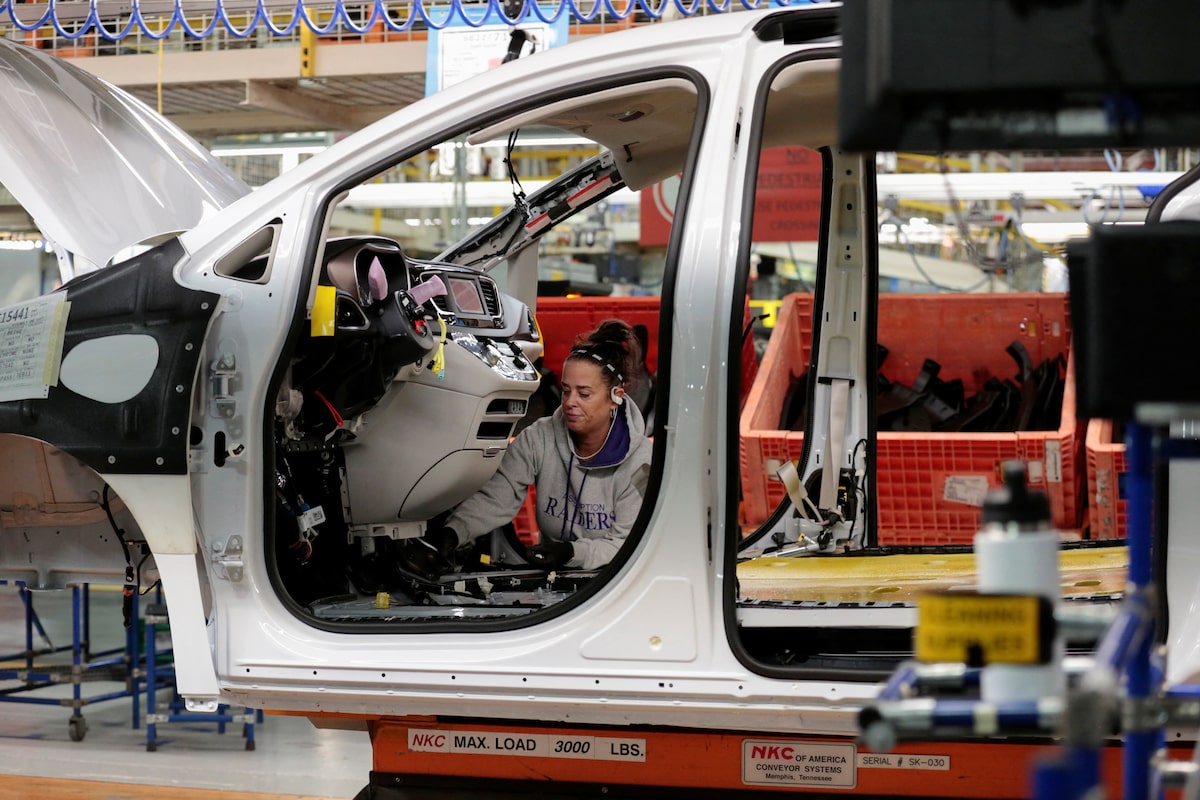
A Stellantis employee works on the interior of a Chrysler Pacifica at its plant in Windsor, Ont., in 2023. The company is set to add a third production shift at the plant.REBECCA COOK/Reuters
Stellantis NV STLA-N is set to add a third production shift at its minivan and muscle car plant in Windsor, Ont., creating 1,700 jobs in a sector battered by tariffs and an uncertain outlook.
The new shift starts on Tuesday, and will bring the head count at the factory to about 6,000, including 250 workers that transferred from the idled Stellantis plant in Brampton, Ont.
The Windsor plant makes Dodge Chargers – gas and electric versions – as well as minivans: the Chrysler Grand Caravan for the Canadian market and Chrysler Pacifica for the North American market.
The jobs are a rare bit of good news amid uncertainty and recent job losses in the Canadian auto sector stemming from U.S. tariffs and weak demand for electric vehicles. Ottawa has threatened legal action against Stellantis over a decision to move some production to Illinois.
The new shift, which was supposed to start last fall but was delayed as automakers grappled with tariffs, is being added amid rising sales of minivans.
Federal government launches dispute process over Stellantis Jeep production move to U.S.
Opinion: Canadian leaders are naive to be shocked over Stellantis pulling Jeeps from Brampton
Minivan sales rose by 40 per cent in Canada to 43,000 in 2025, according to DesRosiers Automotive Consultants, and by 21 per cent in the U.S. Overall sales in both countries rose by about 2 per cent.
“Canadians are starting to look at minivans as a more practical solution for their families” as prices for large SUVs rise beyond many buyers’ reach, said Trevor Longley, chief executive officer of Stellantis Canada.
The company has been under fire for its October decision to build the Jeep Compass in Illinois rather than at its plant in Brampton. The factory near Toronto closed in 2024 – with about 3,000 workers laid off – to be retooled for the Jeep. That work paused a year ago after U.S. President Donald Trump said he would impose 25-per-cent tariffs on Canadian-made cars.
Before announcing the shift to Illinois, Stellantis received $223-million from Ottawa for work on its plants in Brampton and Windsor.
Industry Minister Mélanie Joly has threatened to sue Stellantis, and served the company with a notice it is in default of its public funding agreement, which had jobs and production requirements.
Ms. Joly said last week the federal government is working to get back “hundreds of millions” of dollars from Stellantis and General Motors, which also received taxpayer money before laying off workers in Oshawa and closing its electric-van plant in Ingersoll, Ont.
“I’ve already said that we would get our money back from Stellantis and also from GM. We’re in evaluation mode right now as to how much,” Ms. Joly said on Feb. 3. Her office and the Department of Innovation, Science and Economic Development Canada did not answer e-mailed questions on Wednesday and Thursday.
Stellantis Canada CEO Trevor Longley says Canadians are starting to look at minivans as a more practical solution for their families as prices for large SUVs rise beyond many buyers’ reach.Sammy Kogan/The Globe and Mail
Mr. Longley, in an interview at an auto show in Toronto on Thursday, said he is in talks with Ottawa about the future of the plant, but has not been asked to give back any money.
“The conversation we’re having right now is, ‘how do we find a solution that’s sustainable and productive for Brampton?’” Mr. Longley said. “I would like to see cars rolling down the line in Brampton.”
When asked, he stopped short of committing to reopening the plant with a new vehicle.
“We’re committing to working through something that could make sense,” he said. “At the current time we need to understand the landscape that we’re in. We need to look at like what actually makes sense for us to do and put in there.”
Stellantis sells stake in Ontario battery plant to LG Energy Solution for $100 amid EV reset
That landscape has shifted dramatically in the year since Mr. Trump took office. He has imposed tariffs on Canadian-made cars, disregarding the North American free-trade deal the industry has relied on for decades. Canada has imposed countertariffs, with remissions for cars built here. And the U.S. market for electric vehicles has become much smaller in the U.S., after he removed purchase incentives for zero-emissions cars.
Stellantis last week handed its stake in the NextStar battery plant to partner LG Energy Solution for a nominal US$100. Stellantis, like its North American peers, is taking massive writeoffs on EV investments as sales growth slows and U.S. policy changes favour internal combustion power.
Against this backdrop, negotiators in Canada are preparing for the review of the U.S.-Mexico-Canada Agreement in July.
Mr. Longley said Stellantis continues to push for the deal’s renewal, given 90 per cent of Canadian production ends up on a U.S. car lot. “Without free trade it makes it difficult,” he said. “That is why I am saying we need to find sustainable solutions that reflect the realities of what the long term is going to look like” in Brampton.