
Published February 13, 2026 01:18AM
When Tadej Pogačar posted his February 11th ride on Strava, our eyes were immediately drawn to the title and caption.
“Honest question to all fans…” was how Pogačar began the post before going on to describe a fan interaction in which he was allegedly shown the middle finger and yelled at. It was quite the negative interaction, almost a desperate plea to fans to give professional cyclists space and patience.
But once you clicked on Pogačar’s ride, you realized that he left a gold mine: his power data.
This is the first time in years that Pogačar has made his power data public. In 2019, I actually wrote a Power Analysis using Pogačar’s power data on Strava. It was the year that he won the Tour of California and set the record on Mt Baldy. But it wasn’t long before he started hiding his power data, and eventually he made most of his training files private.
But in 2026, we finally have a Pogačar file to analyze.
Let’s take a closer look at the world champion’s ride, what it means, and what we can learn from the greatest cyclist of all time.
Aero testing before the training ride
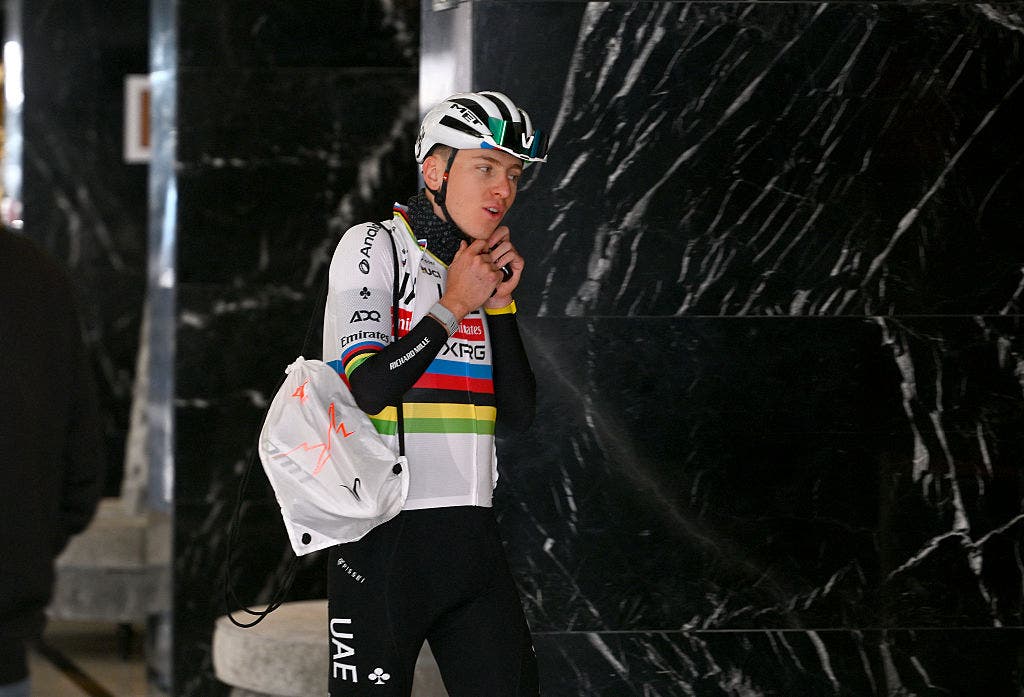 We believe Pogačar was in Valencia carrying out some early season aero testing. (Photo: Jose JORDAN / AFP via Getty Images))
Pogačar’s ride was a one-way route from Valencia to Calpe. This is a common route for WorldTour pros in the depths of their winter training camps. The velodrome in Valencia serves as an aerodynamics testing ground, perfect for analyzing new bikes, gear, and riding positions.
Pogačar posted a photo of himself riding his road bike on a trainer in the velodrome. He was wearing an aero helmet in the photo, which means he probably went out and rode on the track at some point.
We don’t know exactly what kind of testing was done, but it’s likely that Pogačar rode for an hour or two, including some race-pace efforts at over 50kph.
So by the time that Pogačar started his public Strava ride, he was probably a few thousand kJs into his training day. What followed was one of the most impressive files I’ve ever seen in cycling – but for Pogačar, it was just a typical Zone 2 ride.
Tadej Pogačar’s power data
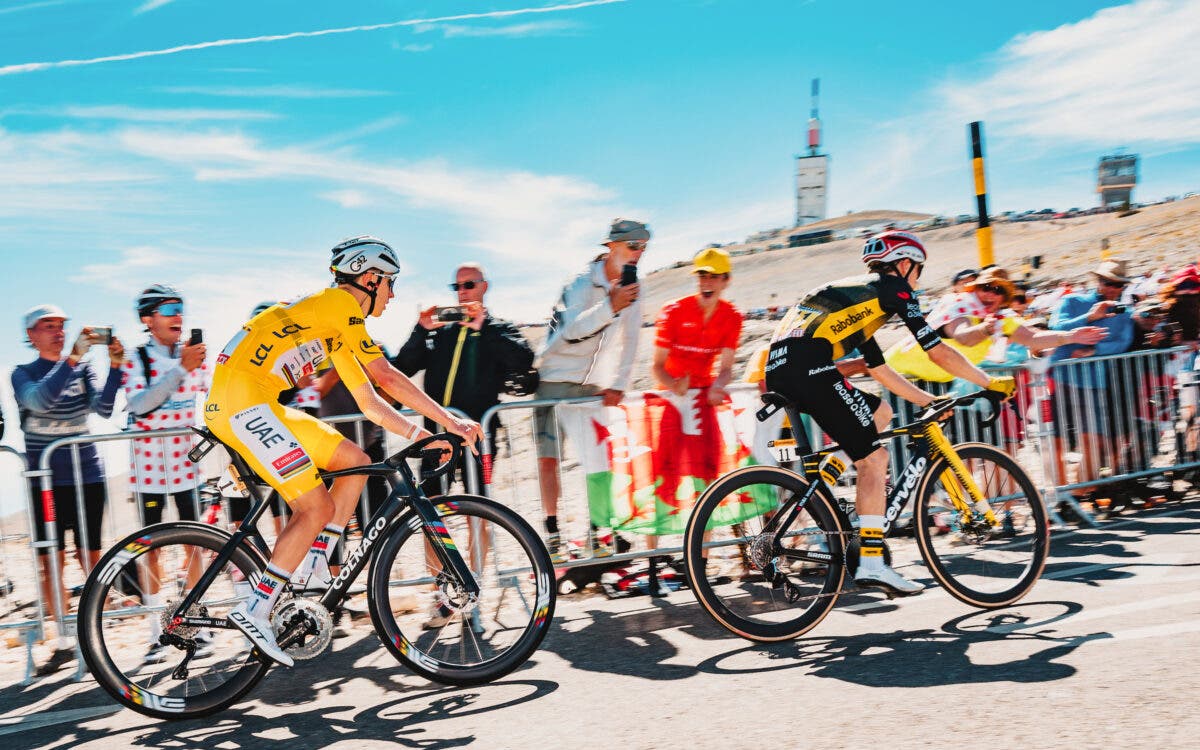 Pogačar’s assault on Mont Ventoux at the Tour de France is rated one of the best climbing performances of all time. (Photo: Gruber Images)
When we zoom into Pogačar’s ride, we can see that he is pushing 320-340w for the majority of the session. The overall average power is a bit lower at ~300w, but that includes the coasting, turning, and stopping at traffic intersections.
In the first half of the ride, Pogačar rode a long section of road near Cullera where his pedaling was hardly interrupted for 45 minutes. This is where we can see his true capabilities.
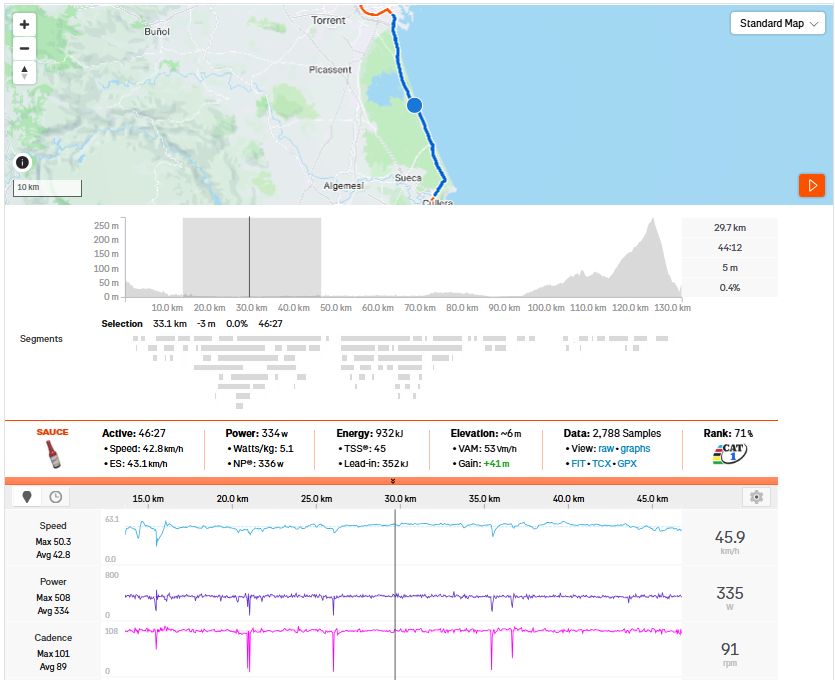
First Part of the Ride in High Zone 2
Time: 46 minutes
Power: 334w (5.1w/kg)
Avg Speed: 42.8 kph
Pogačar averaged 334w (5.1w/kg) during this section of the ride, his top-end Zone 2 as described on the Peter Attia podcast. During that interview, Pogačar said that the top of his Zone 2 is 320 to 340w, which lines up perfectly with this real-life data.
To put this into context, Pogačar’s FTP is likely between 420-440w. Over many years of calculating racing and training data, we can be confident that Pogačar’s FTP is slightly higher than the effort he did up Mont Ventoux at the 2025 Tour de France.
We estimated Pogačar’s performance at ~410w (6.4w/kg) for 54 minutes that day, one of the greatest climbing performances of all-time. However, that effort included multiple attacks, counter attacks, and a nasty headwind in the finale. So it wasn’t the full gas, one-hour effort that Pogačar might be capable of.
In addition to the power data, Pogačar also posted a photo of his head unit during the ride.
Based on the time of day, we can assume this photo was taken near the end of the ride, about 3hrs into the session and just before Pogačar descended back into Calpe. There is an average power of 303w, Normalized Power of 314w, average heart rate of 144 bpm, and maximum heart rate of 163 bpm.
Pogačar also mentioned on the Peter Attia podcast that his Zone 2 heart rate is around 140 to 150 bpm, with a max heart rate around 190 to 200 bpm. So despite the massive power nearing 5w/kg, Pogačar’s heart rate is solidly in Zone 2.
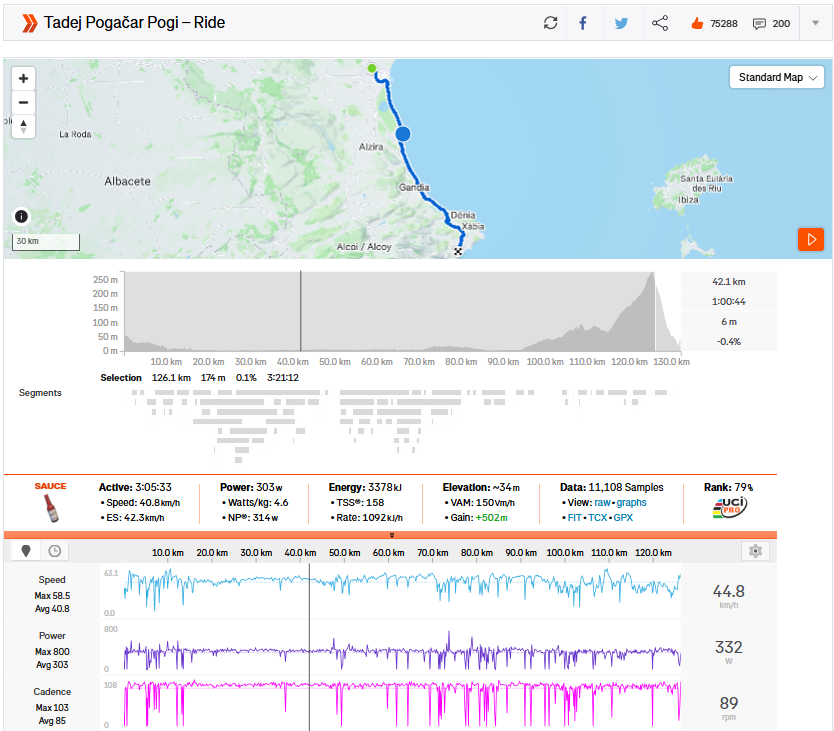
Full Ride Stats
Time: 3 hours
Power: 303w (4.6w/kg)
NP: 314w (4.8w/kg)
Avg HR: 144 bpm
Can we learn anything from Pogačar’s power data?
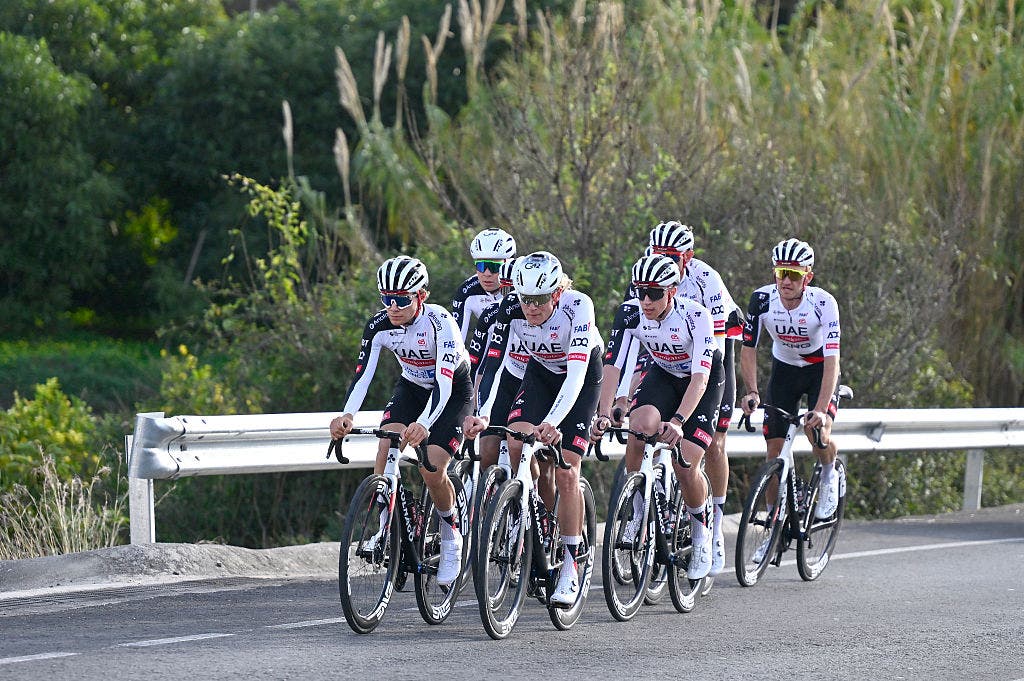 Pogačar and his UAE teammates follow a high Z2 training philosophy. (Photo: Jose JORDAN / AFP via Getty Images)
With an FTP around 430w, we can calculate Pogačar’s Zone 2 using a standard FTP training model. Most cyclists ride at 60-75% FTP during Zone 2 rides, which is quite a wide range.
The longer the ride, the lower your target power for endurance rides. Pogačar actually mentioned this in the aforementioned podcast, saying that he might target 290-300w during longer Zone 2 rides. Additionally, athletes who are better aerobically trained might ride at a higher percentage of FTP, and that’s where Pogačar’s at.
One of the fittest humans in the world, Pogačar is riding at roughly 75% of his FTP at 320-330w. That is a high output for any cyclist, let alone someone whose FTP is over 400w.
The biggest takeaway here is confirmation of UAE Team Emirates-XRG’s training philosophy. For years, we have heard that UAE Team Emirates-XRG prescribes hard Zone 2 rides. These are not your typical Sunday group rides complete with a chat and casual paceline – these are tough endurance rides where you are on the pedals all day.
Most WorldTour rides have FTPs over 400w (or >6w/kg for lighter riders), which means that their Zone 2 rides are done at 300-350w. Trucks like Brandon McNulty or Nils Politt might do their Zone 2 rides at 300-350w for 4-5 hours. It’s a pace that would leave most amateurs in the dust. But this is how UAE Team Emirates-XRG trains.
Whether that is the best way to do your Zone 2 rides is up for debate. But now we know this is exactly how Pogačar trains.