
What makes Canadian football ‘Canadian’?
Perhaps it’s purely about the physical location: Canadian-based organizations in Canadian communities participating in a sport that traces its origins back to 19th-century Montreal. Is it more intangible? Maybe Canadian-ness is the culmination of the unique culture and traditions that have arisen around the sport. Or maybe it’s more about the game and its rules. The rouge — a single point awarded after kicking the ball through the end zone. Three downs. 12 players. 110-yard fields with 20-yard end zones and uprights on the goal line. These are all unequivocally Canadian features, distinct from American variations of gridiron football.
In September, CFL commissioner Stewart Johnston announced a series of rule changes to be implemented in 2026 and 2027, the league’s most significant transformation in decades.
Hoping to expand their appeal, the CFL’s modifications primarily focus on smoothing out the game and increasing scoring — specifically, touchdowns — an aspect of the sport that many consider more exciting. Johnston said that the modifications aim to “make our fantastic game even more entertaining, and to win in the attention economy.”
Given their concern with audience growth, it’s not surprising that several new rules seemingly mimic the CFL’s immensely popular American cousin, the NFL.
With a record US$23 billion in revenue over the 2025 fiscal year, the NFL is unequivocally the most lucrative sports league in the world, with nearly double the earnings of the second-place MLB. The 2025 Super Bowl achieved an average viewership of 127.7 million, making it the most-watched TV event in NFL history, according to Nielsen. Comparatively, seven of the CFL’s nine teams failed to return a profit in 2024, while the 2025 CFL championship game, the Grey Cup, was viewed by less than 4 million people.
Perhaps most worrisome for the Canadian league, recent studies indicate that even within Canada, the NFL is more popular than the CFL. A 2023 report by the Angus Reid Institute found that around 20 per cent of Canadians said they followed the NFL closely, compared to 16 per cent for the CFL. Even worse, 62 per cent of football fans in Canada said they would choose to watch the NFL’s Super Bowl over the CFL’s Grey Cup.
While the CFL has often aimed to distinguish itself from the NFL, with these new rules, it seems that some of those differences are no longer viewed as beneficial.
The reaction from the CFL community has been divided. Nathan Rourke, the Victoria-born quarterback of the B.C. Lions and the Most Outstanding Player in the CFL last season, called the planned modifications “garbage.”
“What we’re moving toward is not Canadian football, the game I grew up loving,” he said.
While the CFL is changing, it’s up in the air whether all of Canadian football will change with it. U Sports, the governing body for Canadian University sports, has yet to decide if they will adopt the CFL’s upcoming rule changes.
In response to the CFL’s initial announcement, U Sports released a statement asserting that they would “begin engaging with [their] members and stakeholders … to determine the ramifications for U Sports football, and the best course of action”.
The impact of this decision would affect the majority of large universities within Canada, including UBC, all of which fall under the domain of U Sports. While an air of uncertainty abounds, for those actually working in and playing the game, some changes may be more welcome than others — especially those occurring in 2026.
As of this year, the CFL will stop using its 20-second play clock, which is manually initiated by an official, often creating inconsistencies, and replace it with an automatic 35-second countdown that begins when the prior play is whistled dead.
I appreciate the fact that they’re trying to change the game but still keep … appreciation for the Canadian game and how it differs from America.
“The way they want to change the [play] clock, I think, is a good decision,” said the head coach of UBC’s football team, Blake Nill. “I wish U Sports would do that.”
Another 2026 rule change will mandate the locations of team benches.
Some CFL stadiums currently place opposing team benches on the same sideline, with the teams right next to each other. Starting next season, this will change, as the league will require benches positioned on opposite sides of the field. This arrangement is not just in-line with common procedure for the NFL, but also already used in some Canadian venues, like UBC’s Thunderbird Stadium. Ideally, having benches on opposite sides will smooth out substitutions, preventing situations where a team’s bench is dozens of yards downfield of the line of scrimmage.
Having managed the bench of a CFL team himself as the head coach of the CFL’s Montreal Alouettes from 2019–2022, UBC offensive coordinator Khari Jones has plenty of experience to draw on when judging this change. He approves.
“The one rule change that I love … is both teams on opposite sides,” said Jones. “To have teams on the same side has always been ridiculous to me.”
In the only direct modification to how the game is scored, 2026 will also see adjustments to the rouge. Unique to Canadian football, the rouge is a single point awarded to the kicking team when a punt, kickoff or missed field goal travels into the receiving team’s end zone and is not returned to the field of play.
For instance, according to current CFL rules, a kicking team might earn a rouge if a punt sails through the back of the end zone, or if the returner goes down in the end zone. However, under the modified rules, a rouge will no longer be earned when a field goal misses wide of the goalposts or when a punt or kickoff travels through the end zone. Instead, the point will only be awarded if the kick is received by a returner who either gives himself up or is tackled in his own end zone.
As someone who has kicked plenty of rouges himself, UBC kicker and punter Kieran Flannery-Fleck is in favour of this particular alteration.
“From a kicker’s perspective, I was never really a fan of the rouge,” he said. “I didn’t really love the fact that … you’d be awarded a point for a missed field goal.”
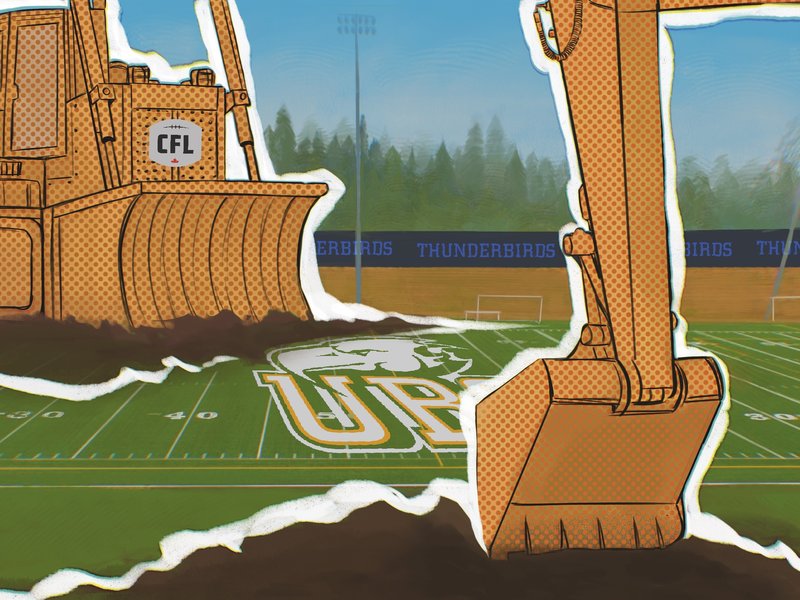
For many in the CFL community, the 2027 rule adjustments are the real source of apprehension. This final wave of modifications will alter the gridiron, shortening the field of play from 110 to 100 yards and the end zones from 20 to 15 yards. Goalposts will also be relocated from the front of the end zones to the back.
Though CFL fields will remain about 10 yards wider than those south of the border, these new dimensions evoke the NFL, where teams play on a 100-yard-long field with 10-yard end zones and the uprights at the back. These changes are core to the sentiment that the CFL is becoming more like the American game.
“That’s what Canada’s known for,” said Flannery-Fleck. “We have the big end zones, which are now going to be smaller. We have [a] wide and long field, which is now going to be smaller. I don’t love it, because I feel like you’re just changing the Canadian game and making it more American.”
“I love the Canadian game,” said Jones, an American and former CFL quarterback. “I’ve been up here now since 1997, playing and coaching, and made my career up here. And I really love the way the game is played. I love the field dimensions … I don’t want to see that change.”
The field alterations could transform the style of football played in the CFL — much more substantively than the 2026 changes. As Commissioner Johnston put it, the CFL is “trading field goals for touchdowns.” In other words, by shortening the field, the league is de-emphasizing special teams — which has historically been more prevalent in the CFL than NFL — in favour of play that is considered more exciting.
They’ve taken the opinion that these changes will help fan experience, in an attempt to increase ticket sales. But it won’t impact the athlete’s ability to play the game or to transition [to the CFL].
By decreasing the distance to the goal line while increasing the distance to the goalposts, the CFL hopes to limit situations where teams can settle for a field goal, instead creating more scenarios where teams are scoring touchdowns or attempting third-down conversions. Shortening the field may also lessen the importance of starting field position and, consequently for kickers, special teams play as a whole.
“Kicking is such a massive part of football, and Canadian football more so than American, so it’s too bad that it’s changing,” said Flannery-Fleck. “You have to be optimistic about it in the sense that it’s going to be higher-scoring games — maybe kickers are going to be relied on more.”
While the rule changes will also impact offensive and defensive play, it is more as a reaction to the lessened importance of special teams. Because kicking has been disincentivized, both units will need to prepare for an increase in third-down attempts around the 40 to 30-yard line.
“[Currently,] once you hit the 40-yard line or so … you’re kind of in field goal range. You’re still playing two downs and kick,” said Jones.
However, pushing the goalposts back means that attempts from this area will no longer be in safe range for most CFL kickers. Rather than punting in enemy territory, most teams will likely opt to go for it. From a scheming perspective, Jones would have to “be more creative” inside the 40, with the knowledge that the region is three-down territory.
The new field dimensions will also impact how teams approach plays near the end zone.
“It’ll be more congested down there when you get down to the three, four or five-yard line,” said Jones. “You’ll probably start seeing things similar to the NFL, where it is a little tougher to score because it’s condensed.”
Fortunately for offences, the goalposts will no longer be an obstacle in the end zone — removing the uprights from the front of the end zone will “open the playbook a little bit more, close to the goal line,” according to Jones.
However, while modifying the field will bring significant changes to the strategy and identity of the game, it may have even greater consequences for the youth and amateur level of Canadian football.
U Sports now faces a dilemma. CFL stadiums are used by several university teams, including the University of Calgary Dinos and the University of Regina Rams, who share a conference with UBC. By the time CFL fields are renovated in 2027, either these teams will have to relocate to fields with the original, 110-yard length, or U Sports will have to adopt the CFL’s new field dimensions nationwide.
U Sports may be exploring some middle-ground solutions — for example, converting individual conferences to the CFL’s dimensions — but it is highly unlikely that such a situation would be feasible long-term. The organization must also consider whether or not to implement the CFL’s other changes, irrespective of the field. Nill and others at UBC believe that the U Sports will maintain its current field dimensions.
“Universities are not going to assume the cost of changing fields,” said Nill. “I cannot see there being a lot of interest at the administrative levels [in] spending money to change the way the game of football is played.”
If U Sports decides to make the switch, the necessary field modifications would cost around $800K to $1 million per university — a tall ask on a tight budget.
Of course, upholding the field dimensions poses its own complications, particularly for the universities sharing venues with CFL teams. For instance, Nill pointed out that McMahon Stadium is owned by the University of Calgary, but the CFL’s Calgary Stampeders are “its biggest client.” The university will likely have to choose between losing the Stampeders or relocating the Dinos, the latter being more beneficial.
At UBC, there has been little discussion between the administration and the football team about potential field changes. For now, it seems like decision-makers are confident that the new CFL rules will not result in significant changes for the school.
“I don’t think it’s going to move the needle one bit,” Nill said. “I would be surprised if it did.”
U Sports may still choose to adopt the CFL’s smaller rule changes, like the modified rouge, without altering the gridiron. If Nill, Jones and Flannery-Fleck are any indication, these new rules would be welcomed by many and hardly impact the game as a whole.
More pressingly, if U Sports does not adjust its fields, the 2027 season will mark a sudden divergence between Canadian university football and the CFL, the primary destination for U Sports athletes aiming to play professionally. The gravity of this depends on where you stand on the field.
As a kicker, Flannery-Fleck believes that the new rules will initially favour prospects from American schools, where the uprights are already at the back of the end zone.
“I think Canadian field goal kickers will have more of an adjustment,” he said. “I don’t know if … Americans would have a complete advantage. But … I think it’s going to be a bit of a rough patch for Canadian guys coming out of U Sports, because guys coming out of college in the States, they’re used to this.”
Having experienced the American field at NCAA camps, the difference in the goalpost placement was notable for Flannery-Fleck. “Visually, you’re just not used to it,” he said.
Kickers aren’t the only ones who will be affected. The drastic changes to special teams matter more broadly, because that phase of the game has often been a stepping-stone for U Sports players getting into the CFL.
“It’s going to be an adjustment for everybody, especially because … in the CFL, they recruit U Sports players mostly to play special teams at first,” said Flannery-Fleck.
Comparatively, Jones, who has spent his extensive career on offence, foresees little change in the pathway from U Sports to the CFL. “I think the biggest thing is it’ll be maybe a little tougher to evaluate [players],” he said. “The way the game is played is still going to be similar.”
Unlike the kicker position, Jones felt that the rule changes would not make the CFL more friendly to quarterbacks from stateside.
“Keeping the width, keeping the 12 guys out there, it’s still going to be an adjustment,” said Jones. “It’s still going to take some time for most of them.”
He’s speaking from experience — Jones played quarterback at an NCAA college in America before winding up in the CFL.
Nill believes that the rule changes aren’t significant enough to affect the overall experience — especially given that most of the CFL’s players already come from American schools — emphasizing that the adjustments are targeted at the audience.
“They’ve taken the opinion that these changes will help fan experience, in an attempt to increase ticket sales,” said Nill. “But it won’t impact the athlete’s ability to play the game or to transition [to the CFL].”
Yet, in pursuit of audience growth, the CFL has upset much of its current fan base. A petition imploring the CFL to delay the rule changes has acquired nearly 8,000 signatures. They state, “The CFL is not just a game; it is a cultural institution woven into Canada’s fabric. … Our league should not surrender its identity or abandon the elements that differentiate Canadian football from its southern counterpart.”
I love the Canadian game. I’ve been up here now since 1997, playing and coaching, and made my career up here. And I really love the way the game is played … I don’t want to see that change.
Flannery-Fleck, a lifelong CFL fan, offered a more optimistic view. “I appreciate the fact that they’re trying to change the game but still keep … appreciation for the Canadian game and how it differs from America.”
For now, the CFL will be keeping some of its more unique features, namely three downs, 12 men and a wider field. Both Flannery-Fleck and Jones expressed hopes that these aspects of the game would remain intact.
The “Americanization” of the game is difficult to deny, but changes to the sport, even those inspired by the American game, are nothing new.
In the early 20th Century, Canadian football was influenced by an influx of American players and coaches. For example, American player Frank Shaughnessy, who became a football coach at McGill in 1912, is credited with bringing the concept of the forward pass to Canada.
More recently 2023, the CFL moved its playoff games to Saturday to avoid conflict with the NFL’s Sunday games. For similar reasons, the CFL had previously moved its doubleheaders to Friday and Saturday.
The flow of influence isn’t one-sided. In the 1990s, the CFL briefly expanded to the States, placing teams in a handful of American cities. The Baltimore Stallions — named after the NFL’s former Baltimore Colts — were especially prosperous. In 1995, they set the CFL record for the most wins in a single season and became the only non-Canadian team to win a Grey Cup, all while ranking second in attendance numbers across the league.
A month after the Stallions’ Grey Cup win, the NFL announced plans to return to Baltimore, likely influenced by the CFL’s success within the city. The Baltimore Ravens debuted a year later, won the Super Bowl in their fifth season, and have remained one of the winningest NFL teams of all time. To avoid competing directly with the NFL, the Stallions moved to Montreal, becoming the present-day Alouettes.
The Baltimore situation encapsulates the symbiotic, sometimes antagonistic, relationship between the CFL and NFL.
For over a century, American and Canadian football have evolved alongside each other, making adjustments according to the other’s influence. The upcoming rule changes are a more extreme extension of that pattern.
Still, one has to question rules that are more focused on growing viewership than improving player experience, and risk the league’s current fans for the prospect of new ones.
Only time will tell if the CFL’s rule modifications are for the better or worse. For now, the CFL community will enjoy one more year before the field, and the game they love, is changed.