
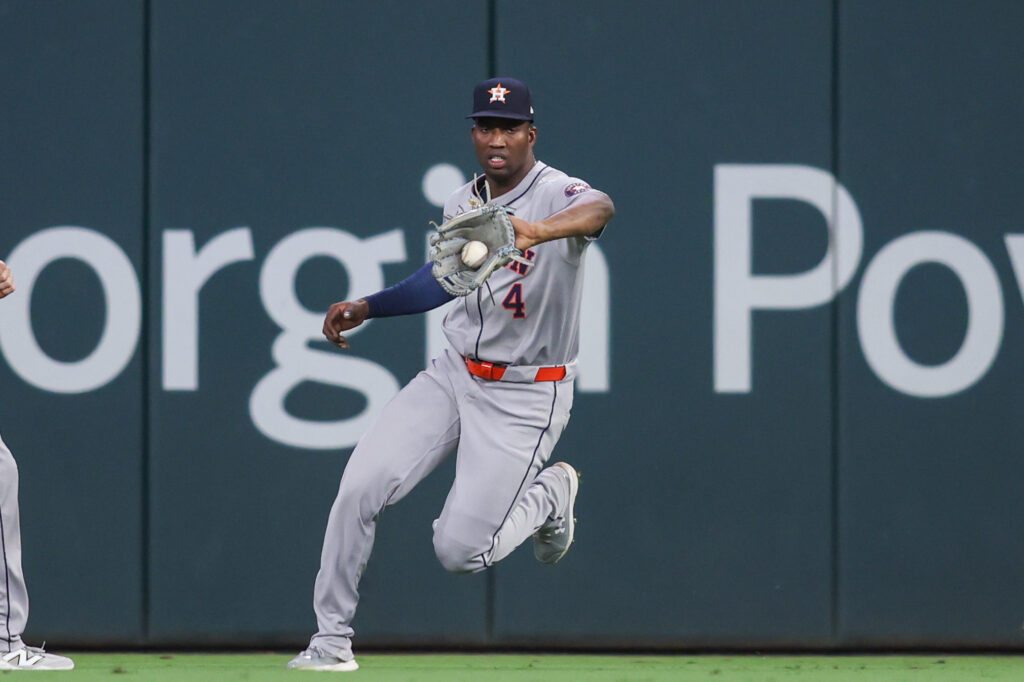
The Blue Jays have acquired outfielder Jesús Sánchez from the Astros in exchange for fellow outfielder Joey Loperfido, per announcements from both clubs. Both players are on the 40-man roster, so no corresponding moves will need to be made.
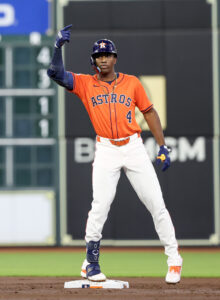
Sánchez’s tenure in Houston will only wind up lasting half a season. Houston acquired the lefty-swinging slugger from Miami at last year’s deadline in a trade sending righty Ryan Gusto, minor league infielder Chase Jaworsky and minor league outfielder Esmil Valencia to the Marlins.
Sánchez came to the Astros with a track record of hitting right-handed pitching but struggled against right-handed and left-handed opponents alike in his new environs. He slashed just .199/.269/.342 (71 wRC+) in 160 plate appearances as an Astro — a far cry from the .253/.319/.428 line he’d posted in nearly 1300 plate appearances with the Fish dating back to Opening Day 2023.
The Astros could have non-tendered Sánchez on the heels of those struggles but chose to keep him around despite a projected arbitration salary of some note. The two parties agreed to a $6.8MM deal for the 2026 season. Toronto will take on the entirety of that sum in this swap and, as a third-time luxury payor in the top penalty tier, pay a 110% tax. That brings the total monetary expenditure to $14.28MM for the Jays.
It’s a heavy price to buy low on a player, but Sánchez touts a career .253/.324/.450 batting line against right-handed pitching and has plenty of encouraging underlying metrics. He’s averaged a hearty 91.1 mph off the bat in his career and logged a robust 45.7% hard-hit rate. Last year’s 75.9 mph bat speed ranked in the 93rd percentile of MLB hitters.
Sánchez is limited to the outfield corners on the defensive side of things but offers solid range and a plus arm. In 2777 career innings in right field, he’s been credited with 11 Defensive Runs Saved. Statcast rates him five Outs Above Average in that time. He hasn’t played as much left field but has above-average marks there from both DRS and OAA.
The Jays don’t have an immediate path to regular at-bats for Sánchez, who’s out of minor league options. He’ll presumably occupy a part-time role, mixing into the outfield corners alongside fellow lefty swingers Nathan Lukes and Addison Barger, who figure to patrol the corners alongside center fielder Daulton Varsho. Sánchez gives the Jays a viable option in either outfield corner and can obviously log some time at designated hitter if George Springer needs a breather. He’s a nice bat to have in a limited role, and if he hits well enough to merit a raise in arbitration, he can be controlled through the 2027 season.
The addition of Sánchez adds some power to a lineup that will again be without last winter’s major offseason signing, Anthony Santander, for an extended period of time. Santander missed significant time in 2025 and hit poorly when on the field due to ongoing shoulder troubles. He recently underwent surgery on that balky shoulder and will be sidelined for five-plus months.
Toronto had obviously been hoping that an offseason of rest could get Santander back to the form he showed in Baltimore from 2022-24, when he slashed .244/.317/.478 with 105 home runs (including 44 in 2024). Instead, it’ll be another largely lost season for the switch-hitting slugger. Sánchez doesn’t have the same offensive ceiling due to his long-running platoon struggles, but he adds some power to help the Jays compensate for that loss.
Loperfido, 26, returns to the organization that originally drafted him with this trade. Houston sent him to Toronto alongside righty Jake Bloss and infielder Will Wagner in exchange for left-hander Yusei Kikuchi at the 2024 trade deadline. He wasn’t likely to break camp with the Jays and may not do so in Houston, either. He’s entering his final minor league option season and has five years of club control remaining.
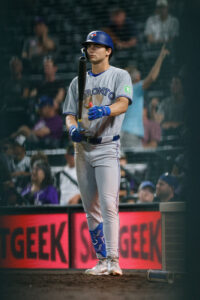
While Loperfido slashed .333/.379/.500 in 104 plate appearances for Toronto last season, there was a fair bit of smoke and mirrors involved in that batting line. His offensive output was propped up by a huge .431 average on balls in play that won’t be sustainable over a larger sample, and Loperfido logged a somewhat concerning 26% strikeout rate against just a 3.8% walk rate. His batted-ball metrics (87.3 mph average exit velocity, 37.1% hard-hit rate) were well below average. Loperfido spent the bulk of the 2025 season in Triple-A and was roughly a league-average hitter there, slashing .264/.341/.401 with a 21.4% strikeout rate and a below-average 7.8% walk rate.
Loperfido will have a chance to break camp with the ’Stros but will need to earn his spot with a big spring performance. Houston has Jake Meyers locked into center field but minimal certainty otherwise. Rookie Zach Cole hit well in a 15-game cup of coffee last year, but he also struck out in 38% of his plate appearances after fanning at a 35% clip in the minors. His hit tool is a major red flag. Cam Smith was the talk of spring training last year, and the former top prospect had a hot start to his big league career before fading as the season went on.
Houston has been on the lookout for left-handed bats throughout the offseason and has continued its search in camp. Loperfido gives them a lefty hitter but does so at the cost of the left-handed Sánchez, so there’s no net gain. However, the most important aspect of this morning’s trade for the Astros could simply be shedding Sánchez’s $6.8MM salary from the books. General manager Dana Brown said in announcing the trade that he’s “not done” making moves (via Matt Kawahara of the Houston Chronicle).
Astros owner Jim Crane is reluctant to cross the luxury tax threshold for what’d be a second straight season, and prior to moving Sánchez, Houston was within $5MM or so of the $244MM tax line. Brown and his staff in the front office now have some extra breathing room as they look to make further additions to the roster. Houston’s infield logjam has been well-documented this winter, and corner infielder Isaac Paredes’ name, in particular, has surfaced in frequent trade speculation. With some extra financial breathing room, the Astros have more leeway to make other additions without necessarily needing to move Paredes or find a taker for pricey first baseman Christian Walker (owed $40MM over the next two seasons) on the heels of a down year.