
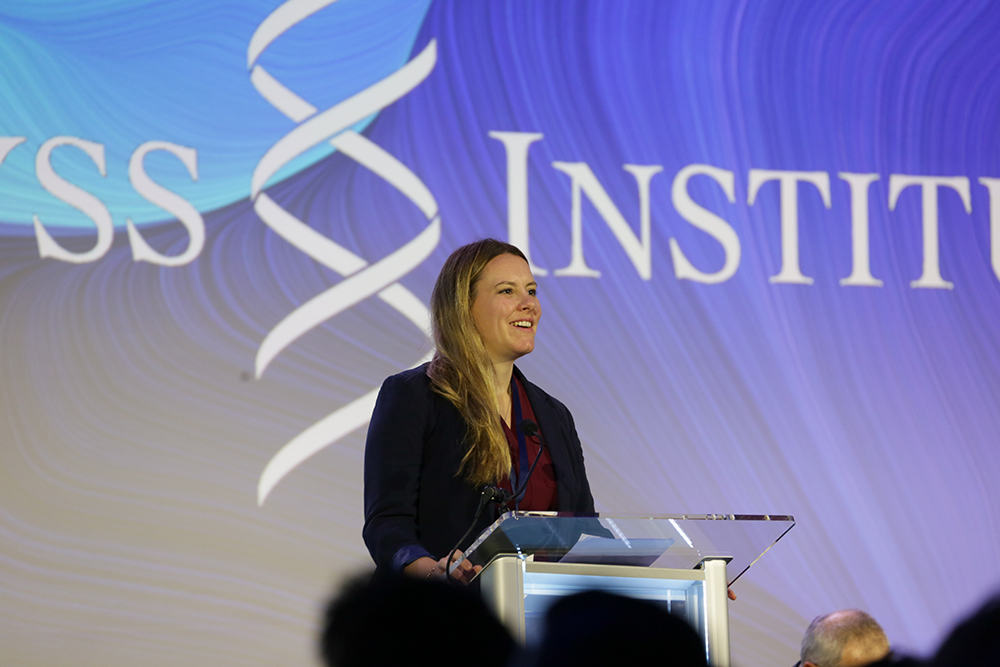
An AI tool developed by U of T Engineering professor Nicole Weckman (ISTEP, ChemE) can quickly diagnose infections caused by Candida auris (C. auris) — a pathogenic fungus that has risen to the top of global threat lists for hospital-acquired infections. The organism has been behind many deadly disease outbreaks in hospitals and has developed resistance to multiple common antifungal drugs, making it difficult to diagnose and treat.
The new diagnostic platform is called digital SHERLOCK (dSHERLOCK) and was introduced in a study published recently in Nature Biomedical Engineering. It was developed by Weckman and her collaborators while she was a postdoctoral fellow at Harvard University’s Wyss Institute.
The tool builds on an earlier technology known as Specific High-sensitivity Enzymatic Reporter unlocking (SHERLOCK), which was created by Professor James Collins, the Termeer Professor of Medical Engineering & Science at MIT and a founding member of the Wyss Institute. It uses CRISPR-Cas proteins to detect unique DNA sequences that can help identify which pathogen is causing an infection.
dSHERLOCK takes this system to the next level by bringing in the power of AI. Machine learning algorithms are used to measure and analyze the fluorescence produced by thousands of tiny CRISPR reactions at once, which allows quantitative measurements of how much of a pathogen is in a sample in less than 20 minutes.
The international research team — co-led by Collins and Professor David Walt of the Wyss Institute’s Diagnostics for Human and Planetary Health platform — was assembled in response to several outbreaks of C. auris infections in hospitals around the world.
These outbreaks highlight the need for enhanced diagnostic tools to help prevent the spread of infections in our healthcare systems. The appearance of treatment resistant C. auris strains also poses major health risks to immune-compromised individuals, such as patientsreceiving chemotherapy or nursing home residents.
“There are two challenges to dealing with C. auris outbreaks,” says Weckman.
“The first challenge is diagnosing that the infection is caused by C. auris and the second challenge is determining which antifungal treatment will be most effective.”
Currently, determining if C. auris is resistant to a particular antifungal treatment can take up to a week, whereas patients suffering from the infection require immediate treatment.
Weckman joined the team at the Wyss Institute in 2020 to help dive deeper into SHERLOCK’s CRISPR-mediated detection mechanism to speed up the diagnosis process.
“My postdoctoral work with Professor Collins was focused on developing streamlined, one-step CRISPR diagnostics that detected C. auris genes and single base mutations in C. auris DNA that are associated with resistance to antifungals,” says Weckman.
“We found that CRISPR reactions detecting DNA with a mutation generated fluorescence at a different rate than DNA without the mutation. We then used machine learning to analyze the fluorescence signals allowing us to quantify how much of a particular mutation was in the sample in only 40 minutes,” she says.
“The capabilities that we are introducing with dSHERLOCK satisfy the major clinical requirements for a next-generation assay to rapidly identify and quantify the C. auris burden in easily obtained patient samples,” says Collins, who is co-senior author of the study.
“This has not been possible using previous diagnostic methods and is a technological feat that, in addition to CRISPR engineering, required us to deeply integrate the SHERLOCK technology with the Walt group’s cutting-edge single molecule detection technology and a tailored machine learning approach.”
Since establishing her research group at the University of Toronto in January 2023, Weckman has carried on her research into detecting antimicrobial resistant Candida infections.
She received a New Connections Grant from the Emerging & Pandemic Infections Consortium to collaborate on this project with Dr. Robert Kozak, clinical microbiologist at Shared Hospital Laboratory located at Sunnybrook Health Sciences Centre and Professor in the Department of Laboratory Medicine & Pathobiology at the University of Toronto..
Weckman Lab member Amy Heathcote (ChemE MASc, 2T5) recently completed her MASc designing CRISPR diagnostics for three other Candida species that can cause severe invasive infections: Candida albicans, Candida parapsilosis and Candida glabrata.
Heathcote also investigated how to engineer CRISPR systems to reliably detect antimicrobial resistance mutations, even for particularly hard to detect DNA sequences of interest.
Researchers are optimistic about the potential future applications of dSHERLOCK against other infections and viruses.
“The dSHERLOCK platform has much broader utility beyond the C. auris threat: by allowing us to refit the specifics of the CRISPR-based detection machinery it can be relatively easily adopted to detect, quantify and characterize multiple other pathogens that pose serious health problems,” says Walt.
Weckman — who is also the Paul Cadario Chair in Global Engineering and a Core Research Faculty member with the Centre for Global Engineering (GGEN) at the University of Toronto —is encouraged by the ability to deploy this platform in international healthcare settings.
“Two of the major advantages of the CRISPR diagnostic platform are that it can be easily redesigned to detect many different infectious pathogens and it can be run at room temperature without the need for costly equipment,” says Weckman.
“Our group is looking at how we can use this technology, beyond C. auris diagnosis, to help tackle global challenges in healthcare, water quality, and agriculture,” says Weckman.