
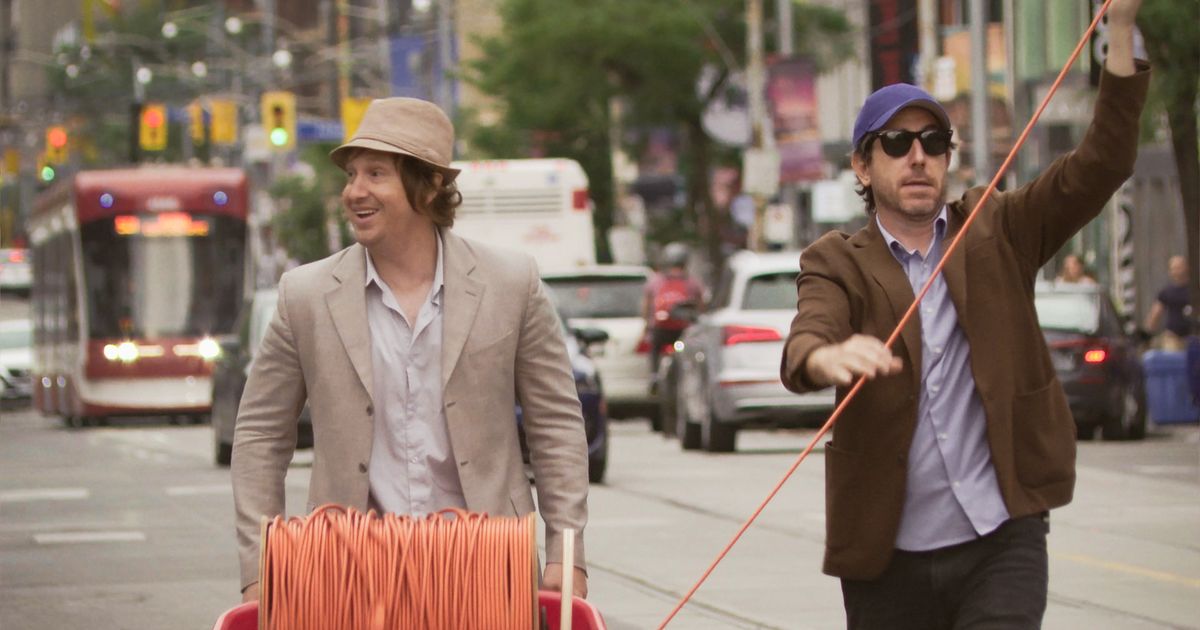
It’s tempting to liken Nirvanna the Band the Show the Movie to like-minded mid-budget hybrid docu-comedies, like the work of Nathan Fielder or Jackass, but the most apt comparison for Matt Johnson’s big-screen adaptation of his and Jay McCarrol’s small-screen web series might be — somewhat improbably — Mission Impossible: The Final Reckoning. The opening 20 minutes feature a set piece involving the CN Tower (which did not approve the film’s use of its site) in a sequence that may stress out those who balk at heights. Nirvanna the Band the Show, which ran as a web series from 2007 to 2010 and then as a sitcom from 2017 to 2018 on Viceland, was not known for its stunts. But in order to make good on the movie-ness of it all, Johnson and McCarrol leaped and ran and dived into the sky, all for the sake of booking a concert at the beloved Toronto venue Rivoli.
Nirvanna the Band the Show the Movie is almost impossible to describe, but here’s an attempt: Johnson and McCarrol play fictional versions of themselves — Matt and Jay — who are aspiring musicians in a band called Nirvanna the Band (no relation to the obvious) who try, in vain, over and over, to book a show at the aforementioned Rivoli with hopes of making it big. There’s little narrative through-line; the show was far more akin to a comic strip than a narrative sitcom. Both the web series and the TV show allowed these characters to wreak havoc on the city of Toronto, frequently enlisting the help of unassuming and unprepared civilians, all in an effort of finally booking a single show.
Following the success of Johnson’s Blackberry, he got the green light to adapt his and McCarrol’s show into a film, which ups the ante several times over with death-defying stunts, time travel, and an alternate history in the mix. The feeling of watching the movie is entirely disorienting and completely hilarious. It is as much like Caught by the Tides as it is Back to the Future. Johnson and McCarrol don’t want to give all their secrets away, but the movie they made was pieced together shot by shot, stunt by stunt, over a number of years. While Johnson and McCarrol never set out to make something that left its audience wondering how they pulled it off, the sense of disbelief and wonder never vanishes, even as you’re laughing.
This isn’t the movie you initially started out making. What was the first iteration like?
Matt Johnson: The idea was to make this movie very quickly: Blackberry had just come out, and the Canadian government had agreed to finance this movie. I was thinking it would be really fun to have these two characters from Nirvanna the Band meet people from different cultures — a bit like The Trip, which is a movie Jay and I both really like. We thought we might do something more non-narrative, like a tour film. But the real issue when we looked at the footage was that it didn’t have any scope. It didn’t feel like it should be a movie. In Canada, there’s a TV show called The Trailer Park Boys, and they’ve released a number of movies that feel like episodes of their TV show in terms of the scale.
Jay McCarrol: We were watching it back and feeling a bit like, No matter how well we finish this, there’s going to be something missing.
Johnson: We were shooting this movie in different American cities where we didn’t know anybody and we had no connections, and we were scrambling to make a story come together. And then we ended up setting the movie in Toronto in basically our own backyard. It felt so effortless that it made the extremes that we went through much more tolerable for us. Not because America is particularly difficult to film; in some ways, it was the opposite. My interpretation of the standard American citizen is that they all should be on television. It’s like the entire country has media training. Everybody we met was a charismatic game-show contestant.
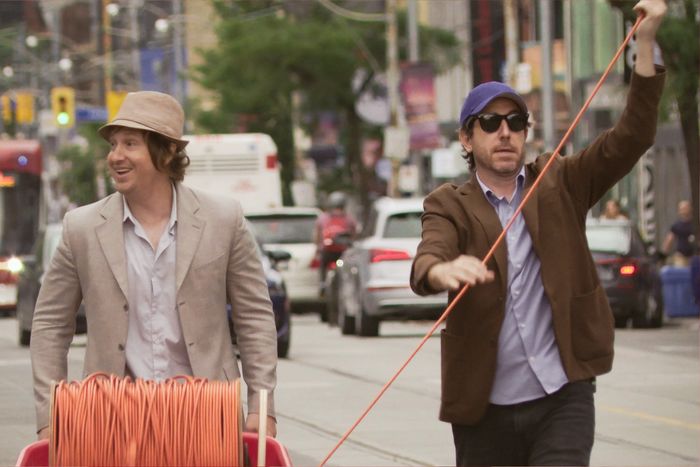
Shooting in Canada just made everything less hard. One of the big tricks to how we made this movie is that we returned to the same thing over and over and over again. We shot many of those sequences over the course of weeks, sometimes months, one shot at a time. For example, when we’re dragging that cable across town from the CN Tower to Queen Street to plug it in, we shot that piecemeal over the course of weeks, one or two shots at a time.
A lot of what you guys do when you’re shooting out in Toronto is interact with members of the public, who you enlist to aid and abet in these characters’ various schemes. These aren’t paid actors. They’re not in on the bit. You’ve called this “social engineering.” What’s an example of how we see that social engineering play out onscreen?
Johnson: That CN Tower sequence that starts the movie is the perfect example: As you’re watching Jay and I come out onto [the ledge of] the tower, it’s not immediately apparent that the camera is not controlled by us. It’s a GoPro on the head of a tour guide who had never met us before. We’re getting this guy to look and move exactly where we need him to in order to create the beats of that sequence without him even realizing he’s doing it, with the real crazy trick being that we leave with the footage.
McCarrol: We always want our cameramen to be like National Geographic documentarians filming wildlife. We go through efforts to make it feel believable that a cameraman would just barely get his camera up in enough time to see Matt running around with a giant cable. We go over the psychology of how a four-person camera team could capture something so fantastic, and that’s what ends up forcing us to find where those strange lines between reality and fiction are. We try to go as far as we can without actually needing to cross a line into fiction. Any of those tricks, it really is exactly what you’re seeing 90 percent of the time.
When you’re going for something like the CN Tower sequence, does the gamble become scarier when it starts to feel like you’re going to get away with it?
Johnson: I think both Jay and I are quite hesitant, and oftentimes we back away from things. Curt [Lobb] and Bobby [Upchurch], our editors, are always telling me specifically, “You got too scared. This could have gone way farther.”
McCarrol: It’s really hard to stay committed.
Johnson: And I think in some ways that speaks to our Canadian-ness, or at least mine — the desire to not get in the way of somebody’s day is so powerful in my mind when we’re shooting this that I’m always taking my foot off the gas before we really inconvenience somebody.
Was using the CN Tower part of what you wanted to do when it came to expanding the scope?
Johnson: That was one of the first things that we realized we should do.
McCarrol: It was also a bit of a white whale for us in the Nirvanna universe. The show started as an extension of us just being real and sincere with our lives, but then it became fun that we were hitting more Toronto landmarks, and in that pursuit, we realized the CN Tower is like our city’s greatest piece.
To what extent do you try to plan some of these set pieces around other things going on? I was reading you did the trolley stunt the same day as the Eras Tour.
Johnson: The credit for that goes to our producer, Matt Grayson, who tries to set good conditions for us. When we’re doing things in public, it’s not so much that we might get arrested, it’s more about the efficiency of trying to shoot something that complicated without permits and very quickly. Planning it the same day as a Taylor Swift concert in Toronto means that there’s so much chaos in the city that whatever we’re doing is not going to compare. Matt tries to set up our shoots as often as he can with that type of defense mechanism.
A friend was saying that the proverbial “fifth Beatle” of your operation is also your lawyer. To what extent are you roping him into the creative process?
Johnson: Yes, his name is Chris Perez, and we have a very direct back-and-forth conversation about more or less every single thing that we do. It’s been that way since my first film, The Dirties. We are trying to be at the vanguard of fair-use law, specifically American fair-use law, and we’re only able to do so because Perez has kind of walked me through, film after film, what we can and can’t do and the circumstances that we need to create in order to do these things legally. Writing the use cases creatively, why these things need to happen in the film — it’s actually quite fun. It’s bizarrely like high school again, where you get these little assignments of “Make a case in two paragraphs as to why Back to the Future is narratively important to this film” or “Why this song is narratively important to this film” over and over and over again.
McCarrol: And if it’s not, then we can be maneuverable and adjust the writing so that it does fit a case that we can justify.
Back to the Future is a huge touchstone in this film, as your characters go back to 2008, which was about a year after the web series started. There are several bits about comedy that haven’t aged well — references to Bill Cosby and Russell Peters, and there’s a scene from The Hangover. How has your own comedy changed between then and now? Is there a difference in terms of what you will and won’t touch?
Johnson: We haven’t really been asked that, but my answer is no. I view more or less everything as on the table. My sense is, especially in Nirvanna the Band the Show, that if it’s making us laugh, there’s something to it. Curt and Bobby are really the only other people who see our raw footage, so we go pretty crazy when we’re shooting, acting as much like adolescent boys as we can. Maybe at a subconscious level there’s a certain amount of self-censorship.
McCarrol: I think we, collectively, have a pretty deep desire to protect ourselves. So, yes, when we shoot and we improvise, there’s no script and tons of shit is said. We say everything. I think, generally, everybody subscribes to this idea that the edgier or the more contentious the language, we have a bigger responsibility for it to be clever enough and to strike that balance where we know that the broad audience is going to understand that the intention is to all laugh at this together. It’s like if we can take the edgiest, rudest stuff and somehow get a whole family to have a wholesome laugh at it, that feels good. In the web series, we enjoyed pushing boundaries because that was sort of the time.
Johnson: There’s nothing that little kids like more than taboos. They feel sacred.
McCarrol: Like sticking your hand in the cookie jar.
Johnson: By the way, I know you can see me moving out into the snow, and it’s because I’m going to a Magic tournament.
McCarrol: Oh, that’s today!
Are you competing? Observing?
Johnson: A little bit of both. I would love to go and just play in a tournament for fun. That was my dream as a kid. I’m writing and directing the Magic Card movie for Legendary and Hasbro.
I have one more question, which takes us back to the beginning of our conversation when we talked about TV movies and The Trailer Park Boys. What do you think makes for a successful TV-show movie, or how did you think about transposing one medium into another?
Johnson: I think credit might go to Bobby for this answer, but I think a successful TV adaptation of a show could work as the beginning of an audience watching that show. And by that I mean even though it’s absurd to say, I think that for most people, this movie is going to serve as the pilot of the TV series, and they’re going to go from watching the movie to the TV show as a continuation from this. If there’s anything we did that was cynical in terms of the construction of the movie, it was to try to make it so that if this is the very first time you’ve seen these characters ever, that you will be excited to leave this and then watch the show, as opposed to something that only people who had ever watched the show would enjoy.
Related