
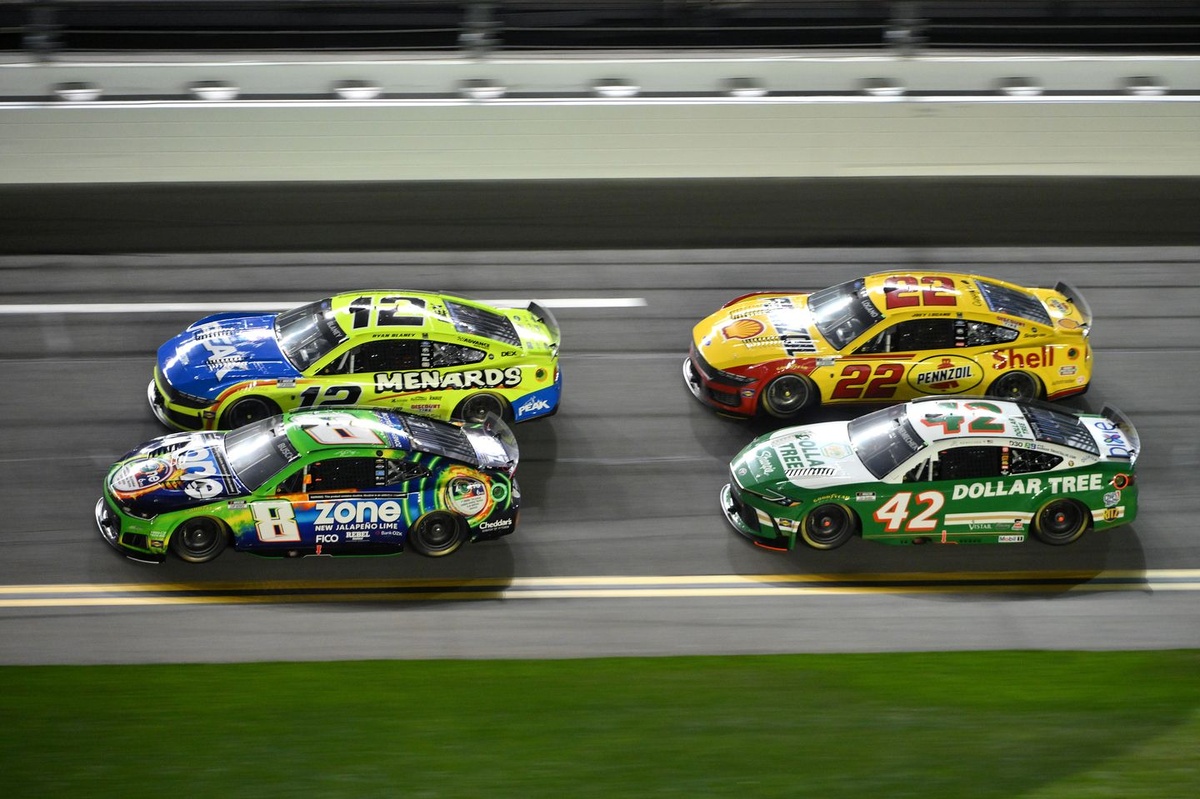
At least for the time being, NASCAR’s identity is internal combustion engines that making loud noises and relate to a majority of the American consumer.
While the Sanctioning Body continues development on a prototype race car that can adapt to any alternative fuel or power source, all four manufacturers that compete across the three national tours are content with the internal combustion status quo.
Advertisement
The question was posed to the four manufacturer competition leaders representing Chevrolet, Ford, Toyota and RAM.
Dr. Eric Warren, vice president of global motorsports competition for GM motorsports
Tyler Gibbs, president of TRD USA
Kevin Kidd, North American motorsports competition director for Stellantis
Pat DiMarco, Ford Racing NASCAR and analytics manager
There have been times over the past decade that Chevrolet, Ford and Toyota have each expressed a degree of inevitability towards electrification. Now, that’s been replaced with a sense that alternative fuels is more likely, but certainly not something that will eliminate the sound and power of the status quo.
Advertisement
For NASCAR’s part, the vehicle it produced alongside ABB, is a malleable machine that can adapt to any powerplant developed in the years to come. There continues to be no plans to race the car as a formal series but is instead a playground to adapt emerging technologies.
DiMarco noted that Ford racing across the glove in a wide variety of categories using numerous power plants and see development value in each of them.
“Yeah, we race in 34 countries around the world, 47 weekends a year; I think 36 different series,” DiMarco said. “We have the opportunity to race hybrids in other series. We have the opportunity to run completely (Internal Combustion) here.
Advertisement
“For us, our product in the showroom matches our product on the racetrack. It’s just not here in NASCAR that we feel that we need to bring hybrids or electrification at this point. Down the road 20-30 years, who knows? Who knows what technology will bring in that. But currently in NASCAR, we’re happy with the formula we have.”
His current Cup Series peers feel the same way with Gibbs and Warren both acknowledging what American fans seem to want more than anything else.
“Yeah, it depends really on our fan base, and we know where our fan base is here,” Gibbs said. “Again, when you look at the length of our races and some of these kinds of things, electrification is a little bit more challenging on racetrack like this where there is no regen or any of those kinds of things.
Advertisement
“So, for us it mimics what our customers want in the marketplace, and the same thing from a motorsports perspective. So, we’re racing hydrogen in certain racing series; we’re racing hybrids in others. It really just depends on kind of what the fan base in the particular series is most engaged with, and that then goes on to our customers.”
Warren says Chevrolet similarly races a wide variety of power plants globally and says they are prepared as an OEM no matter what direction NASCAR goes.
“The energy requirements in this form of racing are totally different,” Warren said. “The weight of the car, the accelerations and how you would implement is not really suitable here as much as it is at other series, so I think that drives a lot of it. There’s not really an added benefit to the sport as a whole.
Advertisement
“Certainly us as a manufacturer, we’re building great EV vehicles, great gas-powered vehicles, and our attempt is to bring the right vehicle to the customer of whatever they want.
“I think NASCAR, we love the close competition racing, and we want the power train to be suitable for the event and the competition.”
Kaulig Racing Ram Truck logo
Kaulig Racing Ram Truck logo
Stellantis has been extra aggressive in expanding internal combustion offerings globally even before it caught on amongst its peers. Softening regulatory standards for emissions in the United States has certainly encouraged that sentiment domestically too.
Advertisement
Kidd echoed the prevailing narrative that American fans say they want internal combustion vehicles and want to see them raced too — thus the return of RAM to the Craftsman Truck Series.
“I think our core business is to bring the customers what they want to buy and really give a good offering of that in the marketplace,” Kidd said. “So no different than what Tyler and Eric talked about there.
“What’s unique for us and unique about NASCAR is this is about raw American horsepower. Let’s call it what it is. This is fire breathing muscle cars, and that’s part of our brand. That’s a very strong part of our brand. Coming to NASCAR, we’re able to lean into that pretty heavy, and that is something that has resonated with all the Mopar loyalists across the planet.
Advertisement
“We’re happy to be here and making horsepower normally aspirated, and we will support whatever the direction of the sport is in the future. We’ll help shape that. But recognizing the fact that our fans really do resonate with normally aspirated horsepower.”
Read Also:
Hendrick would have signed Kyle Larson to lifetime deal if he could
Duel shows why anything is possible in the Daytona 500

Is NASCAR going to let Garrett Mitchell be Cleetus McFarland?
To read more Motorsport.com articles visit our website.