
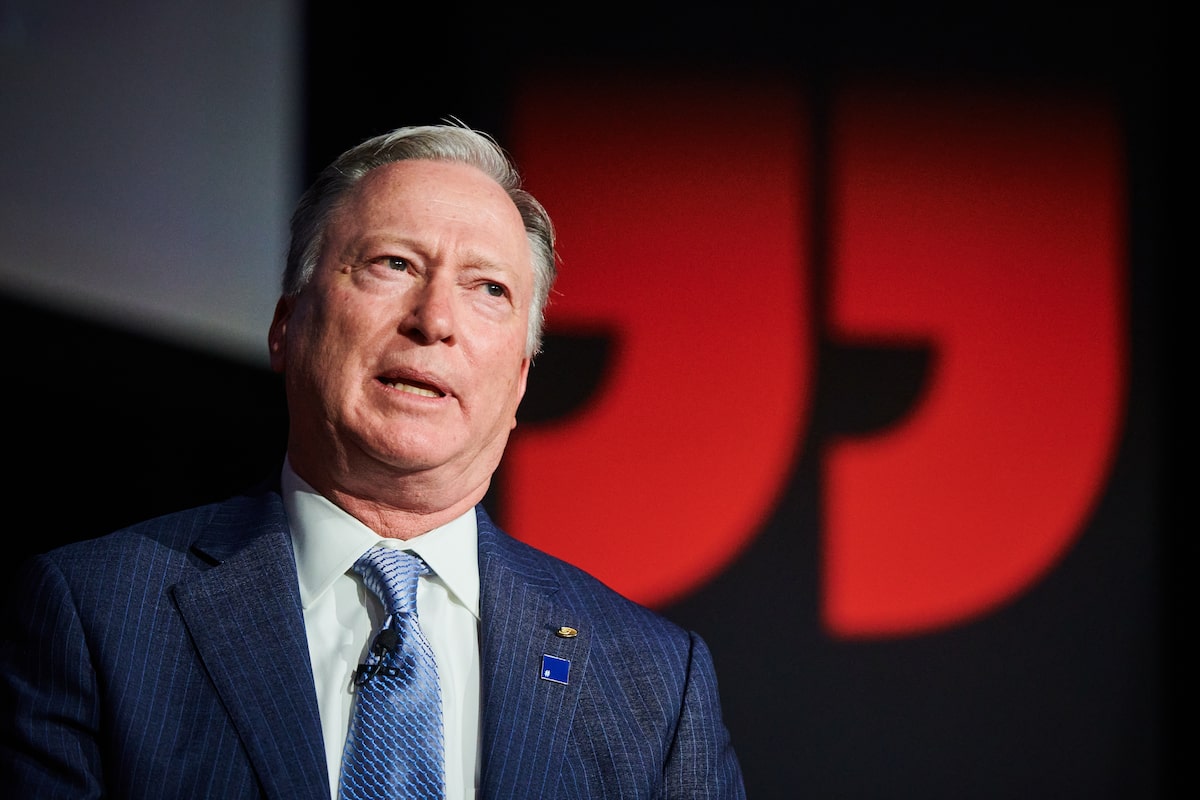
Greg Ebel speaks at an event in Toronto in October, 2025. The Enbridge CEO points to Northern Gateway to explain why his company is not interested in taking on the risk of a new pipeline project.Sammy Kogan/The Globe and Mail
The head of Enbridge Inc. ENB-T says the company is unwilling to take on the financial risk of developing a new oil pipeline from Alberta to Canada’s west coast.
Calgary-based Enbridge is one of three energy infrastructure companies tapped by the Alberta government to provide technical and regulatory expertise on a proposal for a new oil pipeline. But chief executive Greg Ebel said Friday his company has no intention of floating such a project.
“I don’t think investors or the infrastructure companies should be taking on the risk of development in jurisdictions that have historically created a challenge,” Mr. Ebel told analysts on an earnings call.
Mr. Ebel pointed to the defunct Northern Gateway pipeline.
The pipeline, which would have moved bitumen from Alberta to the northern coast of British Columbia, was cancelled in 2016 after the Federal Court of Appeal found Canada failed to consult with First Nations on the $7.9-billion pipeline project.
Enbridge had invested roughly $600-million in the project, Mr. Ebel said, “and the rug was pulled out from underneath us.”
“So that’s not the type of risk that we’re looking to take on at this time. We don’t need to with all the other opportunities.”
Opinion: Ottawa cannot keep giving mixed signals to Canada’s energy sector
Indeed, Enbridge secured roughly $14-billion worth of projects in 2025. Together, they are set to increase oil pipeline capacity from Western Canada, expand transmission capacity and storage of natural gas in the U.S. Northeast, the Gulf Coast and in B.C., and build renewable power generation to support data-centre operations for companies such as Meta META-Q.
It expects to make final investment decisions on another $10-billion to $20-billion of growth projects over the next 24 months, Mr. Ebel said Friday.
But massive energy infrastructure projects take years to develop, he said. As such, they are subject to policy and political whims that, “with the stroke of a pen,” can sound their death knell.
While the sweeping energy deal signed by Ottawa and Alberta was a “very encouraging” signal for the oil and gas industry, Mr. Ebel said Enbridge is still looking for concrete action to boost sector growth.
“It’s not so much about the signals and the speeches. It’s more about the actions and the results,” he said.
The Ottawa-Alberta memorandum of understanding is a deal that both governments said would position Canada as a global energy superpower while also meeting climate goals.
It aims to unlock Alberta’s energy sector and diversify export markets, and laid the conditions for construction of a new oil pipeline to the west coast.
Alberta intends to submit a West Coast oil pipeline proposal to Ottawa’s Major Projects Office in July for designation as a project of national interest. The province is eyeing Asia as a significant source of growth for its crude oil export market.
Smith says she and Eby share ‘common ground’ on Trans Mountain pipeline expansion
Mr. Ebel doesn’t expect the federal government will provide a financial backstop to private players to build a new pipeline, but said some kind of cushion during the development process could be helpful.
“We’re quite happy once we get the go ahead to take the risk on building them, but we’re not going to take the risk of them being stopped before they go into service or frankly, even FID [final investment decision], because some of these projects you’re spending hundreds of millions of dollars before you even get regulatory approval.”
Enbridge Inc. says it made a profit of $1.95-billion in the fourth quarter, up from $493-million in the same quarter last year.
The company says the earnings attributable to common shareholders worked out to 89 cents per share for the quarter ending Dec. 31, up from 23 cents per share the prior year.
It says adjusted earnings came in at 88 cents per share in the fourth quarter, up from 75 cents per share in the same quarter of 2024.
While Enbridge does not expect any material impact from the recent geopolitical events involving Venezuela, Colin Gruending, the company’s president of liquids pipelines, acknowledged that the longer-term outlook remains uncertain.
Earlier this year, U.S. President Donald Trump pledged that American oil companies would take over energy infrastructure and production in the South American country after U.S. forces captured Venezuelan President Nicolás Maduro and his wife in a military raid.
Much depends on how quickly Venezuela ramps up production, Mr. Gruending said, but the U.S. Gulf Coast remains the world’s best heavy refining market.
“Canadian crude is the meat and potato part of the diet there, so I think it’s still going to work pretty well all around.”
With a report from The Canadian Press