
I spent roughly 25 weeks in 2022 on my bathroom floor, inspecting the grout between the tiles and waiting for whatever food I futilely put in my stomach to come back up. “Grout is such a stupid invention – impossible to clean,” I’d think, and then press my cheek against the floor, preparing to reacquaint myself with a reconfigured version of the saltine crackers and ginger ale I consumed 20 minutes earlier. “I’m never doing this again.”
I was lucky that I was able to experience the indignity of pregnancy under the best conditions possible: I had a home, a partner, a job (one that I could do from my bathroom floor) and savings. Those conditions haven’t changed, and yet the thought of going through it all again now – this time with a toddler – seems impossible. And nuts. And increasingly unusual, at least according to data about family composition in Canada.
The 2021 census showed that of families with children, single-child families were the most common (45 per cent), followed by two-child families (38 per cent), and then three or more (17 per cent). In other words, more and more Canadian women are stopping at one child, if they choose to have children at all.
In 2024, Canada’s total fertility rate (TFR) – the number of children a woman will have over the course of her reproductive life – reached a record low of 1.25. That put Canada in the category of ultralow fertility, alongside countries such as South Korea (0.75), Japan (1.15) and Finland (1.30). To maintain population stability, women need to have on average 2.1 children, and yet we’re nowhere close to that, and we haven’t been for a while.
That poses an enormous threat to Canada’s future economic stability (we’ll have too many retirees and not enough workers), our economic growth (what type of innovation can happen when we’re barely keeping the social safety net afloat?) and our geopolitical influence. Our rapidly declining fertility rate poses a risk to our culture and identity, too. What will it mean for Canada when people no longer see raising a family as a worthy life goal?
In January, Statistics Canada released a report on the economic and social factors contributing to Canada’s declining fertility rate. It reported that in 2024, slightly over half of Canadian women aged 20 to 49 had no children, and a whopping 88.5 per cent of women in their 20s did not have kids. That’s a huge change from just a few decades ago, when, in 1996 for example, 44 per cent of women aged 25 to 29 had at least one child. In 1976, it was 62 per cent.
The ‘Biggest Families’ Contest at the Canadian National Exhibition in Toronto in September, 1925. Held under the auspices of the Canadian Manufacturers’ Association, it was a new and popular feature of Manufacturers’ and Flower Day. One of the prize-winning families is shown: Mr. and Mrs. C. Smith, 145 Beaconsfield Avenue, Toronto, winners of the special class for three pairs of twins in a family.John Boyd/The Globe and Mail
But the most striking figures out of that recent Statscan report were about women’s desire to have children: Of Canadian women aged 20 to 49 who had no children, only just over half said they wanted to have them. Roughly one-third said they “definitely” or “probably” did not want children. A little over 17 per cent said they were unsure. The issue, in other words, is not simply that Canadian women are having fewer babies, but that an increasing number have no interest in motherhood at all.
We know that there are many Canadian women who want to have children, but choose to delay starting or growing their families because of economic concerns. Policy changes, such as more affordable daycare spaces or better maternity-leave benefits, might be able to reach this cohort to affect their choice of when to have children, and how many.
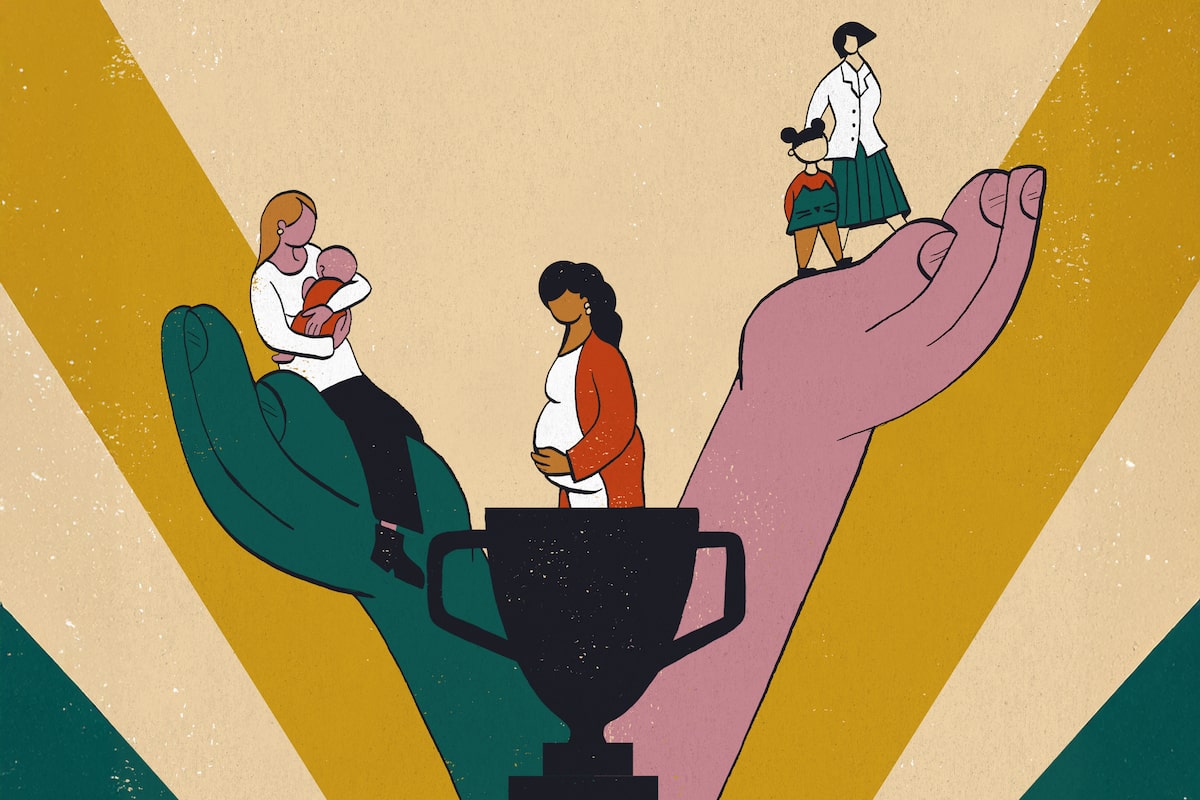
But for the other half – the 50 per cent of Canadian women who say they don’t want kids, or who are unsure – policy changes alone won’t be enough. For those women, Canada needs to experience a cultural shift, too: one that encourages, reveres and celebrates motherhood. And one where child-rearing is treated as more of a communal endeavour, not one that falls disproportionally on the woman inspecting the grout on the bathroom floor.
Fertility-rate decline is not just a Canada problem, or even a problem exclusive to developed nations. In 2025, India’s TFR dropped to 1.9, below replacement level. Indonesia’s TFR is hovering around replacement level, which represents a significant decline from just a couple of decades earlier. China’s TFR is 1.0, which signals a catastrophic hollowing out of its population. Indeed, with the exception of many African countries and a few global outliers, fertility is declining all around the world; the global fertility rate is now less than half what it was in the 1950s.
We understand broadly why this is happening: Women are better educated, better employed, and have better access to contraceptives than they did a generation or two ago, all of which is correlated with a decline in fertility rates (though the data on work-force participation and fertility is more nuanced in high-income countries). What makes Canada particularly susceptible to fertility-rate decline is our high cost of living and exorbitant housing costs – two primary factors that many would-be parents cite for delaying starting a family (which, in turn, often means they have fewer children than originally planned). One recent study from the University of Toronto actually quantified that rising housing costs in the U.S. since 1990 resulted in 13 million fewer babies being born.
But the issue is more complex than just economics. Millennials grew up with a very particular, somewhat nihilistic world view; as children we learned about acid rain, the hole in the ozone layer and the dangers of overpopulation. We watched China execute its devastating one-child policy on the other side of the Pacific, while being taught about the deleterious effect that our growing population was having on the environment. The message was never explicitly about not having babies, but even a 10-year-old trying to clandestinely read her YM magazine in class will draw some inference about lessons about how humans are destroying the planet.
Millennials came of age during a period of third-wave feminism, when girls were encouraged and expected to outperform the boys academically and achieve the highest professional qualifications possible. They entered postsecondary education around the time that the number of women with university degrees in Canada surpassed men for the first time ever, and yet they still emerged to find that their qualifications would not give them the type of life their parents enjoyed. So they studied more, worked longer, and put parenthood off to one side, wondering what type of life their hypothetical kids, in turn, could have if they themselves can barely afford to buy a 500-square-foot shoebox in the sky.
Those who do decide to have kids find that parenting is not the same as it was when they were growing up. Screentime is verboten (I lie at every pediatrician appointment), childhood boredom has been replaced with organized programming (here in Toronto, you must use two devices simultaneously if you want to snag a spot in a city-run class on sign-up day), and other parents will look at you sideways if you scroll on your phone at the playground instead of spotting your kid on the slide (please mind your own business, Ashley).
The current style of parenting is more hands-on, more intensive than it was before; some research shows that working mothers nowadays actually spend more active, engaged time with their children than stay-at-home moms did decades ago. And because Canadian women now are older when they have their first child (on average 31.8 years old, compared with 27.8 years in 1991), grandparents tend to be older, too, which can mean they are less actively involved than they might have been had they become grandparents at a younger age.
That leaves millennial women to try to somehow juggle everything: work (wait, did someone have a doctor’s appointment this week?), home (crap, I forgot to take the meat out of the freezer for dinner), child care (how long after a fever can I send this kid back to daycare again?), the budget, the schedule and so on. Partners help, of course, but the reality is that the mental and physical load of parenthood still disproportionately falls on women. And who has time to puke for 25 weeks when they’re dealing with all of that? That’s why many millennial women are stopping at one, and why many Gen Zers are looking ahead and thinking motherhood is not for them.
Countries all around the world have implemented various measures to at least address the economics of parenthood. In 2025, China announced it would pay parents the equivalent of about $700 annually for each child under three years old. The U.S. under President Donald Trump launched “Trump Accounts,” which offer $1,000 to every eligible newborn, with the opportunity for parents and grandparents to make annual tax-deferred contributions. Japan recently raised the lump-sum payment it offers to parents to cover the cost of birth, and it removed the income cap on the monthly allowance given to parents of children up to age 18. Hungary, which has become one of the most unabashedly pro-natal countries in the world under Prime Minister Viktor Orban, has implemented a whole suite of measures that include everything from grants for large vehicle purchases for big families to an income tax exemption for mothers of three or more children.
But the evidence shows these policies have little effect on overall fertility rates. There was no baby boom in Canada after the government introduced $10-a-day daycare (which might have something to do with the dearth of actual spaces). Hungary’s policies appear to have incentivized women who were always going to have children to start building their families earlier, but these policies have not, so far, sustainably raised its TFR (which was 1.39 in 2024). Japan is still grappling with existential population decline.
Part of the problem is that the decision to have children is complex and multifaceted, and these policies only offer cursory economic relief. Most people won’t switch banks for a $1,000 bonus; why would it be enough to motivate them to have children? Women also don’t want to feel like paid incubators, which is why, in some cases, these policies have actually provoked a backlash. And they do nothing to address the cultural pressures: the ways that parenthood disproportionately falls on women, the lack of a “village” for support, the expectation to participate in a more intensive style of parenting, and all of the other perceived burdens that come with procreation.
Yet there is one place in the world – in fact, the only country out of all OECD nations – that has bucked the global trend, and somehow managed to keep its TFR well above replacement level: Israel. By most indicators, Israel should be suffering from the same fertility-rate decline as all the other developed nations; its cost of living is higher than in Canada, housing prices are exorbitant, and women there are among the most educated in the world. Plus the country exists in a perpetual state of fight-or-flight, with war or conflict breaking out nearly every decade. Yet in 2025, Israel’s TFR was 2.8; high both for Jewish Israelis (2.9) and Arab Israelis (2.6), high for both secular Jews (around 2.0) and ultra-Orthodox Jews (6.6).
So how is this possible? Why are Israeli women (who, by the way, only get a maximum of 15 weeks of paid maternity leave) still having multiple children, when women all around the world are stopping at one – or none?
There are some observable cultural differences. Helicopter parenting isn’t really a thing in Israel, which makes parenting multiple children far less onerous. Grandparents also tend to be much more involved in daily child care, and since Israel is a small country geographically, an extra pair of hands typically isn’t more than a few hours away. Like many countries, Israel offers tax breaks to parents and allowances for families with children, but unlike many countries, it funds unlimited IVF treatments for women up to the age of 45 for their first two children. That policy conveys a clear message: If you want to become a mother, we will help you as long as necessary.
That implicit message speaks to the main cultural difference between Israeli society and Canadian society. In Israel, there is no greater good – no greater purpose – than starting a family and having children. Whereas pro-natalism in North America is generally the domain of the right wing, the celebration of new life in Israel is a politically agnostic core belief. Jewish identity does play something of a role in the desire for multiple children – the memory of the Holocaust and the six million lives lost looms large over life in Israel – but that desire does not extend to secular Jews living in the U.S., for example, who have on average 1.5 children. That means there’s something about Israeli society itself that fosters a desire to build and grow a family.
In Canada, children and families can sometimes be an afterthought; there was no clearer demonstration of that than during the COVID-19 pandemic, when playgrounds were closed long after the initial panic and schools were shuttered for months on end, with parents expected to just figure it out.
Caution tape surrounding equipment at a playground along Toronto’s waterfront in March, 2020.Fred Lum/The Globe and Mail
In Israel, families are central to society. Children are a joy. They are a blessing. They are encouraged. They are included. “Childfree by choice” isn’t really a thing in Israel. To have a fulfilling life is to bear and raise children, and your family, your community, and your friends will all help you do it.
The Japanese town of Nagi attempted to effectively manufacture this cultural ethos over the last two decades, and surprisingly, it worked: Nagi doubled its TFR from 1.4 in 2005 to 2.95 in 2019 (it has since stabilized around 2.6). Rather than offering piecemeal economic incentives (though it offered those, too), the town adopted an all-of-community approach to raising children, which included a child care home for parents to drop off kids so they could run errands, and the engagement of older residents to help care for children and babies. But what makes Nagi different from the rest of the country is the community’s attitude toward children. “The child-rearing support is beneficial,” Miho Iwasawa, a demographer at the National Institute of Population and Social Security Research, told the L.A. Times in 2023. “However, what really counts is the mindset of Nagi residents, which is that having a child is a good thing.”
Canada can’t cultivate a pro-child society overnight. But it can start to make small changes to public spaces (stepstools in public bathrooms, for example, so parents don’t have to hoist their kids to wash their hands), policy changes to try to address the motherhood penalty (by allowing women on maternity leave to earn income without clawing back their benefits) and tax benefits for working families (such as allowing parents of young kids to income-split, which now, bizarrely, is allowed only for retirees). These sorts of gestures help to convey the message that our society recognizes and appreciates the challenges of motherhood.
But policy changes must come in concert with an unabashed (and apolitical) pro-natal outlook: one that celebrates children not because we need the future workers and our social safety net is in peril, but because children are a joy. A blessing. Because in Canada, they are encouraged and included. More women need to hear and see that, more often. We must extol motherhood, support motherhood and collectively remind Ashley to mind her own business.