
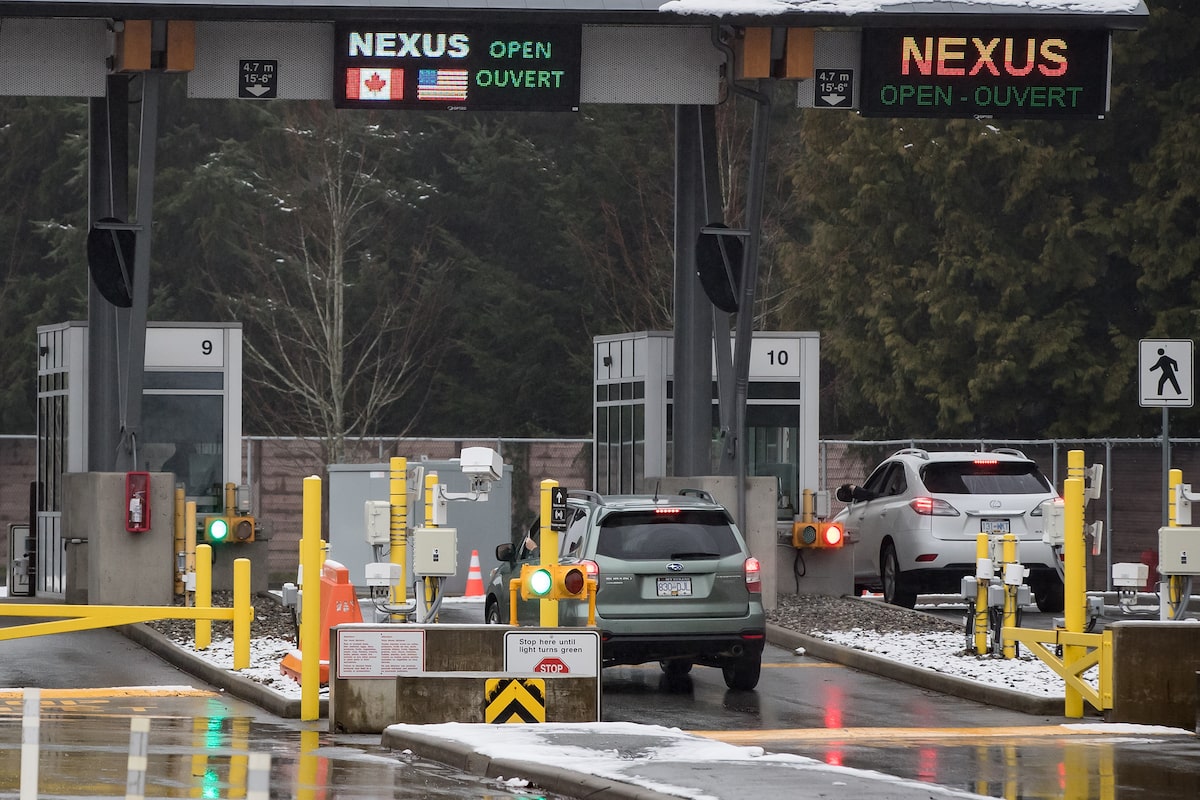
Motorists wait in the line reserved for Nexus card holders at the Peace Arch border crossing in Surrey, B.C. in 2020.DARRYL DYCK/The Canadian Press
Canadians who want to be trusted travellers, a status that allows them to speed through screenings at Canadian airports, face a bizarre conundrum. Even if they only travel within Canada, the only way they can get approved as a “verified traveller” is by applying to Nexus, a cross-border program that requires them to give biometric data and pass an extensive background check – with both the Canadian and U.S. governments.
It makes no sense that Canadians need approval from a foreign country to be trusted to fly within their own country. The situation is especially vexing given the ongoing threats and poor treatment Canada is receiving from U.S. President Donald Trump.
In Canada, aircrew members, police and military are considered verified travellers by the Canadian Air Transport Security Authority (CATSA), meaning they get improved airport security screenings. But there’s no way for other Canadians to get approved, outside of Nexus.
Editorial: Canada has gutted its economic migration program
At airports, verified travellers have access to express screening lines, and they don’t need to remove liquids and electronics from their carry-on luggage. The 2.1 million holders of the Nexus card – the majority of whom are Canadian – have the additional advantage of faster border clearance when going into the U.S. and when coming to Canada from abroad.
Once considered a positive example of cross-border co-operation, Nexus has suffered in recent years due to tensions between the two countries. Applicants used to be able to do the required interviews with both Canadian and American officials at joint Nexus offices at land borders and airports, but a dispute around legal protections for U.S. officials working in Canada several years ago led to delays and a massive backlog.
Applicants now face a cumbersome workaround. In addition to meeting with Canada Border Services Agency officials, they must drive to a U.S. land border to meet with American officials. The U.S. interview can also be done at certain Canadian airports with American pre-clearance facilities, but only if the applicant has a plane ticket to a U.S. destination.
In the past year, since Mr. Trump took power, applications for Nexus dropped dramatically, from around 700,000 in 2024 to under 350,000 last year. Under the Trump government, fears have risen about being fingerprinted and photographed for facial recognition, a requirement of a Nexus application. The applications are processed by U.S. Customs and Border Protection, a part of the Department of Homeland Security, which is involved in the current immigration raids in Minneapolis. The drop in Nexus applications comes during a steep decline in cross-border travel.
Linking Canada’s security screening with the U.S. means Canadians have to defer to American policy. For example, non-binary or trans Canadians can select X as a gender marker on their passports, but following an order from Mr. Trump, they are no longer able to do the same on their Nexus cards. The situation could lead to a court challenge in Canada.
The federal government needs to create a made-in-Canada trusted traveller program. While the program wouldn’t help while crossing into the U.S., it would still be useful for airport security screening and for faster border clearance when returning to Canada from abroad. Last fall, Senator Paula Simons introduced a motion in the upper chamber calling for the federal government to bring in a Canadian-specific trusted traveller program.
The U.S. already has its own American-run trusted traveller program, Global Entry. In fact, its members, as well as members of the U.S. military, currently enjoy verified status within Canada.
Editorial: A history lesson on the future of living beside the U.S.
For many years, Canada did have its own trusted traveller program, Canpass Air. When it launched in 2004, it used iris recognition technology and was considered ahead of its time, according to airline expert Duncan Dee. The Canada Border Services Agency shuttered the service due to low usage in 2018. (A small Canpass program still exists for private aircraft.)
Nexus can continue to exist as a separate program, but it’s time for Canpass Air to be activated again, with service extended to Canadian land border crossings.
Canada should be the one to decide which Canadians are trusted travellers inside this country.