
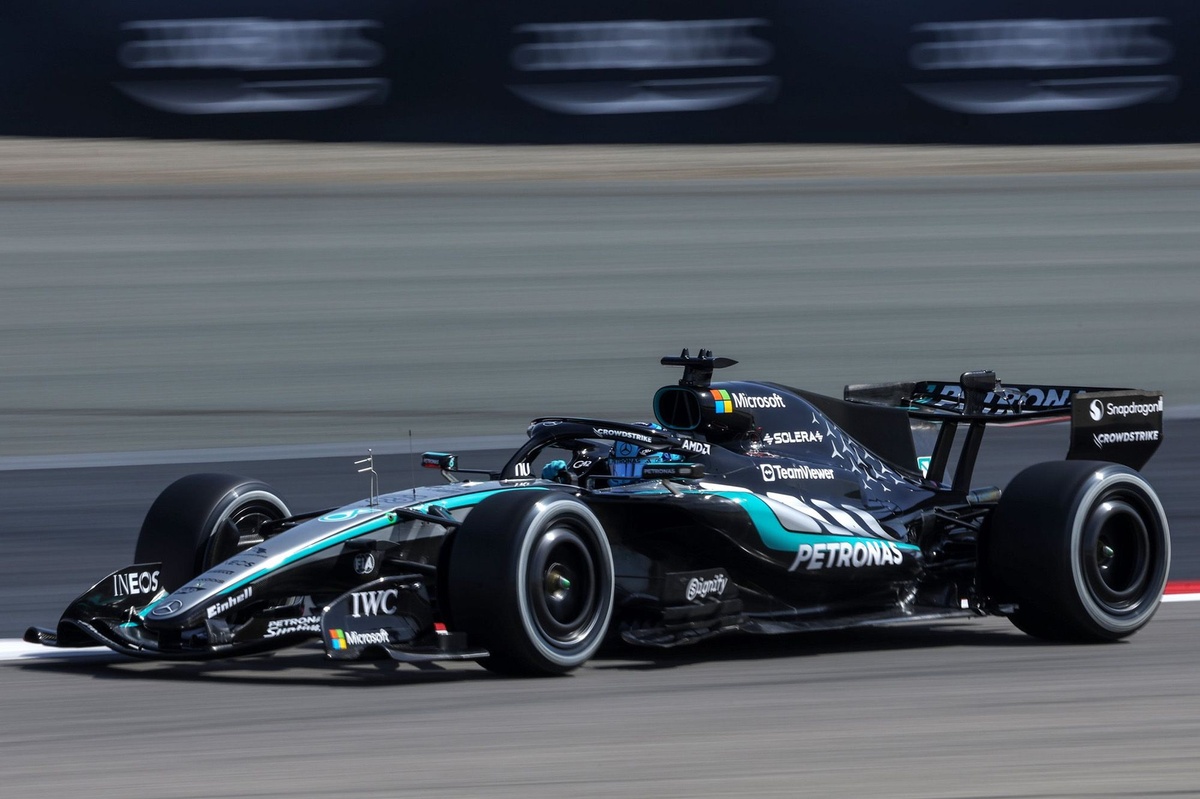
The jury remains out on the 2026 Formula 1 regulations, and you suspect it will remain out for some time. It’s too early to say whether they’ll work out; the drivers need time to adapt to their ever-evolving challenge, and the engineers need time to smooth out the efficiency of the new powertrains and cars. That said, long before the cars had even turned a wheel, conclusions over the pecking order for 2026 had already started to be drawn.
If titles were decided on hearsay and conjecture, then Mercedes would have scooped the honours already. Certain members of the F1 fraternity have pointed towards the Silver Arrows as the favourites for the championship, based upon the team’s apparent command of the new power unit regulations and rumours that the new W17 is close to the lower 2026 weight cap – now set at 768kg, a 30kg reduction from the previous generation of cars.
Let’s not forget the driving line-up. George Russell enters the campaign off the back of a 2025 during which he shone, with two wins in a season dominated by the two McLarens and Max Verstappen, while Andrea Kimi Antonelli demonstrated his talent towards the end of the year after a mid-season blip defined by a handful of rookie moments. His hope is that he’s managed to purge those moments of ignominy from his system.
Championships, however, cannot be won on paper. Success is a culmination of preparation and execution, tenets that Mercedes understood well during its run of dominance prior to the 2022 regulations. The past four years have been comparatively lean; the seven grand prix wins it accrued in that time pale in comparison to its tally of nine in 2021, itself dwarfed by the double-figure counts achieved in each of the preceding years between 2014 and 2020.
The comparatively scant victory count across the ground-effect era has scarcely been sufficient to keep the (Toto) Wolff from the door. Brackley’s finest has been kept ravenous; whether it has sharp enough fangs to tear into the feast presented to it is quite another matter entirely…
The ground-effect lean years
If there was one team pleased to see the back of the 2022-25 ground-effect generation, that was Mercedes. Even though the W16 of 2025 demonstrated some degree of improvement over its predecessors, it was not of a sufficient magnitude to turn the screw on McLaren and Red Bull on a regular basis. It was only very seldom that it could present a challenge to either team, and in very specific conditions.
During the four-year span of those rules, Mercedes went through every conceivable problem generated by a ground-effect-style floor: heavy porpoising in 2022, then struggles with handling in 2023 and 2024, and eventually tending towards a more neutral car in 2025.
The 2022 machine, the W13, was one of those on the grid most affected by porpoising. While the application of an “aerodynamic oscillation metric” helped to alleviate some of the more immediate concerns, Mercedes had to focus on getting the car to run more effectively at higher ride heights.
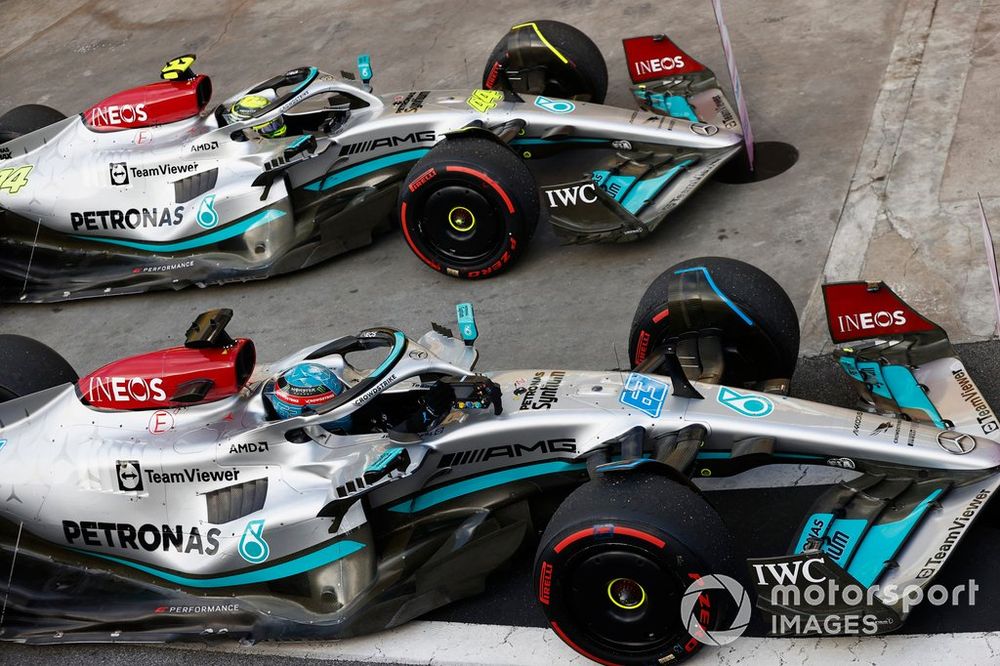
Russell outscored Hamilton during their seasons together; he won here in Brazil in 2022’s porpoising-prone W13
Photo by: Andy Hone / Motorsport Images
By changing sidepods, and by changing its floor focus, Mercedes had to keep taking backward steps throughout the ruleset to pursue a new course. In the words of trackside engineering director Andrew Shovlin, the team began 2022 on the back foot, and it’s no surprise that it never truly caught up to the cars ahead with those course-corrections.
Once porpoising had been dialled out, a new problem emerged: excess rear tyre overheating. The front end was too weak for the drivers to work with in isolation and resulted in understeer, requiring them to employ a few blips of the throttle to get that rear turned in. As the lateral loads increased, this built up more heat; in cold conditions, this could be a helpful trait – but very few F1 races are genuinely held in sub-20C environs.
After Mercedes had improved the handling of the car more organically, 2025 brought some renewed hope, as the culmination of all that the team had learned over the previous three seasons. The rear-end tyre heating issues were largely gone, although Shovlin admitted that much of that progress had been achieved with a flexing front wing – and the team needed a more permanent solution for the Spanish Grand Prix.
It chose to run with a bit more front wing by default over the remainder of the season, which proved a compromise with straightline speed. Furthermore, the anti-lift rear suspension it introduced at Imola in May came at the cost of stiffness, which made the rear end of the car more wayward and unpredictable to contend with. The suspension switch was considered a key reason behind Antonelli’s struggles in the middle portion of the season; note how his confidence turned a corner once Mercedes dumped the suspension ‘update’ after Spa in July.
It almost goes without saying that Mercedes’ power unit was the class of the field back in 2014. With reliability on its side, it allowed the team to access the higher power modes without putting too much undue strain on the internal architecture
None of these issues should be recurrent, given the scope of the new regulations. Porpoising won’t be an issue following the reversion to a flat floor and softer suspension allowing for a different brand of platform control (if it is, someone’s made a grave error somewhere), but that doesn’t mean that the aero challenges are gone. Visual evidence suggests Mercedes has not been conservative in attempting to square up to them.
W17 runs reliably at Barcelona
If anyone remembers as far back as the last time F1 introduced new powertrain regulations back in 2014, it became clear further into the first test that Mercedes had been able to inject its new turbo-hybrid power unit with an encouraging dose of reliability. Although its first day at the end-of-January Jerez test hadn’t been without issue, the team managed to log 300 laps over the course of the four-day run in Andalusia.
Twelve years later, Mercedes didn’t have to contend with first-day wobbles; the new car logged 149 laps on the Barcelona shakedown’s opening day, then 183 laps on the Wednesday. Antonelli, who did 91 laps that afternoon, put a full race simulation together amid his run-plan to give the team a colossal bank of early data. If the first test of 2014 set the scene for Mercedes’ dominance, then doing more mileage in half the time surely bodes well for the team.
What we don’t know is how good Mercedes’ W17 is, even though the team did feel confident enough to put its car through qualifying-style simulations on its last day. Barcelona’s shakedown running was little more than a reliability test, an area where Mercedes largely excelled across its three days at the Circuit de Barcelona-Catalunya. But that doesn’t mean that you can’t cast a magnifying glass over the silver-teal-black machine and identify some of the key innovations.
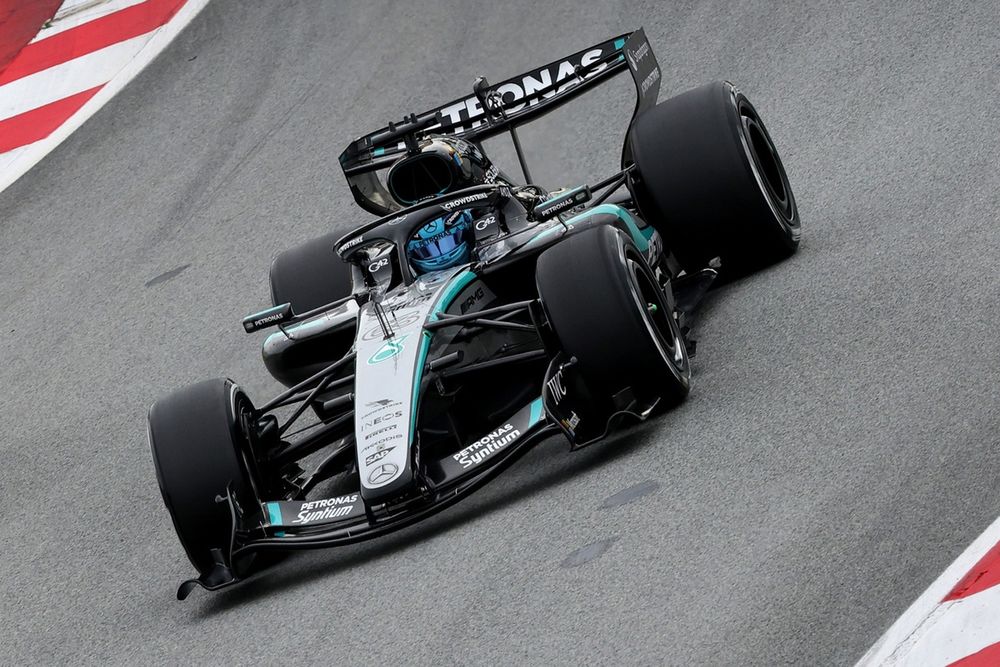
Mercedes impressed during its initial ‘shakedown’ running at Barcelona
Photo by: Mercedes AMG
Some of those points of interest sit on the front wing, particularly around Mercedes’ chosen method of producing its active aero effect. It has opted to tilt only its upper front wing element in ‘straight mode’, leaving the middle element fixed along with the mainplane. Furthermore, it has broken the front wing’s upper element into three pieces, also leaving the central part static during the retraction of the wing.
This is marginally different to the Ferrari’s active aero device, where it actuates both middle and upper elements. The middle element only moves back very slightly, but it’s likely that teams will be able to chop and change this depending on the aero demands of a circuit.
Of further note are the dimensions of the sidepods. Mercedes’ launch renders demonstrated a car with sidepods that swept all the way to the rear, although these have been shortened at the trailing edge to clear the space around the rear suspension components. Many of the teams that have demonstrated their 2026 car have attempted to keep this area clear, aiming to employ the ‘Coke bottle’ area to build more power within the diffuser through expanding on the pressure differential between the top and bottom surfaces.
Mercedes has continued this further forward, by excavating a heavy undercut around the sidepods to shorten the path the airflow needs to take. This exposed section of floor also gives the team more latitude to play with any airflow washing outwards, which is either turned into a vortex by the 90-degree cutout along the floor’s edge, or pushed around the rear tyres by the small cluster of slots and winglets situated on the floor’s rear corner.
What is especially intriguing is the hole in the diffuser, sitting between the centreline of the car and the side of the rear wheel. This is an effort to maximise the power of the diffuser. Given that the sidepod undercut should reduce the quantity of low-energy air here, offering it the chance to move through the diffuser and keep the flow within attached will help to enhance the level of downforce it produces.
Compress to impress? Mercedes’ powertrain prowess
While chassis and aero design together present a significant part of the puzzle, the car itself cannot succeed without a strong powertrain.
It almost goes without saying that Mercedes’ power unit was the class of the field back in 2014. With reliability on its side, it allowed the team to access the higher power modes without putting too much undue strain on the internal architecture. It was even suggested that, since Mercedes had got both pieces of the puzzle right for that season, it could often hold off from turning up the engine to its full potential.
Since there’s a restriction on overall energy usage for 2026, upgraded from the fuel flow regulations to now include the energy input for the electrical components, efficiency is key. Cars are only allowed to expend 3000MJ/hour, and it benefits the powertrain engineers to ensure that every single joule of energy is spent wisely.
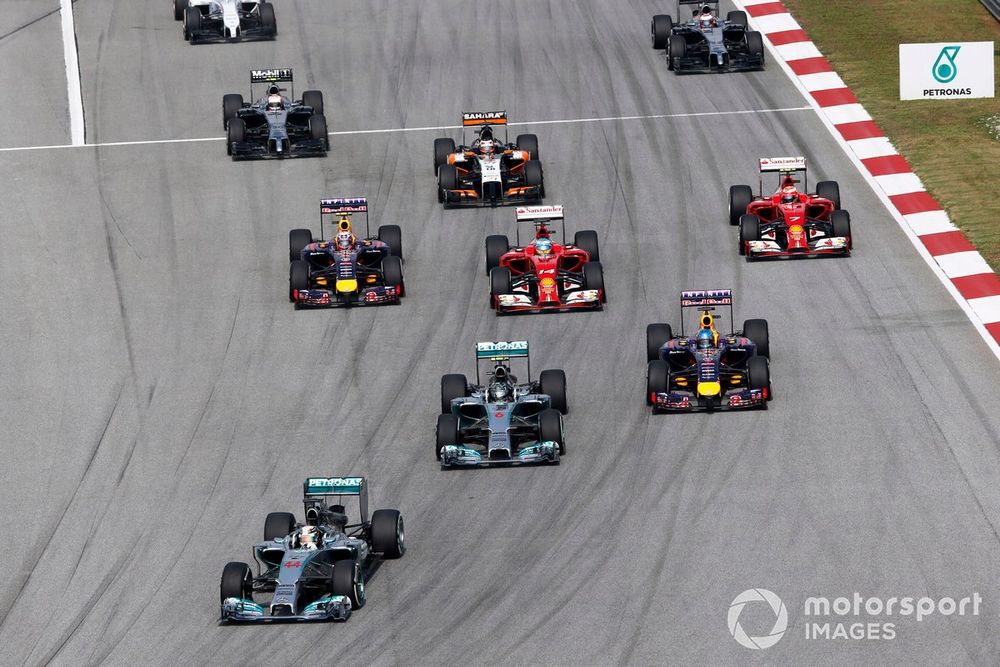
Mercedes was dominant from the off in 2014, its power unit the class of the V6 turbo-hybrid field
Photo by: Charles Coates / Motorsport Images
Mercedes is one of two powertrain manufacturers rumoured to be engaging in the dynamic compression ratio trend, measured at 16:1 at ambient temperatures but tending towards the old upper limit of 18:1 when the engine is running. Enhancing the compression ratio in this way should yield a cleaner burn, thanks to the smaller volume that the same air-fuel mixture occupies.
It’s difficult to prove, since the FIA has only given itself provision to measure the compression ratio at those ambient temperatures; discussions are in place to define a method of monitoring compression while the engine is running. Whether this will indeed implicate Mercedes is another matter entirely, although the FIA will attempt to find a solution before the season begins. Watch this space.
Either way, the powertrain seems to be reliable thus far. McLaren and Alpine have added laps to Mercedes HPP’s latest project, ensuring that the Brixworth contingent should be quietly confident about its efforts.
The man behind the wheel
“Everything went smoothly,” Russell mused after Mercedes’ second day on track, accompanied by the hints of a grin. It’s too early to over-analyse his cheery demeanour, but he knows that 2026 should present his best chance of a title.
To beat a team like Red Bull, McLaren couldn’t just rely on having a quick car. Even if Red Bull was not in command of a race, its potency on the pitwall can often change the dynamic of a lead battle – and McLaren knew it needed to boost its own strategic arsenal
Russell had been hoping for that chance upon joining Mercedes in 2022. After stepping up from Williams to replace the COVID-sidelined Lewis Hamilton at the 2020 Sakhir Grand Prix, the Briton had been oh-so-close to winning his first race with the team before a series of tyre dramas befell him in the final 24 laps – first, Mercedes mixed one of his sets up with that of Valtteri Bottas, forcing another stop, and then another when Russell picked up a puncture. The 2020 Mercedes W11 had been the class of the field; the 2022 W13 was certainly not.
Russell had, to his credit, outscored Hamilton across their 2022-24 seasons together as team-mates. That’s of small significance when the team’s drop in form over the ground effect era has yielded Russell just five grand prix wins, far fewer than perhaps he’d anticipated upon joining the team.
It’s fair to say that his 2025 season was excellent. Now handed the mantle of de facto team leader upon the arrival of Antonelli, Russell stepped up and captured four podium finishes in the opening six GPs.
When opportunities came to punish either McLaren driver (in that phase of the year, usually Lando Norris) for any profligacy in qualifying, Russell took it. He did so too when there were the occasional (read: two) opportunities to win races, adding to his win tally in Montreal and Singapore. If the car’s good, Russell is not of the disposition to waste the opportunity.
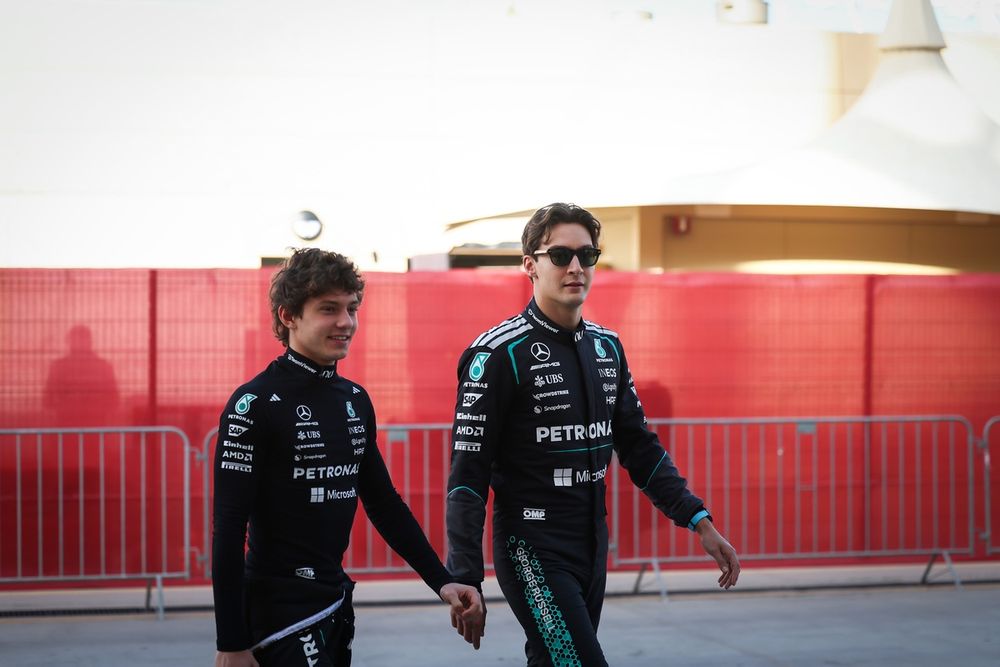
Merc driver line-up is strong; Antonelli’s focus will be on his first win, while for Russell it’s all about the biggest prize
Photo by: Ayman Yaqoob – Anadolu – Getty Images
Antonelli will also be looking to prove a point and, armed with a competitive car, his goal will be to secure his first F1 victory at the very least. Occasional moments of first-lap greediness and qualifying patchiness serve as points for improvement for the Bologna-born teen but, with race engineer Pete Bonnington offering support, he has the perfect foil.
The role of ‘Bono’ as Hamilton’s inner voice of calm through six of his world titles cannot be understated. Having worked with Antonelli for a year now, Bonnington will understand the congenial Italian’s quirks and aim to put more polish on a diamond in the rough.
While 2026 offers many questions regarding the competitive order, the qualities of Mercedes’ driver line-up are not in doubt; it is one of the strongest pairings on the grid.
Can Mercedes remember how to win titles?
When McLaren brought itself into title contention with its considerable progress through 2023 and into the first part of 2024, its approach to race management had been occasionally questionable.
After years in the doldrums, the Woking squad had enjoyed more favourable recent seasons, particularly in the 2019-21 period. Yet there’s a vast difference between heading the midfield pack and fighting for victories on most weekends, especially when against highly tuned competition. To beat a team like Red Bull, McLaren couldn’t just rely on having a quick car. Even if Red Bull was not in command of a race, its potency on the pitwall can often change the dynamic of a lead battle – and McLaren knew it needed to boost its own strategic arsenal.
Mercedes’ own experience of winning titles has been much more recent. Many of the same personnel continue to work at Brackley, which gives it a through-line to its title successes from 2014 to 2021. That race victories have continued to appear, albeit sporadically, through that time suggests there is little rustiness from an operational point of view.
Of course, 2026 offers a completely different approach to racing; beyond pit strategy, drivers have much more to manage with energy consumption, deployment and so on. This is an area that should allow Russell to excel – he has demonstrated over the past few years that his mental bandwidth can be a match for the likes of Verstappen and the cerebral Spaniards Carlos Sainz and Fernando Alonso.
Mercedes’ early vital signs look encouraging, but Bahrain testing should offer a clearer picture beyond the behind-closed-doors Barcelona shakedown. If that picture is truly similar to the state of play in 2014, then Russell will be rubbing his hands with glee – and that hint of a smile early in testing might creak a little wider…
This article is one of many in the monthly Autosport magazine. For more premium content, take a look at the March 2026 issue and subscribe today.
Read Also:
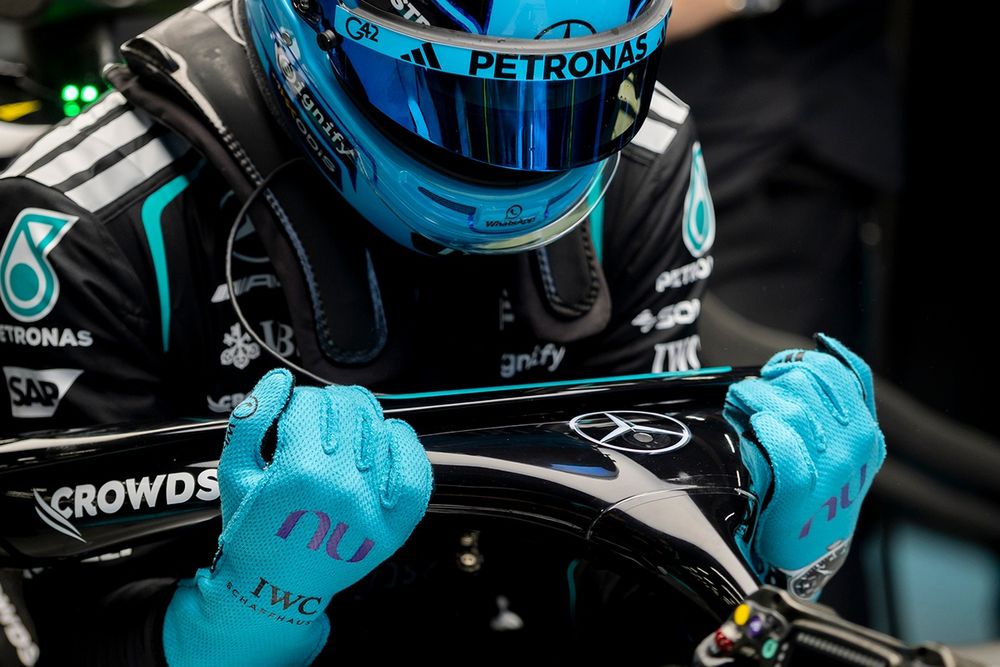
Russell’s mental bandwidth means he should excel in the new generation of F1 cars
Photo by: Mercedes AMG
We want to hear from you!
Let us know what you would like to see from us in the future.
– The Autosport.com Team