
For decades, Dave Scott thought he had done everything right.
At age 69, Scott and his wife — both retired and living in Peterborough, Ont. — are mortgage-free with their home and a family cottage, have converted their savings into retirement income funds and bring in about $5,000 a month.
On paper, their finances look stable.
But it’s the peace of mind, that Scott says has become harder to afford amid rising living costs in Ontario.
“We’re just average people. My wife, she worked for the municipal government and has a good pension, and I worked in private business. But our income in retirement is not keeping up with the cost of living,” he said.
Scott’s unease reflects a broader tension emerging across Ontario, where comfortable retirement remains a top priority even as financial anxiety deepens.
A recent RBC survey found that 66 per cent of Ontarians say their biggest financial goal for 2026 is to “enjoy retirement the way they want” — the highest share in the country. At the same time, polling from Mental Health Research Canada shows 36 per cent of Canadians say the possibility of not being able to pay their bills is negatively affecting their mental health.
For many older Ontarians who spoke with CTV News Toronto this week, the gap between expectation and reality is widening.
 photo illustration A person works on a spreadsheet in a photo illustration made in Toronto, on Monday, Sept. 22, 2025. THE CANADIAN PRESS/Sammy Kogan Feeling ‘stuck in the middle’
Scott and his wife retired a few years ago. Their combined household income was once about $130,000, but they are now living off less in retirement and finding themselves forced to make sacrifices as the cost of everything goes up.
“We’re kind of like a sandwich, stuck in the middle between the wealthy and the ones below the middle class that are suffering and struggling,” Scott said.
Scott said that he knew going in that his retirement income would mean that he wouldn’t be able to “splurge” on expensive trips and other luxuries.
But he said that he has had to make smaller sacrifices as well, particularly at the grocery store.
“We’re not making any exceptions. We’re not buying red meat. There are just some products that are prohibitively expensive, and so we’re trying to stay within a moderate budget,” he said.
Doug Hoyes, a licensed insolvency trustee with Hoyes, Michalos & Associates, agrees that “keeping your expenses as low as possible” should be a priority in retirement.
“Capital preservation is a priority, but keeping your expenses as low as possible is a priority too,” he said.
 A person walks past the TMX Market Centre in Toronto, Wednesday, Sept. 11, 2024. THE CANADIAN PRESS/Paige Taylor White A person walks past the TMX Market Centre in Toronto, Wednesday, Sept. 11, 2024. THE CANADIAN PRESS/Paige Taylor White
Meanwhile, Melissa Allen, founding partner of Capital M Ventures notes a trend of retirees cutting expenses and working longer to manage finances.
“I’m seeing drastic cuts to bills and even luxuries… there are retired folks I know who completely cut out indulgences like a bottle of wine a week, because that extra $30 a month makes a huge difference in terms of their budget.”
For Scott, the stakes are both immediate and generational.
“Obviously, our income in retirement is not keeping up with the cost of living. I’m more concerned about my children and my grandchildren,” he said.
“What is middle class anymore?… We’re kind of stuck in the middle between the wealthy and the ones below the middle class that are suffering and struggling.”
‘You think you’re prepared — but it slaps you’
That squeeze is even more worrisome for Ontarians still working but worried about what comes next.
Carol Johnson, age 56, earns about $70,000 a year and lives in Hamilton, where she bought a three-bedroom home in 2024 after receiving a $20,000 inheritance from her sister. She works as an administrative assistant for the City of Toronto and is the sole income earner after her husband became ill during the pandemic.
“I’m overwhelmed. I’m budgeting to as close to the cup as I can… it’s just a lot. It’s really rough, she said.”
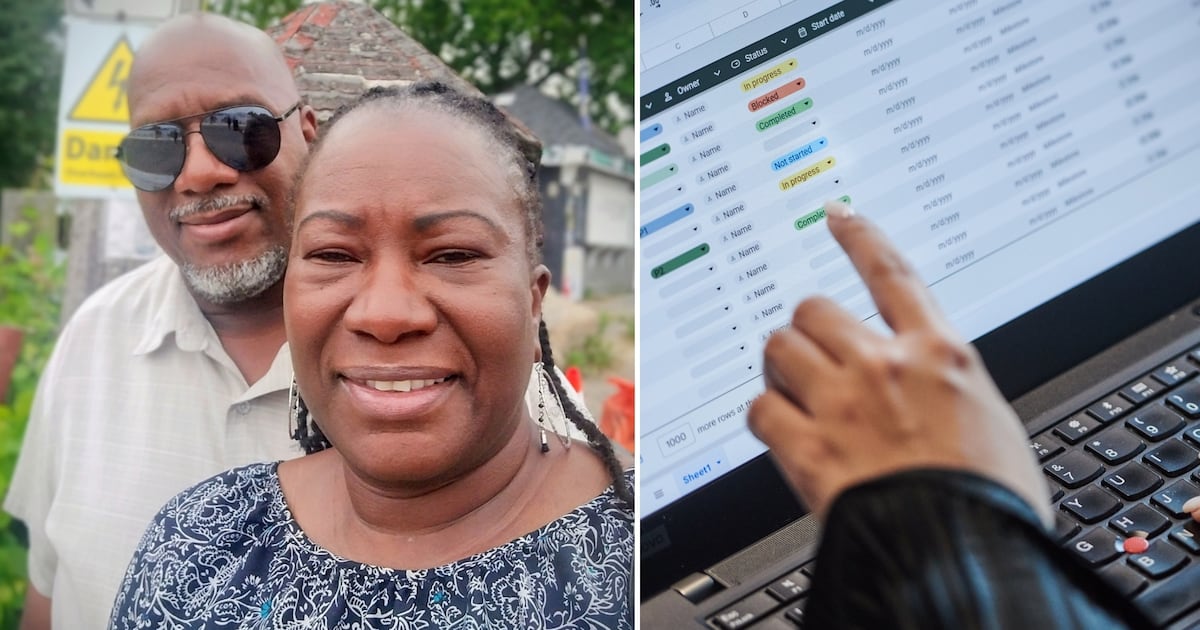
 Carol Johnson Carol Johnson and her husband pictured in a side-by-side composite image (Photo provided by Johnson).
“Moving from a renter to home ownership is crazy. You think you are prepared but it slaps you in the finances and the mental health department more than you bargain for.”
Johnson says the move from Toronto to Hamilton was driven by necessity, not opportunity — a pattern reflected in recent data from Environics Analytics, which shows more than 35,000 households left the Greater Toronto Area over the past year, with Hamilton among the top destinations.
“We have used a lot of credit cards to kind of cover expenses when we were moving. And now it’s hard to get ahead of those debts,” she said.
To cope, Johnson says she has to make sacrifices.
“I’m cutting corners where I can. I bring my own lunch, hunt for sales, buy only what’s necessary and eat less… We’re really looking at food banks,” she said.
Feed Ontario’s most recent Hunger Report found more than one million people used a food bank in the province between April 2024 and March 2025 — an 87 per cent increase since 2019–2020.
“It’s still a struggle,” Johnson said. “It’s a lot, but we have to have some hope.”
An affordability problem, regardless of age
Hoyes, emphasizes that age alone no longer defines what it means to be financially secure.
“The real distinction isn’t old versus young anymore. (It’s) have you benefited from inflation or not?”
Asset owners, he says, generally gained as prices rose — but many others were left behind, especially those approaching retirement while still supporting children and aging parents.
“45 to 55 years old… they’re the most vulnerable, because they are squeezed,” he said.
Hoyes argues that in many cases owning a highly mortgaged home has become a liability and that downsizing or renting can better protect retirement.
“There is not one size fits all for everybody… you should definitely look at the numbers and decide what makes sense in your situation,” he said. “If you could sell your house and put $100,000 in the bank, or half a million, then that really gives you a cushion for the future.”
For Scott, the answer remains simple, even if the future is uncertain.
“For me, it all comes down to peace of mind… protect what you have, ride it out, and reinvest when the climate is better suited.”
—
Editor’s note: CTV News Toronto has been speaking with residents across Ontario to better understand the impact that the rising cost of living is having on their lives. Last week, we spoke to numerous young Ontarians who said they feel like they are unable to get ahead despite having above-average incomes. In part two of this series, we took a closer look at those on the opposite end of the age spectrum.