
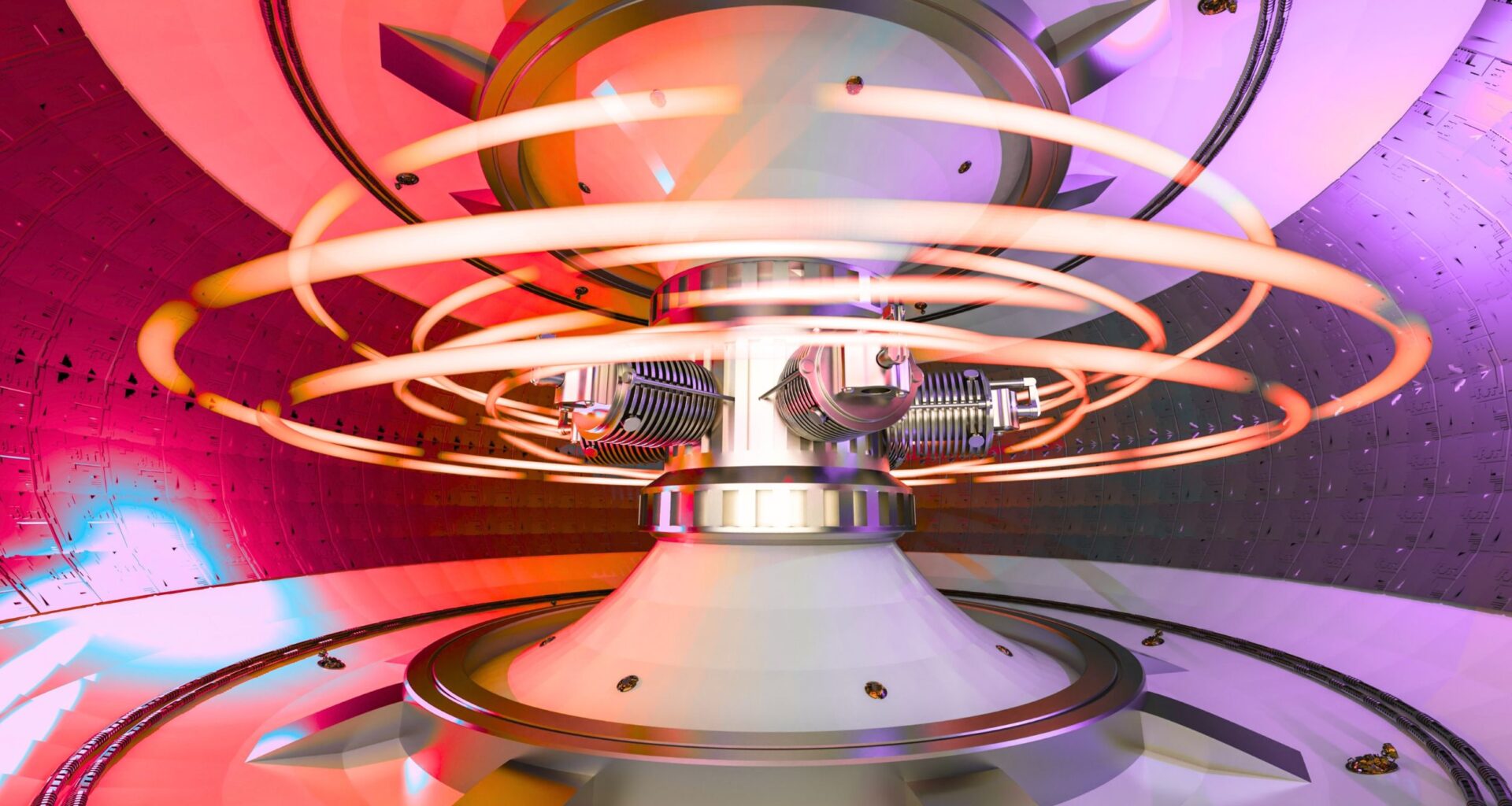
A Chinese fusion experiment has held a hot plasma steady while packing in far more fuel than operators usually risk, breaking through a long-standing density ceiling in tokamak reactors.
The study explains how that barrier was overcome and why pushing plasma to higher densities could move magnetic fusion closer to sustained energy production.
Inside the machine

The paper describes a fully superconducting fusion device in China holding plasma stable while density climbed past old limits.
By steering start-up settings, Prof. Zhu Ping at Huazhong University of Science and Technology (HUST), drove plasma denser without collapse.
Zhu’s team used the Experimental Advanced Superconducting Tokamak, called EAST, to reach 1.3 to 1.65 times the usual limit.
Future reactors could copy that early control, but they still must avoid the sudden disruptions that damage hardware.
Importance of plasma density
Packing more fuel into plasma raises plasma density, the number of particles in a given space. At higher density, ions collide more often, and each collision has another chance to fuse and release energy.
Keeping that fuel hot enough remains hard, so researchers usually trade density against temperature to keep plasmas stable.
When a device holds density without crashing, it buys time for heaters to push toward fusion ignition, self-heating driven by fusion power.
Most magnetic fusion machines are tokamaks, ring-shaped chambers where magnets herd plasma into a loop.
In many tokamaks, pushing density too high cools the edge, and the plasma can abruptly hit the wall and terminate.
Operators often use the Greenwald density limit, a rule of thumb tied to plasma current, as a warning line.
Crossing that line has long forced engineers to accept lower fuel density, which slows progress toward practical fusion power.
Walls that matter
A newer idea blames the density ceiling on plasma-wall interactions, contact that strips atoms from the chamber surface.
When walls release those atoms, the plasma can radiate energy away as light, which makes it harder to stay hot.
French researchers proposed an idea called plasma-wall self-organization, or PWSO, to explain how the plasma and the machine’s inner walls influence each other.
Under this view, adjusting the wall conditions early can guide the plasma into a state where the usual density ceiling no longer limits how much fuel it can hold.
A start-up trick
Instead of waiting until the plasma was established, the EAST team focused on the fragile start-up phase.
They added electron cyclotron resonance heating (ECRH), microwaves that heat electrons quickly, and kept it on during start-up.
High initial gas pressure also mattered, because extra neutral fuel at the beginning shaped plasma-wall contact before temperatures soared.
Starting with that mix let the discharge climb to higher density later, without needing emergency fixes after trouble began.
Cleaner plasma, higher density
ECRH and extra gas changed the wall response, cutting down the impurities that usually build up as density rises.
Less wall material entered the plasma, so less energy escaped as radiation, and the core stayed hotter for longer.
Near the divertor, the part of the reactor that handles excess heat, temperatures dropped and the high-density state remained stable.
That cooler edge reduced stress on the machine’s inner surfaces, but only as long as operators kept the plasma carefully controlled.
Tungsten changes behavior
EAST uses tungsten surfaces, and the plasma reacts differently to this heavy metal when it strikes the wall.
When energetic particles hit tungsten, they can knock tiny amounts of metal into the plasma, changing how clean and stable it remains.
The condition of the walls also mattered, since identical settings sometimes led to different results after earlier runs had altered the surface.
That sensitivity suggests operators will need careful and consistent wall preparation before other machines can reliably reproduce the same outcome.
Scaling to future reactors
Reaching higher density by carefully controlling the start-up phase could translate to other reactors, since every tokamak must pass through that same fragile beginning.
In a burning plasma, where fusion reactions provide most of the heating, higher density can increase energy output without demanding extreme temperature gains.
Instead of adding pellets or other materials to boost fuel, this method focused on managing wall conditions and using ECRH during start-up.
If other reactors achieve the same stable high-density state, designers may be able to move closer to ignition while maintaining strong plasma confinement.
Plasma density and fusion’s future
Testing the idea in high-confinement operation on EAST will show whether density-free behavior survives when the plasma stores more energy.
Higher energy makes disruptions harsher, so the team will need precise control of gas, ECRH power, and wall conditions.
A short article described HUST scientists aiming to extend the density-free approach to next-generation devices.
“The findings suggest a practical and scalable pathway for extending density limits in tokamaks and next-generation burning plasma fusion devices,” said Zhu.
By reshaping start-up and wall behavior, the EAST results show a credible way to raise density without triggering the usual crash.
Proving the method in tougher operating modes would set clearer design targets, but it will still need careful control and repetition.
The study is published in Science Advances.
—–
Like what you read? Subscribe to our newsletter for engaging articles, exclusive content, and the latest updates.
Check us out on EarthSnap, a free app brought to you by Eric Ralls and Earth.com.
—–