
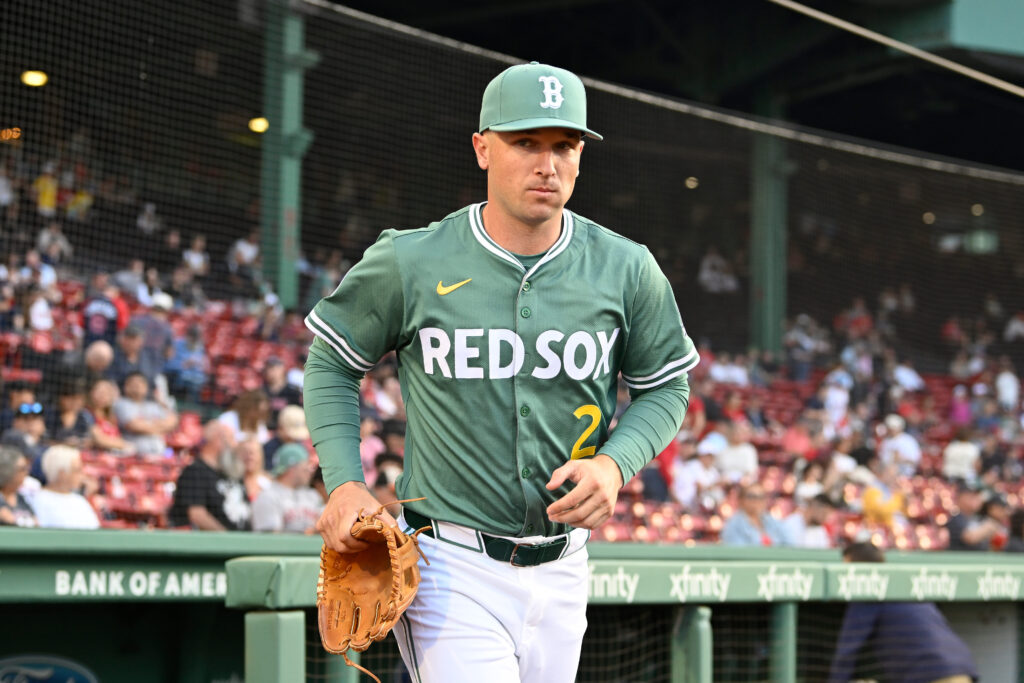
Red Sox president/CEO Sam Kennedy spoke with reporters (including the Boston Globe’s Tim Healey and MassLive.com’s Christopher Smith) today at the team’s Spring Training camp, while Sox chairman Tom Werner also took part in an interview with the Boston Globe’s Peter Abraham. The two executives covered many of the same topics, with much of the focus naturally centered around Boston’s offseason.
One of the matters discussed was Alex Bregman’s decision to leave Fenway Park and sign with the Cubs for a five-year, $175MM contract. Reports indicated that the Sox offered Bregman a five-year, $165MM contract that (like Chicago’s offer) included a lot of deferred money, though Boston’s deferral plan covered multiple decades. The bigger issue seemed to be Bregman’s insistence on a full no-trade clause, which the Cubs were willing to give but Boston wasn’t, apparently due to an organizational policy.
Werner and Kennedy each pushed back on these reports, with Werner flatly saying that the Red Sox “don’t” have any policy against no-trade protection. Kennedy was more circumspect in saying that “we try not to talk about organizational policies and the finer points of negotiations because it just doesn’t serve you well if you do that,” but also said that “if Alex Bregman wanted to be here, ultimately he’d be here.” Kennedy also essentially ducked the question of whether or not the Red Sox would’ve offered Bregman a no-trade clause if asked, saying “it’s theoretical. It’s hard to know.”
More than the no-trade clause or “the fact that he was offered a bit more money in Chicago,” Werner felt Bregman was “happy to be in Arizona [for Spring Training] where his family is. I have enormous respect for Alex, but it wasn’t meant to be and we moved on.” Likewise, Kennedy praised Bregman’s contributions over his one season in Boston, and said “he chose a different path, and we wish him well.”
These statements probably won’t do much to soothe Red Sox fans still upset that Bregman is playing elsewhere, after the third baseman’s leadership and on-field production (at least prior to a right quad strain) was so widely acknowledged as a key factor in Boston’s return to the postseason. Signing Bregman last winter to take over at third base also sparked the chain reaction of events that led to Rafael Devers being traded to the Giants last June, following a lot of hard feelings from Devers over first being pushed off the hot corner into a DH role, and then being asked to learn first base once Tristan Casas went down with what ended up being a season-ending knee injury.
Kennedy expressed regrets over how the Devers situation played out, saying better communication was needed between both sides, and that “Would we have done things differently leading into it? Absolutely.” Werner’s statement (his public comments since Devers was dealt) may again spark more controversy, as while Werner said that Devers is “a wonderful person,” the chairman found it “extremely discouraging” that Devers wasn’t willing to take over at first base.
“It was a discouraging episode. Just pick up a glove,” Werner said.
While the Devers trade and Bregman’s departure may be talking points in Boston for years to come, the Red Sox are more concerned with how the team will fare in 2026. Trades (for the likes of Willson Contreras, Sonny Gray, Johan Oviedo, and Caleb Durbin) have been a big part of the team’s roster remodel, and the Sox made a big free agent strike by signing Ranger Suarez to a five-year, $130MM contract.
Kennedy described the winter as “a successful offseason…long, arduous, lots of scenario planning, but excited that we improved the club in many ways.” Werner was similarly positive, pointing to the team’s improvements on defense and a pitching staff that “I think…is elite.” In regards to further upgrades at the trade deadline, Werner said the team is still open to more spending, saying “we actually have the powder to execute some more moves during the season.”
After completing the 2025 season with a roughly a $208.9MM payroll and a $246.5MM luxury tax number, the Red Sox are projected (via RosterResource) for $195.5MM in payroll and a $263.7MM tax figure. The latter puts the Sox just a hair under the second luxury tax penalty threshold of $264MM, so it would seem like Boston will probably finish in the second tier of tax penalization for the first time since the 2019 season, assuming the team indeed contends and bolsters the roster throughout the year.