
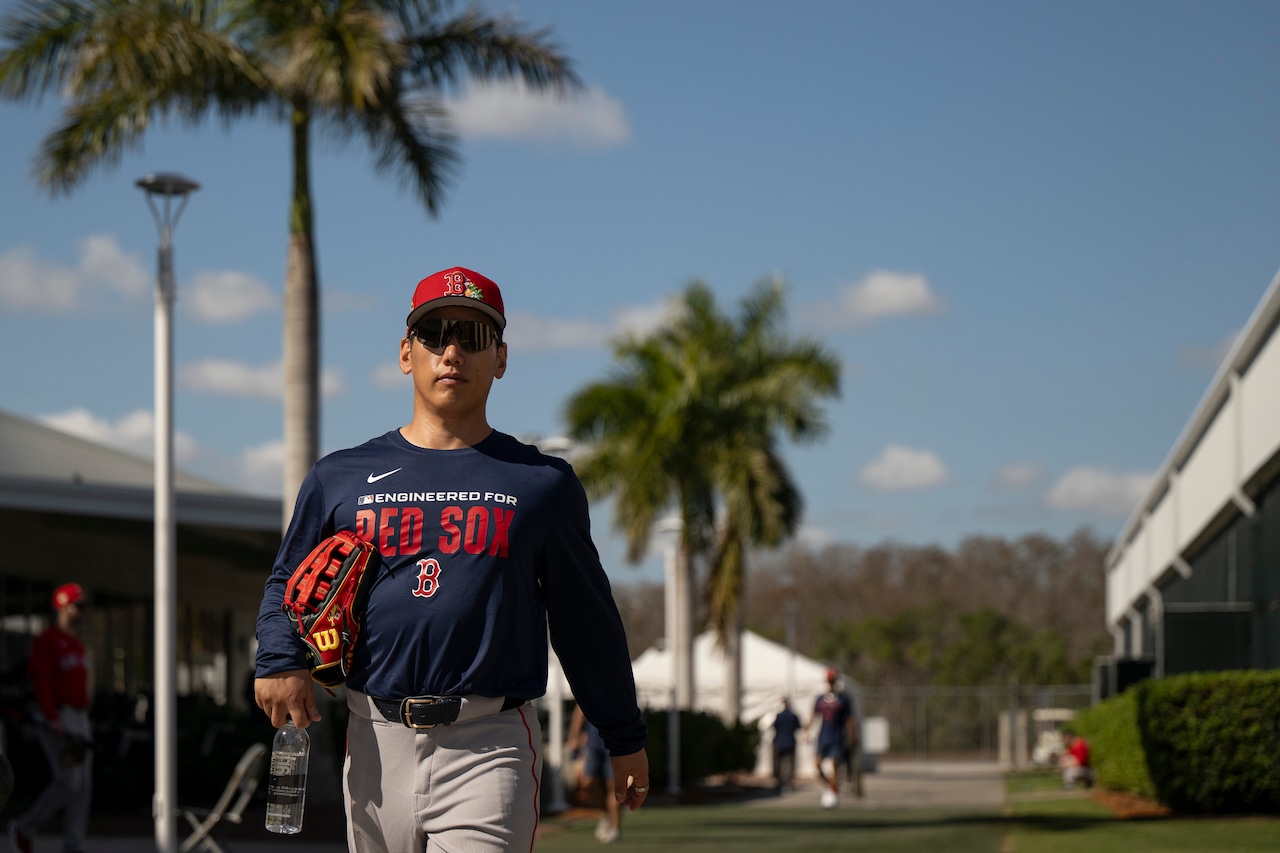
FORT MYERS, Fla. — On Thursday, Red Sox manager Alex Cora described Masataka Yoshida as “part of the solution” when it came to Boston’s crowded outfield and designated hitter mix. But how?
Yoshida, now in the fourth season of the five-year, $90 million contract he signed in December 2022, once again arrived in camp with uncertainty about where he fits on Boston’s roster. The Red Sox already have four starting-caliber outfielders — Wilyer Abreu, Roman Anthony, Jarren Duran and Ceddanne Rafaela — and plan to rotate them through the DH spot. That Triston Casas will likely push for DH at-bats when he returns (Willson Contreras is entrenched at first base) further complicates matters. So does the fact Yoshida, like Abreu, Anthony, Duran and Casas, is a left-handed hitter and therefore redundant in the current mix.
For now, the Red Sox seem content to keep kicking the can down the road when it comes to Yoshida. Boston, while still appearing reluctant to trade someone like Duran or Abreu to clear the logjam, is just a single outfield injury away from the DH spot opening up for Yoshida. At this point, with Opening Day more than five weeks away, the most common refrain from Red Sox officials, including Cora, is a simple one: “These things have a way of sorting themselves out.”
In the eyes of key Red Sox people, it doesn’t make much sense to speculate about a potential role for Yoshida when the deadline for a decision is still weeks away. Still, the awkwardness of his situation pervades. This week, one Red Sox executive conceded that it remains to be determined — and is far from a lock — that if all four of the other outfielders are healthy, Yoshida would be on the Opening Day roster. As things stands, he finds himself in something resembling Red Sox purgatory.
“To be honest with you guys, these three years (weren’t) what I expected,” Yoshida conceded Saturday through translator Yutaro Yamaguchi. “Let’s leave it at that.”
For the next five weeks, the Red Sox have enviable outfield depth that guards against an injury to one of their main contributors (a fact that could be particularly helpful with every outfield candidate, including Yoshida, slated to play in the World Baseball Classic). Yoshida would likely take over in the DH spot in that scenario. If the Red Sox go into the season with all five outfielders healthy, their options would seem to be limited when it comes to Yoshida, who is due to make $18 million in 2026. Unlike a year ago, the club can’t slow-play an injured list stint to make things work. If the Sox don’t choose to carry Yoshida as a bench bat for late-game opportunities against righties (a hard ask on a roster with Connor Wong, Isiah Kiner-Falefa and Romy Gonzalez — if healthy — entrenched in bench spots), a move would need to be made.
Yoshida, as per terms of his contract, would have to consent to being optioned to the minors. It’s unclear if he’d accept. The Red Sox could try to designate him for assignment or outright release him, though that is obviously not a preferred option. Therefore, Yoshida finds himself facing the same question he has in multiple recent springs. Is a trade the best path forward?
“It’s hard to say,” Yoshida said Saturday. “That’s not what I’m thinking right now. All I’m thinking right now is just to perform, play well and play hard.
“That’s something I didn’t really experience back in Japan. Trades don’t really happen as often as here. It’s something new, but to trade somebody, both parties have to agree, right? It’s gonna be tough. It’s part of the business but I just want to say it’s something that has been new to me after I got here.”
According to sources with knowledge of the Red Sox’ thinking, there has been tangible trade interest in Yoshida throughout the winter, with teams recognizing his offensive upside (and the opportunity cost) in discussing him with Boston. Still, considering Yoshida’s limits in 2025 (he got just 205 regular season plate appearances after returning from the injured list) coming off labrum surgery, the Sox might have to wait to make a move. Two sources cautioned that teams who might want to deal for Yoshida likely want to see how he does in spring training games before increasing their aggressiveness.
It’s unclear what the Red Sox could get back in such a deal, which would be a salary dump similar to the January trade that sent Jordan Hicks and pitching prospect David Sandlin to the White Sox. The Red Sox did not have a path to attach some of Yoshida’s deal to Sandlin in talks with Chicago, sources said, because he was not a fit for the White Sox’ roster. Over the weekend, a rival evaluator painted a less-than-rosy picture of Yoshida’s trade value.
“It’s pretty low across the industry,” the evaluator opined. “A lot of teams are really down on the defense and power being below average. Boston would have to pay a very large chunk of salary or part with a top-five prospect to get teams interested.”
The reverent Yoshida has not publicly commented about whether or not he’d prefer a change of scenery to this point, though it’s clear his path to a bigger contribution would be clearer elsewhere. In 303 major league games over his first three seasons, Yoshida has had some good moments in a Red Sox uniform while also enjoying the adjustment to American life. His sightseeing trips have been well-documented on Instagram.
“It’s a new culture, a lot of new stuff that we’ve found as a family,” Yoshida said. “Family’s happy. Each and every day, we find something new. It’s a challenge, but we’ve adapted.”
Despite the fact that other, young players like Anthony and Duran have emerged and taken chances away from Yoshida, the Red Sox don’t view the 32-year-old Fukui native as devoid of value. They know he won’t provide much in terms of baserunning or defense — Cora labeled him “below-average” late last week — but know that his offensive profile can help a team. Boston was reminded of that late last season, when Yoshida hit .351 with two homers, five doubles and an .837 OPS in 20 September games, then hit cleanup for them in the winner-take-all Game 3 of the Wild Card Series at Yankee Stadium.
“Quality hitter,” Cora said. “Man at third, less than two outs, he cashed in 13 times. We didn’t do that as a team. When he’s healthy, he’s one of the best hitters we have. He was healthy in August and September and he proved everybody the type of hitter we envisioned when we signed.”
Yoshida’s OPS+ — which sits at 109 over the last three seasons — suggests he’s an above-average major league hitter, albeit not one who is worth his inflated salary. The Red Sox might find another club that believes more runway will lead to improved numbers. For now, though, it’s status quo for Yoshida in an uncertain start to Year 4.
“I think it just comes down to getting myself ready for Opening Day,” he said. “That’s what really matters.”