

Listen to this article
Estimated 5 minutes
The audio version of this article is generated by AI-based technology. Mispronunciations can occur. We are working with our partners to continually review and improve the results.
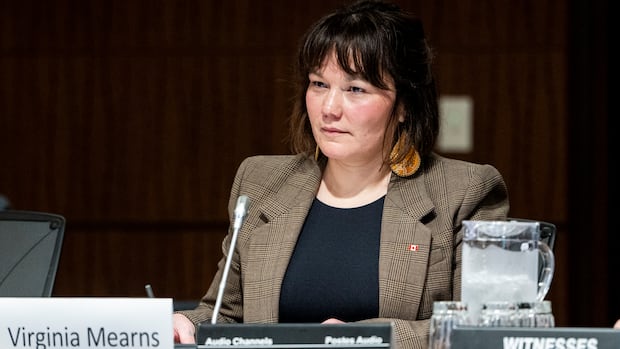
Virginia Mearns probably did not expect to be thrust into the centre of a major geopolitical incident when she started as Canada’s Arctic ambassador last July.
But Mearns was front and centre last week when Canada opened its new consulate in Nuuk, Greenland, in the aftermath of U.S. President Donald Trump’s threats to annex the self-governing Danish territory.
Mearns’s agenda will likely only get busier as Canada seeks to beef up both its military and diplomatic presence in the Arctic amid another global surge in interest in the region.
She spoke with CBC Nunavut’s Carl Cardinal.
This interview has been edited for length and clarity.
How has it been so far, being appointed and taking on such an important role for the Arctic?
It’s definitely been an incredibly humbling experience to be appointed into such a role. This is something that I think we all recognize as significant in being able to bring positive attention to the Canadian Arctic and also create opportunities to strengthen relations between our Arctic region and the rest of Canada, and internationally as well.
What are your priorities as the new Arctic ambassador?
One focal point that I’m hoping to be able to achieve is strengthening the voice of our northern Arctic community members, especially at the international level, to be able to give a real-time perspective as to the realities that exist in our communities, but also echoing the voices that have already been doing a lot of really important work from our communities, for our communities, and to ensure that, where possible, we can shine a light on the achievements of our Indigenous and Inuit communities.
Speaking of that, the new consulate in Nuuk opened last week. How did you find that support coming from Inuit organizations, together with you and Minister of Foreign Affairs [Anita Anand] together?
It was an incredibly special gesture on the part of Inuit leadership from Canada to demonstrate solidarity with Inuit in Greenland, but also I think it brought to the surface how close our ties actually are between Canada and Greenland. I was able to see a lot of Inuit from Canada reconnect with friends and family in Nuuk that have longstanding relationships, whether they’re professional or personal or both.
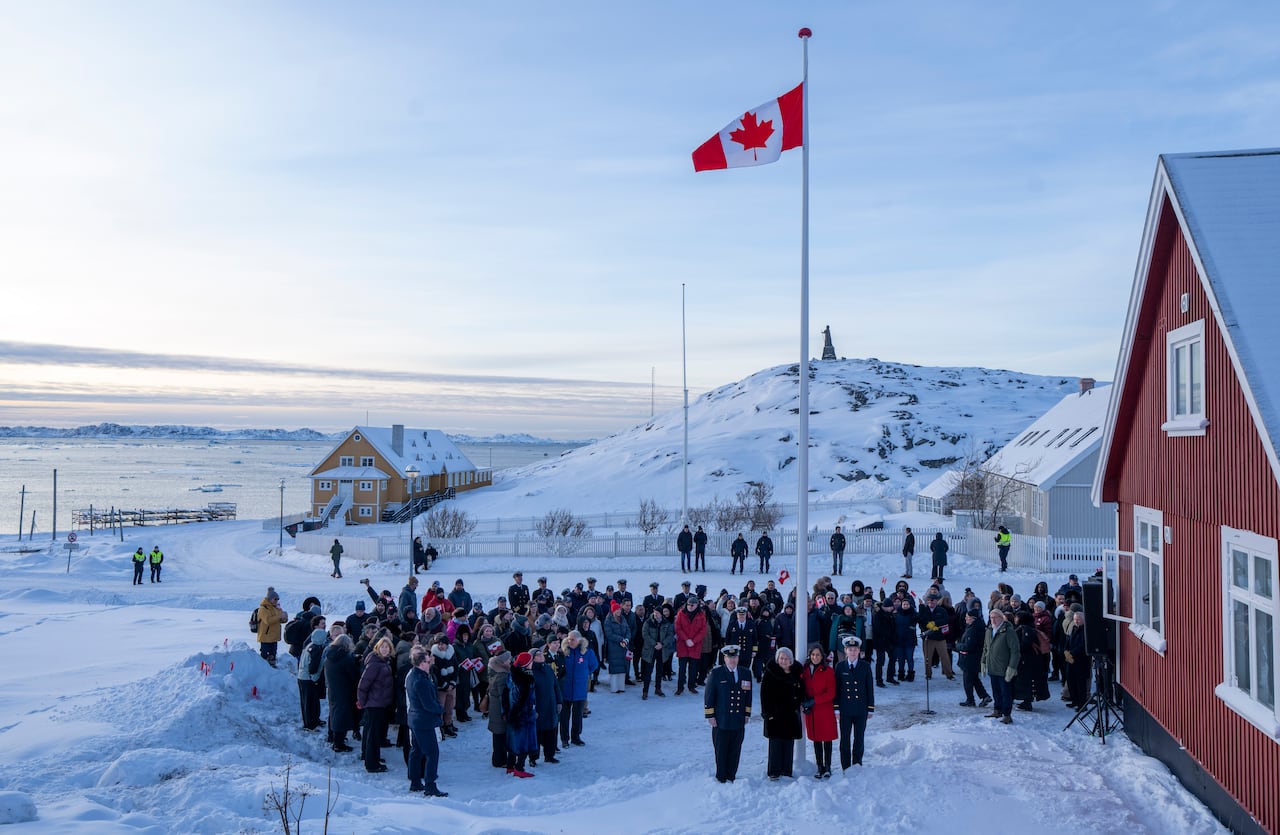 Governor General Mary Simon, second from front left, and Foreign Affairs Minister Anita Anand, second from front right, pose for photos following the raising of the Canadian flag at the new Canadian consulate in Nuuk, Greenland Feb. 6. (Christinne Muschi/The Canadian Press)
But I think for the moment in time, it was such a strong, powerful message that Inuit from Canada could convey that they stand with Greenland and that they are there to support each other. And so it was such a lovely way to add to the official opening of our consulate in Nuuk.
Do you feel that Inuit now have a special place within the federal government?
There’s definitely been decades of work that Inuit leadership have carried out to strengthen the relationship with the Government of Canada. And I think that has been showing up through the work that’s carried out through the Inuit-Crown partnership committee. That committee has created a structure in which Inuit and the Government of Canada can focus on agreed-to priorities, such as the Arctic foreign policy, where ultimately the commitment to open the consulate in Nuuk was brought to surface.
And of course, we were able to fulfill this last week in Nuuk, which is incredible. This is a testament to the dedication of Inuit leadership throughout the years. And it is an example of the strengthening relationships between the Government of Canada and the Canadian Arctic.
As an Inuk woman, does it bring back painful memories of colonialism, seeing that the U.S. was threatening the sovereignty of Greenland?
It definitely has been concerning. And I feel that for Inuit communities, whether they’re in Canada or in Greenland, the impacts of colonialism definitely came to the surface. And recognizing that this type of rhetoric does bring a lot of concern and anxiety for communities that are impacted.
And for our northern communities, especially those in Nunavut, it definitely has brought this to the surface and very close to our homes. We’re not accustomed to it. The Arctic region has predominantly been an area of peace and collaboration.
So I think as we continue to work through reconciliation for the impacts of colonialism here in Canada and on our Indigenous communities, there’s still a lot of work. But we are making progress.
What are some future projects that are on the go for you?
There are definitely a lot of priorities that we’ve committed to implementing through the Arctic foreign policy. And so ongoing engagement and dialogue around Arctic security and sovereignty is most definitely going to be an area that we focus on.
Other areas include science and research, and Indigenous knowledge in research for the Arctic region is going to continue to be a priority of our office. And also, I think more on the horizon, is the finalization of the mandate for my office. This is being formed by the engagements that I was able to carry out between September and December with northern and Arctic partners.
Ultimately, we’re aiming for the spring to be able to release that.