
MILAN — We expected fireworks here in Milan as NHL players appear at the Winter Olympics for the first time in 12 years, ushering in the long-awaited return of best-on-best hockey. And we got a taste of that Sunday, when Tom Wilson recorded what is likely the first Gordie Howe hat trick in Games history — a goal, an assist and a scrap — in Canada’s rout of France.
It happens. It’s hockey.
What we did not expect was for the you-know-what to hit the fan roughly 400 kilometres north in Cortina d’Ampezzo, the picturesque mountain town hosting curling, Yet here we are. Canada now finds itself at the centre of a genuinely heated rivalry, with opponents accusing our champion rock-throwers of — gasp! — cheating.
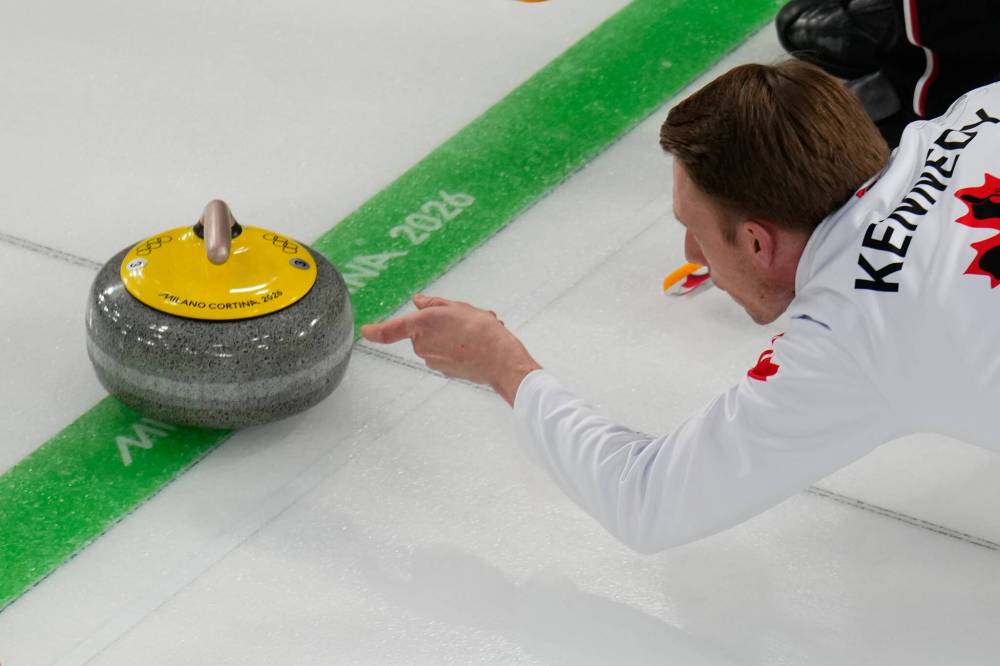
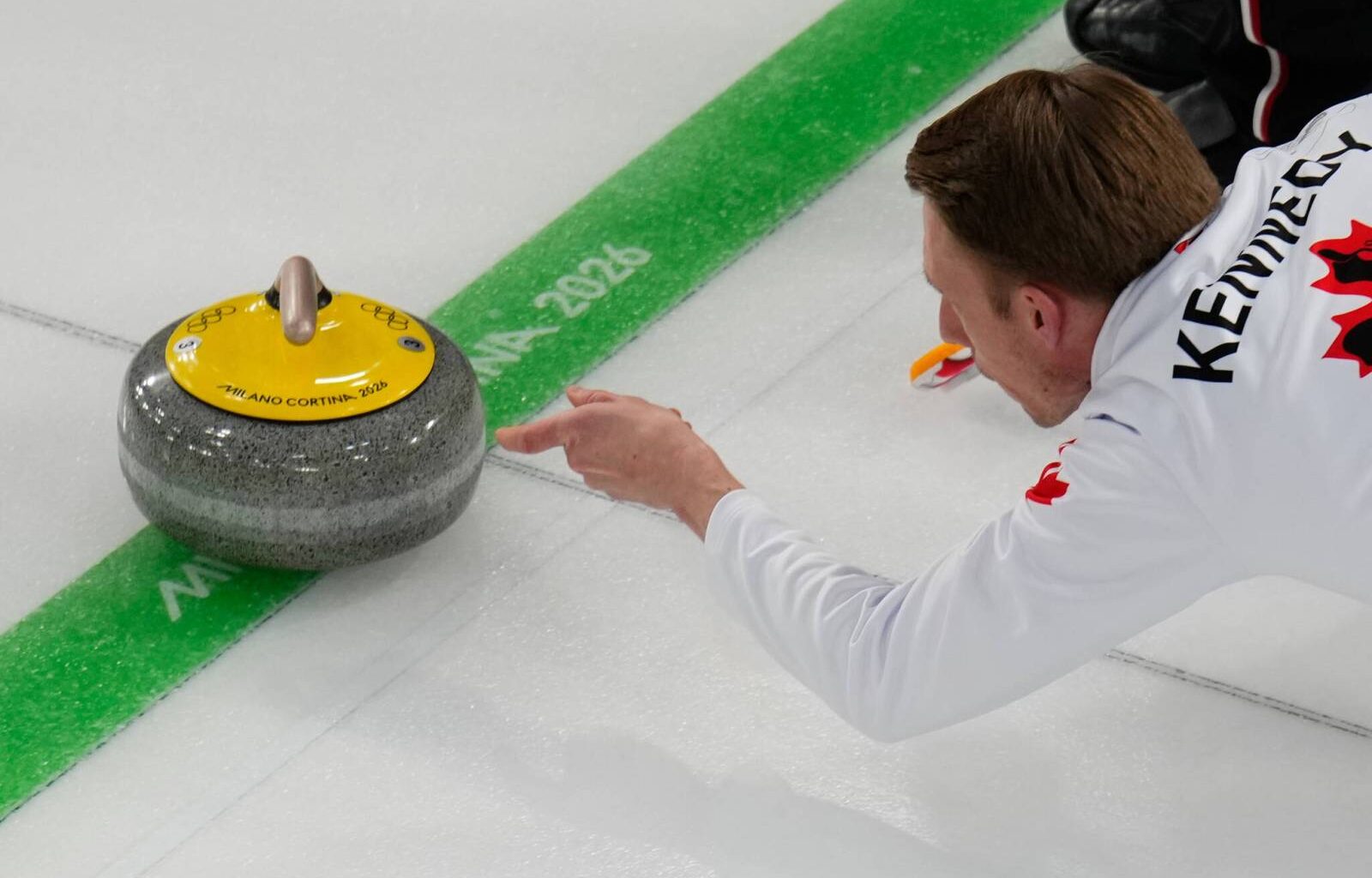
Canada’s Marc Kennedy delivers the stone during a men’s curling round robin match against China at the 2026 Winter Olympics, in Cortina d’Ampezzo, Italy, on Sunday. (David J. Phillip / The Associated Press)
What in the name of Vic Rauter is going on up there? The bizarre conflict has become the talk of the Olympics, putting curling under a blazing global spotlight.
Tensions first flared Friday when Sweden’s Oskar Eriksson accused Marc Kennedy, third for Brad Jacobs’s team, of touching his stone a second time after release — a strict no-no in the roaring game.
Kennedy erupted at the accusation in a colourful exchange that quickly went viral. You may want to hide the children.
Eriksson: “You’re touching the rock.”
Kennedy: “Who is doing it?”
Eriksson: “It has been a couple.”
Kennedy: “I haven’t done it once. You can f—k off.”
Well, that escalated quickly.
“I don’t like being accused of cheating after 25 years on tour and four Olympic Games,” Kennedy told reporters. “He’s still accusing us of cheating, and I didn’t like it. So I told him where to stick it, because we’re the wrong team to do that to. So I don’t care. He might have been upset that he was losing.”
Sweden claimed to have video evidence of the alleged misconduct, apparently the result of their own television broadcaster coincidentally — or was it deliberately? — setting up a camera at the perfect angle which, in fact, showed what appears to be a double touch by Kennedy.
Canada claimed the fix was in.
“They’ve come up with a plan to catch teams in the act,” Kennedy said, while acknowledging he “probably could have handled it better.”
“If I apologize at all, it’s to the young curler around the country that would have expected more for me in that moment.”
Kennedy was issued a verbal warning by World Curling to keep his emotions in check — or else.
“Improper conduct, foul or offensive language, equipment abuse, or wilful damage on the part of any team member is prohibited,” said the governing body. “Any violation may result in suspension of the offending person(s) by the curling organization having jurisdiction.”
The tension spilled over into Saturday, this time with Switzerland accusing Canada of the very same thing. The only difference? No naughty words were exchanged, but the Jacobs team did suffer its first loss of the Olympics in the process.
All of this led to World Curling abruptly stepping up enforcement of the hack and the hog line, something which typically isn’t done, in the form of two umpires who would roam between the four matches going on at a time.
And, just a few hours later, they had their first alleged scofflaw — Canadian Rachel Homan.
“Like, absolutely not. Zero per cent chance,” the world’s No. 1 ranked skip pleaded to no avail. “I’ve never done that in my life.”
However, video of the match seemed to suggest a second grazing touch and her rock was removed in a game against Switzerland, which Homan’s crew ultimately lost to fall to 1-3 and on the brink of elimination.
“It’s frustrating, the officials getting into the game that they have no business getting into,” she later told broadcaster CBC, suggesting the cloud over the Canadian men had now made its way to her crew.
With this sudden scandal making headlines around the world, curling’s governing body tried to bring the temperature down a few degrees by issuing a statement reminding everyone of rule R5(d).
“During forward motion, touching the granite of the stone is not allowed. This will result in the stone being removed from play. The curling stone must be delivered using the handle of the stone.”
Like so much these days, people quickly picked sides as the debate raged on. Many with a stake in the matter have suggested it’s all been blown out of proportion — a molehill turned into a mountain, so to speak.
“Let me take a moment to set the record straight. Marc Kennedy is hands down one of the most honest and fair teammates I’ve ever played with. Fierce competitor? Absolutely. Cheater? Not a chance,” retired Canadian curler John Morris, a two-time Olympic gold medalist (in 2010 as a member of Kevin Martin’s rink with Kenny, and again in 2018) wrote on X.
“The reality is, no curling official at these Olympics has ever been asked to make this call in a competition before, and expecting them to do so under such intense pressure is a tough ask — especially when the outcome of the shot is almost certainly unaffected.”
Morris said there’s nothing nefarious about a double-touch and it is likely something “incredibly subtle and likely something he’s been doing for years without even realizing it.”
The story took another twist Sunday evening, when the federation announced it was removing the umpires just 24 hours after they were deployed. The caveat? Teams can still request their presence. The federation cited a meeting with all competing National Olympic Committees to update their existing policy.
All of this has fuelled an “us against the world” mindset among Canadian curlers, who were already struggling at these Olympics.
The mixed doubles team of Jocelyn Peterman and Brett Gallant, who arrived in Italy as legitimate medal favourites, crashed out before the playoff round. Homan’s team, ranked No. 1 in the world, has now dropped three straight games and has little margin for error if they hope to reach the podium.
Winnipeg Free Press | Newsletter
The Warm-Up
Winnipeg Jets Game Days
On Winnipeg Jets game days, hockey writers Mike McIntyre and Ken Wiebe send news, notes and quotes from the morning skate, as well as injury updates and lineup decisions. Arrives a few hours prior to puck drop.

Jacobs’ team, now carrying the weight of this controversy, may be Canada’s only hope with a 4-1 record so far.
One potential solution is video review, as used in nearly every other sport, to remove doubt or confusion. But curlers remain divided on the issue, with many preferring to preserve the self-policing element that has long defined their sport’s good sportsmanship.
Well… until now, anyway.
Just like in hockey, curlers might want to keep their heads on a swivel. It’s starting to get a little rough out there.
www.winnipegfreepress.com/mikemcintyre

Mike McIntyre is a sports reporter whose primary role is covering the Winnipeg Jets. After graduating from the Creative Communications program at Red River College in 1995, he spent two years gaining experience at the Winnipeg Sun before joining the Free Press in 1997, where he served on the crime and justice beat until 2016. Read more about Mike.
Every piece of reporting Mike produces is reviewed by an editing team before it is posted online or published in print — part of the Free Press‘s tradition, since 1872, of producing reliable independent journalism. Read more about Free Press’s history and mandate, and learn how our newsroom operates.
Our newsroom depends on a growing audience of readers to power our journalism. If you are not a paid reader, please consider becoming a subscriber.
Our newsroom depends on its audience of readers to power our journalism. Thank you for your support.