
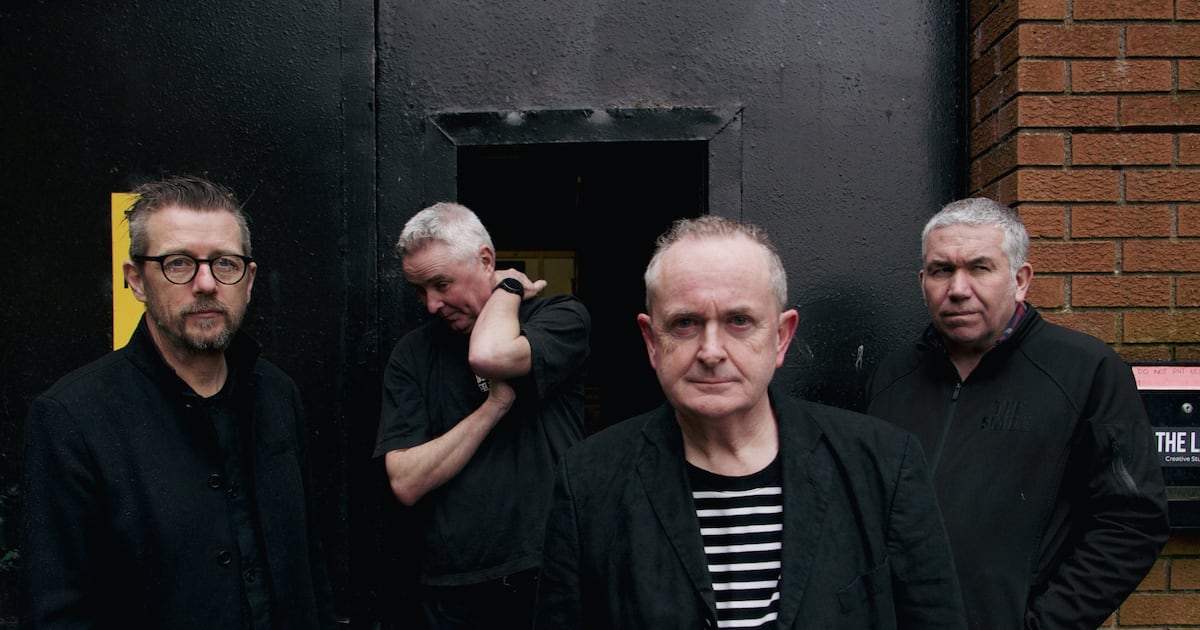
When Cypress, Mine! began to record their debut album, in the summer of 1988, Ciarán Ó Tuama was overshadowed by his past in more ways than one.
The Cork indie band were installed at Elmtree Studios, near the cricket grounds on the southside of the city. High above this leafy panorama loomed the old psychiatric hospital of St Anne’s, a Gothic revival monstrosity that glowered over the city skyline and held particular significance for the singer.
“I grew up next to the mental hospital in Cork, on the Lee Road. I would see a lot of the day patients coming in and out. I met them because I actually used to take photographs,” says Ó Tuama, who today works as a graphic designer in Dublin.
“There were two fields separating us. I was able to walk into it and walk out of it. I met the nurses and the patients. It was very sad to see what was happening there, obviously. A full investigation probably will happen into the way people were treated and admitted.
“I’ve heard a lot of stories of farmers – the idea that one of the sons wanted a chunk of the farm, and the other son fought it, so they got their local doctor to sign them into an institution, and therefore got the person out of the picture.”
Cypress, Mine! didn’t explicitly talk about St Anne’s and the abuses that may or may not have occurred there on that first LP, Exit Trashtown (although it includes several songs about mental illness). But the prominence of that grim landmark in Ó Tuama’s childhood explains the strain of anguish that ripples through the band’s extraordinary debut – and likewise crackles through the group’s equally accomplished comeback record, Pulling All the Clouds Apart, which they are about to release, nearly 40 years after their first album.
There have been many comebacks in Irish music in recent years, from the reinvigorated shoegaze figureheads My Bloody Valentine to bands such as Emperor of Ice Cream, who decided to re-form to finish their debut album after being profiled by the Irish Examiner.
‘That was not the meaning. It was meant to annoy people, to let them ask the question, “Is that what they were really saying about our lovely Cork?” It wasn’t that’
— Ciarán Ó Tuama on the title of Cypress, Mine!’s first LP, Exit Trashtown
But while nostalgia is unavoidable in such scenarios, Cypress, Mine! see their return as being all about the present moment. That wish to keep moving forward rather than dwell in the past is the driving force behind brilliantly vulnerable new songs such as Spellbinding – think The Go-Betweens framed by the moody Cork drizzle – and Safe Highway, which suggests a melancholic Celtic REM.
For Ó Tuama, the catalyst for putting the band back together was the death of his mother. “Ten years ago or so, when my mother died, Mark [Healy], the original drummer, asked me am I free to do anything musically,” Ó Tuama says.
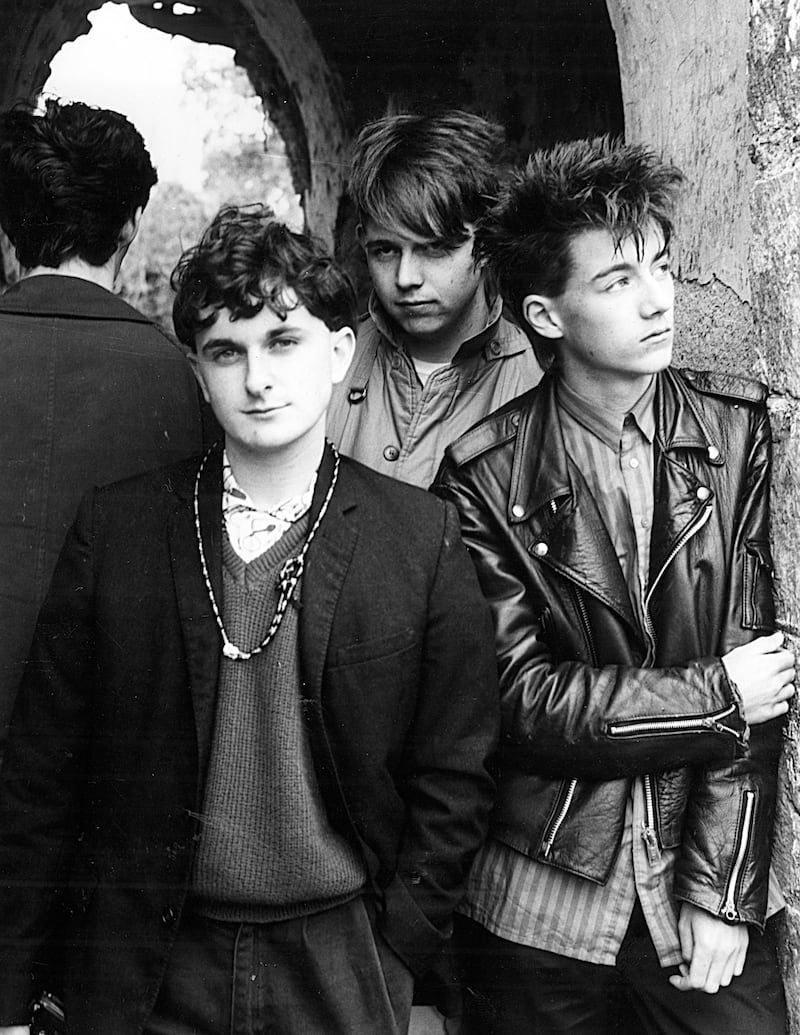 Cork band Cypress, Mine! in 1984: Mark Healy, Ciarán Ó Tuama, Denis O’Mullane and Ian Olney
“I said I’d give it a go. I hadn’t opened my mouth in 30 years, musically. It was very daunting. I went down to Cork and did something with Mark in a kind of cupboard-like office. And it was pathetic – but it actually turned out [fine] after all these years. It’s a very good song, that didn’t make the album, that we might bring out as a single later on. That was the start of it.”
Since moving to Dublin in the early 1990s, Ó Tuama had more or less given up on music. He felt nervous presenting new material to the rest of Cypress, Mine!, which in its 2026 incarnation features the drummer Morty McCarthy, best known from The Sultans of Ping; Ian Olney, who went on to join Power of Dreams; and Healy, who now plays bass.
[ ‘Corkchester’ and the sound of the ‘Lee beat’ in the cityOpens in new window ]
Ó Tuama found songwriting still came naturally to him – but where the songs he wrote in the 1980s were informed by youthful heartbreak and yearning, and the dull ache of a childhood in the shadow of the psychiatric-hospital complex, his new songs are brilliantly bittersweet and freighted with emotional scars accumulated over the long, slow slog of adulthood.
He says that Safe Highway was inspired by a verse in Irish that his father, the poet and academic Seán Ó Tuama, wrote about Ó Tuama’s mother.
“My father and mother died several years apart. They were both dying slowly, let’s say. There was a lot of care between all my family and my parents. That would have taken up any free time, so I couldn’t do anything else.
“It was great to be able to honour my mother and father then in a song, Safe Highway, which is based on a poem by my father that he wrote for my mother on her 66th birthday.”
His father was from Ballyvourney, in the Cork Gaeltacht, and Ó Tuama grew up with Irish as his first language. What would Prof Ó Tuama have made of the popularity today of Irish-language groups such as Kneecap?
“He was asked, ‘What do you see happening to Irish in 50 years’ time?’ That was in 1980. He said, ‘I see a revival in Irish. I see in Europe a grasping of cultures of each nation’ – that it would become stronger, and that Irish would be much stronger. And that we wanted a kind of nationalism that we would be striving for.
“He foresaw, to me, what is happening now. He didn’t link it with nationalism from a far right. He linked it with people believing in the identity of Ireland, and I think that’s what’s happening.”
Exit Trashtown was widely regarded as a commentary on the economic decline of Cork, which had become a sort of Irish rust belt following the loss of heavy industry in the early 1980s.
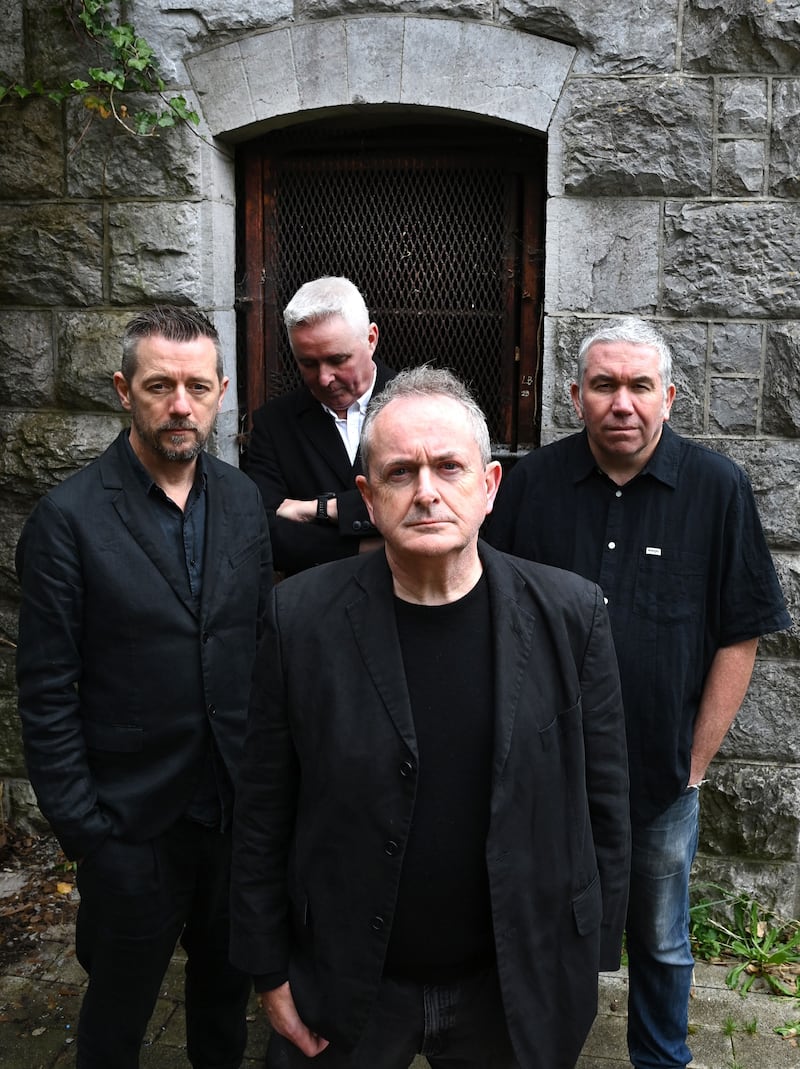 Cypress, Mine! today (from left): Ian Olney (guitar), Mark Healy (bass), Ciarán Ó Tuama (vocals) and Morty McCarthy (drums). Photograph: Eddie O’Hare
That Cork was a city sinking underwater seemed to be spelled out by the album’s cover image of a fishing boat abandoned on the city’s quays. To Ó Tuama, however, the title always had a dual significance, having more to do with his own internal struggles than anything his hometown was going through.
Many people in Cork felt they had to “get out of the city” at the time, he says. “That was not the meaning. It was meant to annoy people, to let them ask the question, ‘Is that what they were really saying about our lovely Cork?’ It wasn’t that. It was more to get out of your head. Think bigger, think wider, think different – and try and do stuff.”
Cypress, Mine! put that philosophy into practise by staying fiercely independent, even turning down an offer from U2’s Mother Records. “We decided to do it ourselves. The gigs were mainly driven by us. The travel was mainly driven by us. And the album was the first postpunk album that was recorded in Cork at that stage.
“I don’t know if [late, great Cork guitarist] Rory Gallagher did an album in Cork. Certainly the showbands did record in Cork. But there was none with the postpunk sound there. So it was a driving force. It never coloured the lyrics on it: that was about cars, love, teenage angst, madness, a bit about emigration. The album wasn’t coloured by the mood in the city.”
The cliche of Cork in the 1980s as a blackspot among blackspots is overstated, according to Morty McCarthy, who is joining the video call from his home in Stockholm. His memories of the time run counter to the stereotype. Yes, there was a lot of unemployment. But young people had a sense of freedom and excitement.
“I had a completely different experience in the mid-’80s, because I’m younger than the rest of the band. I was 16 at the time. For me that was the beginning of the new Ireland.
‘Ian [Olney] was in awe – he thought it was fantastic. I remember very little about Rory, unfortunately, because I just didn’t appreciate it – which was very sad, and I regret that’
— Ciarán Ó Tuama on Rory Gallagher attending a Cypress, Mine! show in London
“It’s very underdocumented, the mid-’80s in Ireland in music. We lived under the shadow of U2. Suddenly there was a lot of… I don’t know if you want to call them strange Irish bands, or bands that didn’t sound like U2 – The Golden Horde, Blue in Heaven, The Stars of Heaven.
“For me, in the Sultans, everyone asks me all the time about the start of the 1990s and all these Cork bands coming through… along with Power of Dreams and Therapy? You have to ask… what made me as a person? The mid-1980s made me as a person.”
Cypress, Mine! drifted apart in the late 1980s. But before that they had close encounters with some of the figures who defined Irish music through the 1970s and 1980s. They shared a bill with U2, who were surprise guests at the Lark by the Lee gig at the Lee Fields in 1985. (The set finished with Bono and the Cobh songwriter Freddie White jamming out a version of the Bob Dylan song Knockin’ on Heaven’s Door.)
A few years later, when they played London, Gallagher sought them out backstage. It is to Ó Tuama’s enduring regret that he was too young to grasp the significance of the encounter.
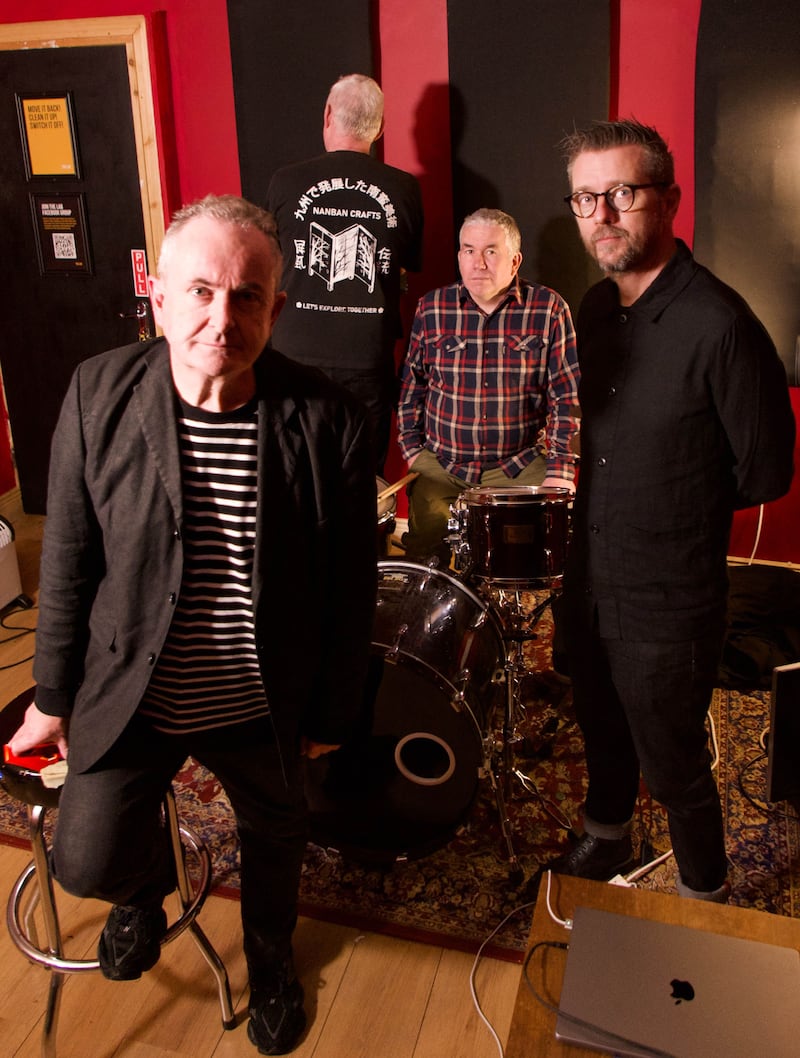 Cypress, Mine! – not looking back: Ciarán Ó Tuama (vocals), Mark Healy (bass), Morty McCarthy (drums) and Ian Olney (guitar). Photograph: Charlotte Self
“I had photographed Rory in Cork City Hall,” he says. “I didn’t appreciate him at the time. I thought it was music for older people, mature people. I certainly wasn’t one of them.
“When he came to the Mean Fiddler to see us… it was amazing to see him come backstage. Again, I didn’t understand it, because I was too young to appreciate it.
“Ian [Olney] was in awe – he thought it was fantastic. I remember very little about Rory, unfortunately, because I just didn’t appreciate it – which was very sad, and I regret that.”
Equally, though, Ó Tuama doesn’t want to live in the past. As a songwriter, he wants to be present in the here and now, and for the songs he writes with Cypress, Mine! to reflect that.
“I wanted to try to create something new. I wanted it to be different and I wanted it to be relevant to these days.”
He has achieved all that and more with on Pulling All the Clouds Apart, an album that shuns nostalgia and addresses the present day with a searing mix of heartache and hope.
Cypress, Mine! play Bellobar, Dublin, on Saturday, March 21st