
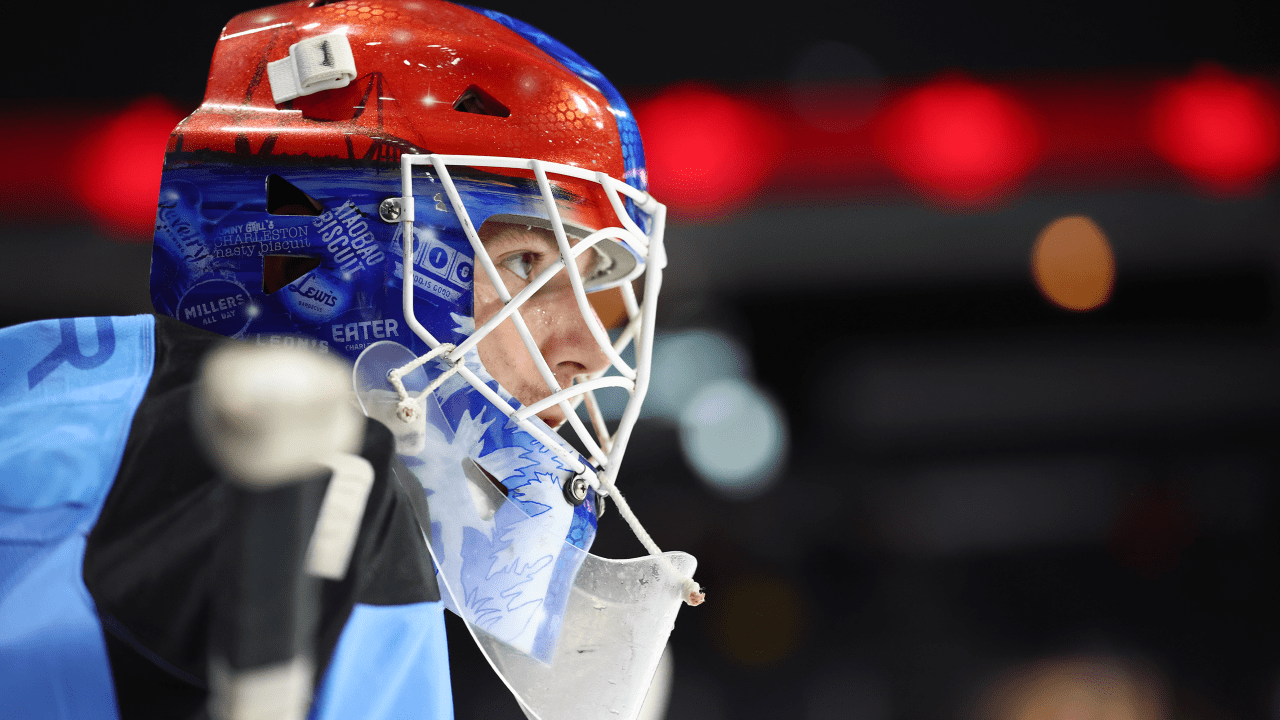
While Thompson is living out his Olympic dream, Milner is nearing the end of his tenure as the Capitals practice goalie. The 35-year-old Pittsburgh, Pennsylvania, native plans to move back to Charleston, South Carolina, full time after this season with his wife Virginia and 6-month-old daughter Emma and focus completely on his “other” job as the food editor at The Post and Courier.
That will end the latest chapter in his hockey career that’s included winning NCAA championships at Boston College in 2010 and 2012 (when he was named the Most Outstanding Player at the NCAA Frozen Four) and playing seven seasons professionally in the American Hockey League with Bridgeport (2013-14, 2015-16), Iowa (2014-15) and Hershey (2016-20) and in the ECHL with Stockton (2013-14), Quad City (2014-15), Missouri (2015-16) and South Carolina (2016-20).
Milner discussed his EBUG experience, becoming Washington’s practice goalie and a food editor and more in a Q&A with NHL.com.
How did you become the Capitals practice goalie?
“I’ve been living in Charleston and my wife, she’s a doctor, so for the residency programs, it’s this whole matching thing. This was in 2022, and we were just making our list and Georgetown has an amazing program and she ended up putting it No. 1 and she got her first program. So, she’s really the reason we were here, and I’ve always stayed in touch with (Capitals goalie coach) Scotty (Murray) because Scotty was in Hershey when I first signed with the Bears and he really helped me just get my game back in order and we stayed really close. So, I just told him kind of casually, ‘I’m around if you need anyone.’ …
“Then, I’ll never forget, it was July 2023, I think, and I don’t know why we were at the rink, but we were here for something and Scotty called while we were here and said, ‘We’d love to make this happen and do you think you could make it work?'”
How would you describe the job?
“Kenny McCudden, who is by far the best skills coach I’ve ever encountered in my life, I kind of follow him around because really the position was they wanted more skill work for the guys to work on scoring. They want a goalie that they can just throw in there and the guys can fire it and not feel like they’re going to injure their starting goalies or tear them apart with really hard situations. So, typically, I just try to get here early and when I see the first guys getting ready to go out, I go out and take what they need and, once Kenny gets out there, I usually just go in the net with him and hang out as long after practice as guys need.
“But I think what it’s been really useful for is the game days. I remember this from when I was playing in the AHL, when you’re the backup goalie and you’re staying out there with the guys who aren’t playing, if they’re playing 3-on-3, you get off the ice and you’re tired and then all the sudden if you have to go in that night, or even if you’re playing the next day, you feel kind of crappy. So, for me to be able to stay out and do that extra work and they can just go focus and be ready for the game, I think that’s huge.”
Alex Ovechkin, the NHL record holder with 919 goals, usually holds back with his shot in practice to avoid the risk of injuring the goalies. What’s it like to face his one-timer at full speed?
“It’s hard, first of all, but reading it off his blade is really impossible. It comes off a different way, it feels like, every time, and there’s just so much heat and power behind it. Not to mention that knowing who’s shooting on you, it kind of plays into it. But just his ability to find a way to score in all sorts of circumstances and situations and get the puck on net in a place the goalie can’t reach is really cool to see.”
How did you learn that the Capitals might need you to back up for the game in Anaheim?
“I was getting off the ice (after the morning skate) and [Lindgren] had gotten off early, but I didn’t even notice because Kenny was peppering me down at the other end. Then, one of the equipment guys slid (game) socks into my stall and I was like, ‘Do you know something I don’t know?’ And he was like, ‘Well, maybe.’ Then, I saw [Lindgren] and I was like, ‘Oh wow. He’s in a tough spot right now.’ But it wasn’t as simple as, ‘All right, I’m here. I’ll be the backup,’ because of the rules and regulations and everything. So, they told me they were going to work on it and see what they could do and maybe around 2:30, 3 p.m. I found out and by that point you’re pretty much going to the rink and getting ready to warm up and everything.”
Was it a dream come true, even though you didn’t play?
“Definitely. That moment was kind of the culmination of the past three years being a dream come true. It’s not the same, obviously, as playing a game or winning a game at this level, but hockey has given more than I could have ever asked for and to retire for three or four years and to start doing this and to have that happen was kind of just the cherry on top.”
Were the NCAA championships at Boston College the highlight of your playing career?
“I would say the BC time was probably the highlight. My junior year in 2012 we went on a 19-game winning streak and ended up winning the national championship. When I look back on my career, that kind of felt like the culmination. Just some of the guys I got to play with, too, from Cam Atkinson to Jimmy and Kevin Hayes, Brian Dumoulin, Johnny Gaudreau. Then, there’s all these little moments scattered throughout and the pro stuff, like my first AHL win in Utica was really special, I got to dress in a preseason game behind Evgeni Nabokov at Barclays Center. My first game in Hershey, kind of seeing the crowd there and experiencing that as well, is something that always stands out.”