
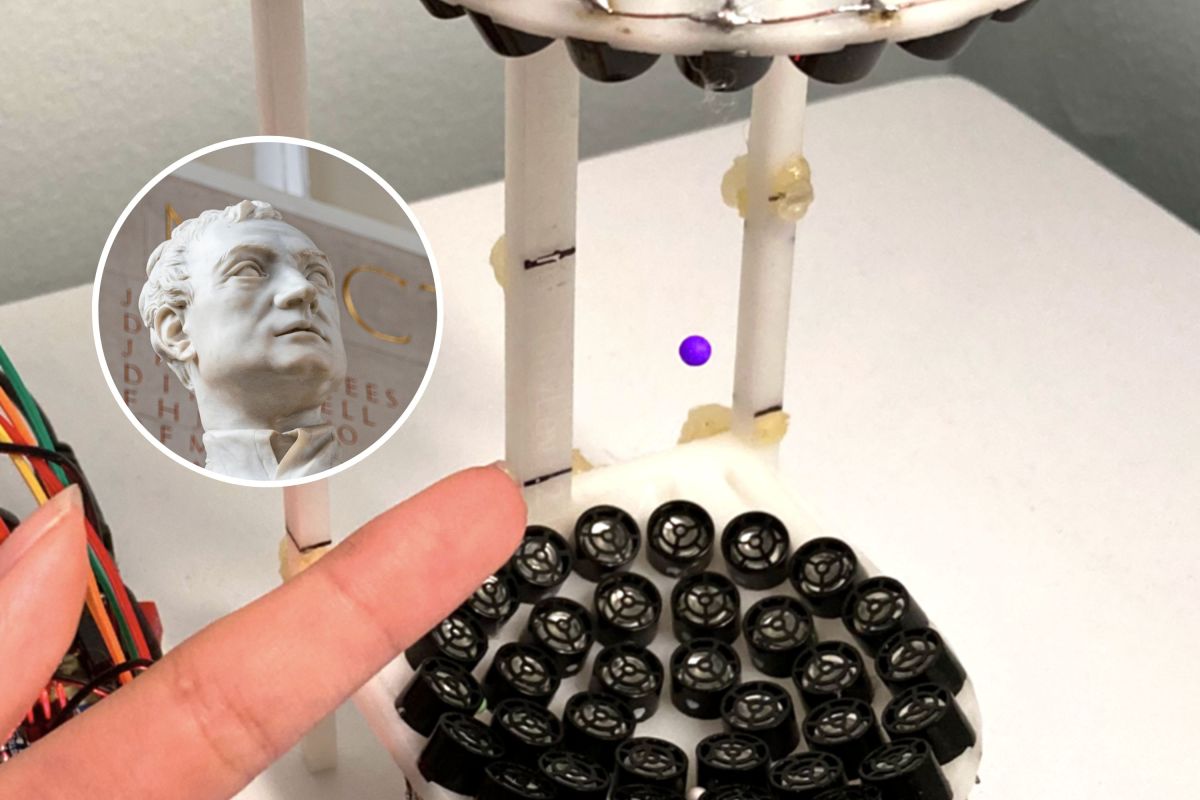
For every action, there is an equal and opposite reaction; so, as you probably learnt in school, dictates Isaac Newton’s Third Law of Motion.
It is this law that explains everything from how walking works to how a baseball bounces— even to how rockets blast off into space.
However, researchers from New York University (NYU) have discovered something that defies Newton’s Third Law—a new type of ‘time crystal’ that levitates on a cushion of sound.
Crystals—whether an expensive diamond or a common grain of table salt—are solids whose atoms are arranged in a highly ordered pattern that repeats across space.
In contrast, time crystals are those that are organized into a repeating pattern over the dimension of time, forming a quantum system of particles that move back and forth in repeating cycles.
They were first proposed back in 2012 by Frank Wilczek, a Nobel Prize-winning physicist at the Massachusetts Institute of Technology, and are thought could one day find practical application in everything from data storage to advanced quantum computing.
“Time crystals are fascinating not only because of the possibilities, but also because they seem so exotic and complicated,” said paper author and NYU physicist David Grier in a statement. He added: “Our system is remarkable because it’s incredibly simple.”
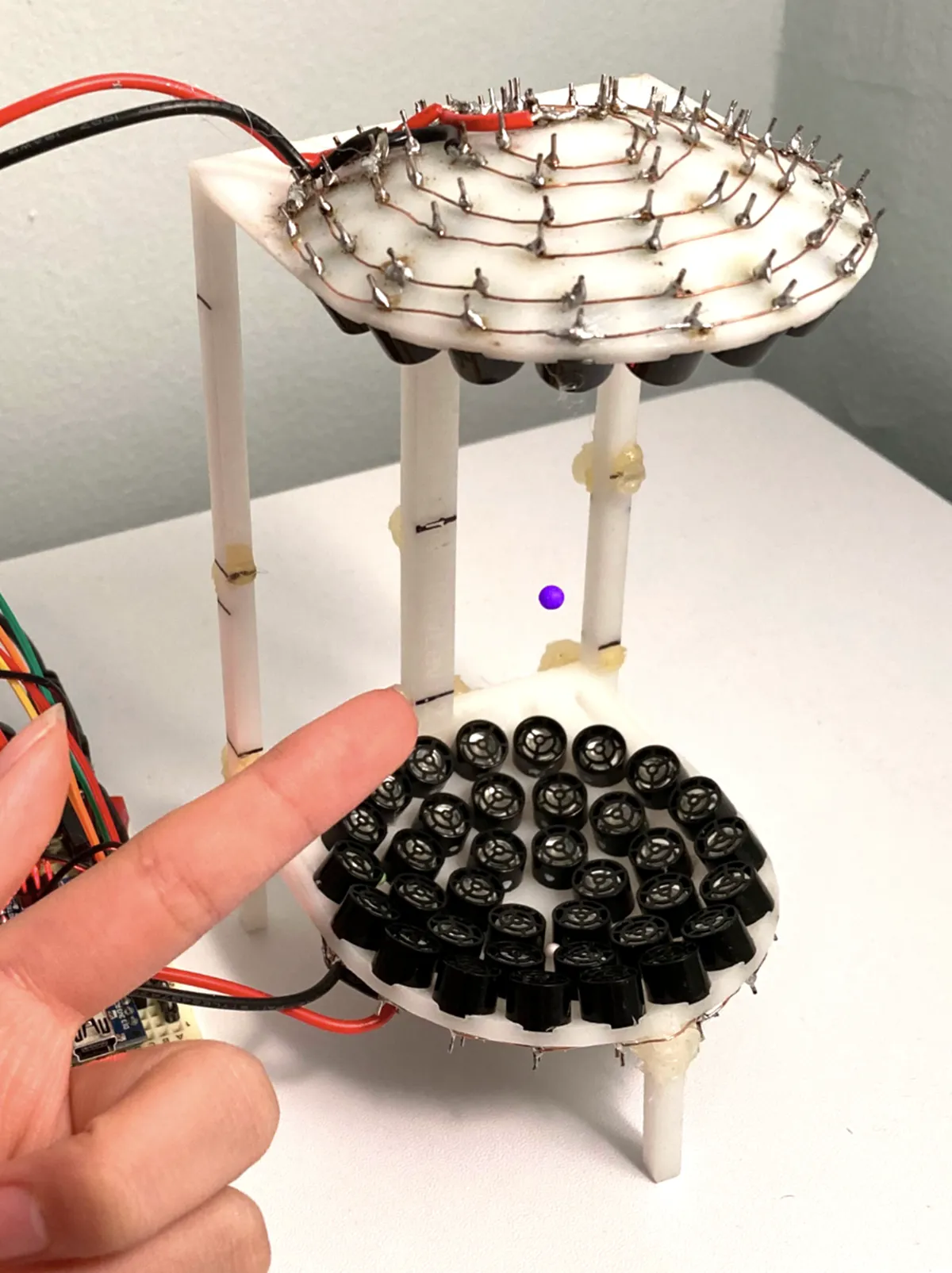
The time crystals whipped up by the researchers consist of beads of styrofoam—much like those used in packing—which are suspended in mid-air between two arrays of speakers, separated by some six inches.
The first step to making the new form of time crystal involves getting the particles to levitate in the centre of the array, on a cushion of sound.
“Sound waves exert forces on particles—just like waves on the surface of a pond can exert forces on a floating leaf,” explained paper author Mia Morrell, also of NYU.
“We can levitate objects against gravity by immersing them in a sound field called a standing wave.”
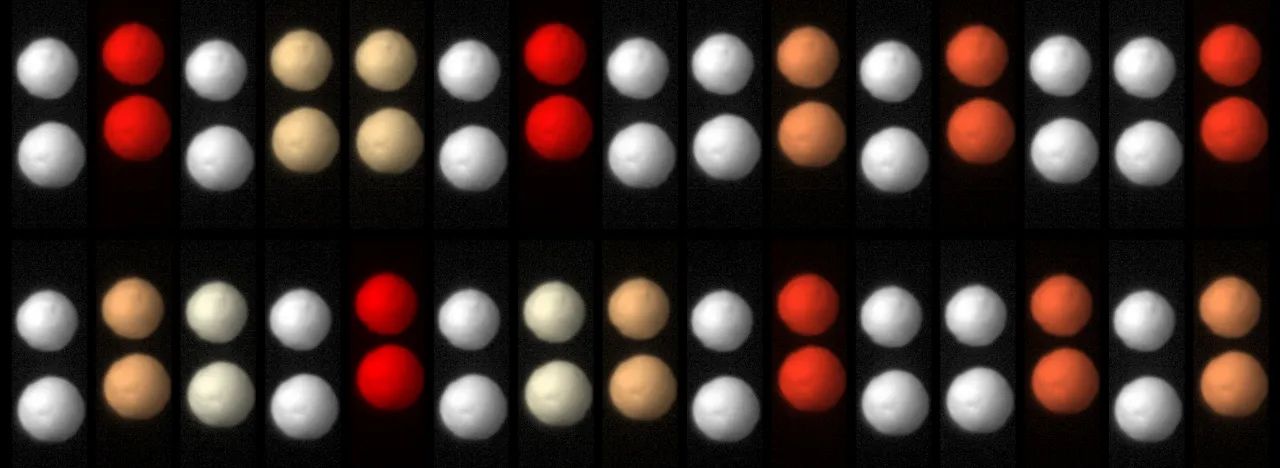
Once levitated in the acoustic field, individual particles interact by exchanging scattered sound waves.
Specifically, larger particles scatter more sound than their smaller counterparts—and thus larger particles influence smaller ones more—resulting in unbalanced interactions.
“Think of two ferries of different sizes approaching a dock,” explains Morrell. “Each one makes water waves that push the other one around—but to different degrees, depending on their size.”
According to the physicists, the wave-mediated interactions between the beads making up the new time crystals are not constrained by Newton’s Third Law of Motion; rather than being tied to balanced forces, they interact and move nonreciprocally in mid-air.
Alongside expanding our understanding of time crystals and the various forms they can take, the new discovery could also offer insights into the circadian rhythms that underpin our biological clocks, the researchers say.
This, they explained, is because some biochemical networks—such as the systems our body uses to break down food—also interact nonreciprocally, like the floating time crystals.
Do you have a tip on a science story that Newsweek should be covering? Do you have a question about time crystals? Let us know via science@newsweek.com.
Reference
Morrell, M. C., Elliott, L., & Grier, D. G. (2026). Nonreciprocal Wave-Mediated Interactions Power a Classical Time Crystal. Physical Review Letters, 136(5). https://doi.org/10.1103/zjzk-t81n