
“It’s ridiculously complex. I sat in a meeting the other day, and they [the Ferrari engineers] were taking us through it. It’s like you need a degree to fully understand it all.” So said Lewis Hamilton, and he was not smiling when he said it. “I enjoy driving flat out, but you can’t drive these cars like that. A lot of what you do as a driver in terms of inputs has a massive effect on the energy side of things, and, for me, that’s just not F1. So, yeah, driving-wise, it’s not so fun.” Thus opined Max Verstappen, in that forthright manner of his that brooks little argument and suffers no fools.
Then there was Fernando Alonso, frank, analytical, and as sharp as a rapier: “Different driving techniques are needed for different cars and different sets of regulations, and these regulations are a little bit more dramatic in that regard. From a driver’s point of view, you want to be able to drive at 100%, but some of the driving that you’ll have to do in order to optimise the energy around the lap, even in qualifying, is a bit annoying.”
When the three most eminent drivers in Formula 1 — first among equals, you might say, for they have won a combined total of 13 F1 drivers’ world championships — line up in rhetorical formation and fire volleys of criticism at a new set of regulations, it is tempting to reach for the panic button. But we must not. Regulation changes in F1 are rarely popular in the first instance with outspoken multiple F1 world champions. They are creatures of habit, such titans, and rightly so. They have honed their craft to a razor’s edge within a given framework; and, when that framework shifts, they feel the tremor more acutely than anyone else.
I have lost count of the times a great F1 driver has sniffed at a new rulebook in February only to accept its virtues by July, Moët magnum in hand. It may therefore be that Hamilton, Verstappen, and Alonso will soften their views in time, especially if they find themselves delivering podium finishes, and also, to be fair to them, if the new regs produce good racing. Moreover, on the plus side, the 2026 F1 cars are shorter and lighter than their 2025 predecessors, which were much too long and far too heavy.
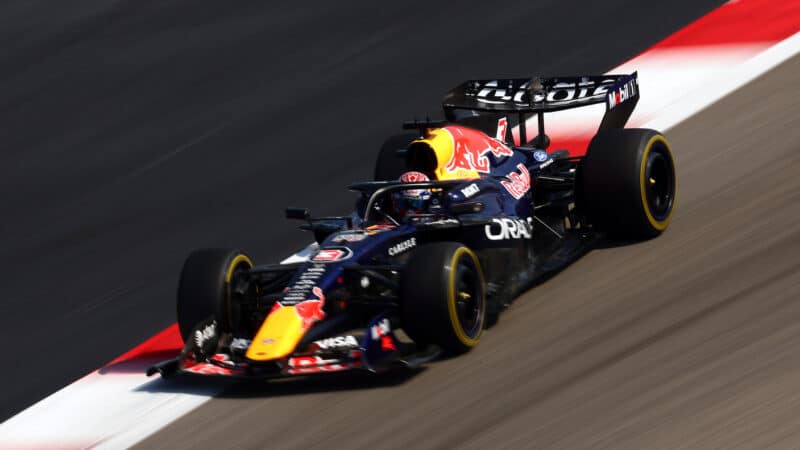
Verstappen labelled the new cars “anti-racing”
Red Bull
Even so, we should not ignore the vehemence of their initial reactions. They are not neophytes carping from the cheap seats; they are multiple F1 world champions, each of them, men who have bent F1 regulations to their will and have danced on the ragged edge of dozens of F1 cars’ nervy performance envelopes. If they say that something feels too complex, overly prescriptive, and insufficiently joyous, we ought to listen to them. F1 is, at heart, a drivers’ world championship, after all. The cars matter, the designers matter, the engineers matter, the strategy boffins matter, the mechanics matter, and above all, the fans matter; but the sport’s beating heart resides in the cockpits. If those who occupy them tell us that they feel constrained by new rules that poop their party, we should pay attention.
We will soon find out what the racing will be like, and we will surely return to the subject of the regulations then. In the meantime Hamilton’s, Verstappen’s, and Alonso’s comments have caused my mind to wander down memory lane, as it often does when the present feels a touch over-engineered, and so it is that I find myself rummaging through the attics of history in search of what I will refer to for the purposes of this column as the optimal F1 formula of the modern era.
Now, before you accuse me of ignoring the pre-modern era, let me make clear that I adore the front-engined cars of the 1950s, exemplified by the glorious Maserati 250F, all voluptuous curves and heroic oversteer; the light, minimalist, cigar-shaped projectiles of the 1960s, of which in my opinion the Eagle T1G was the most beautiful; and the big-winged and massive-tyred machines of the 1970s, of which my personal favourite was Brabham‘s stunning BT44B. But those cars belong to another epoch, magnificent but now sepia-tinted, when mortal danger was a constant and the technology, although ingenious, was not yet labyrinthine.
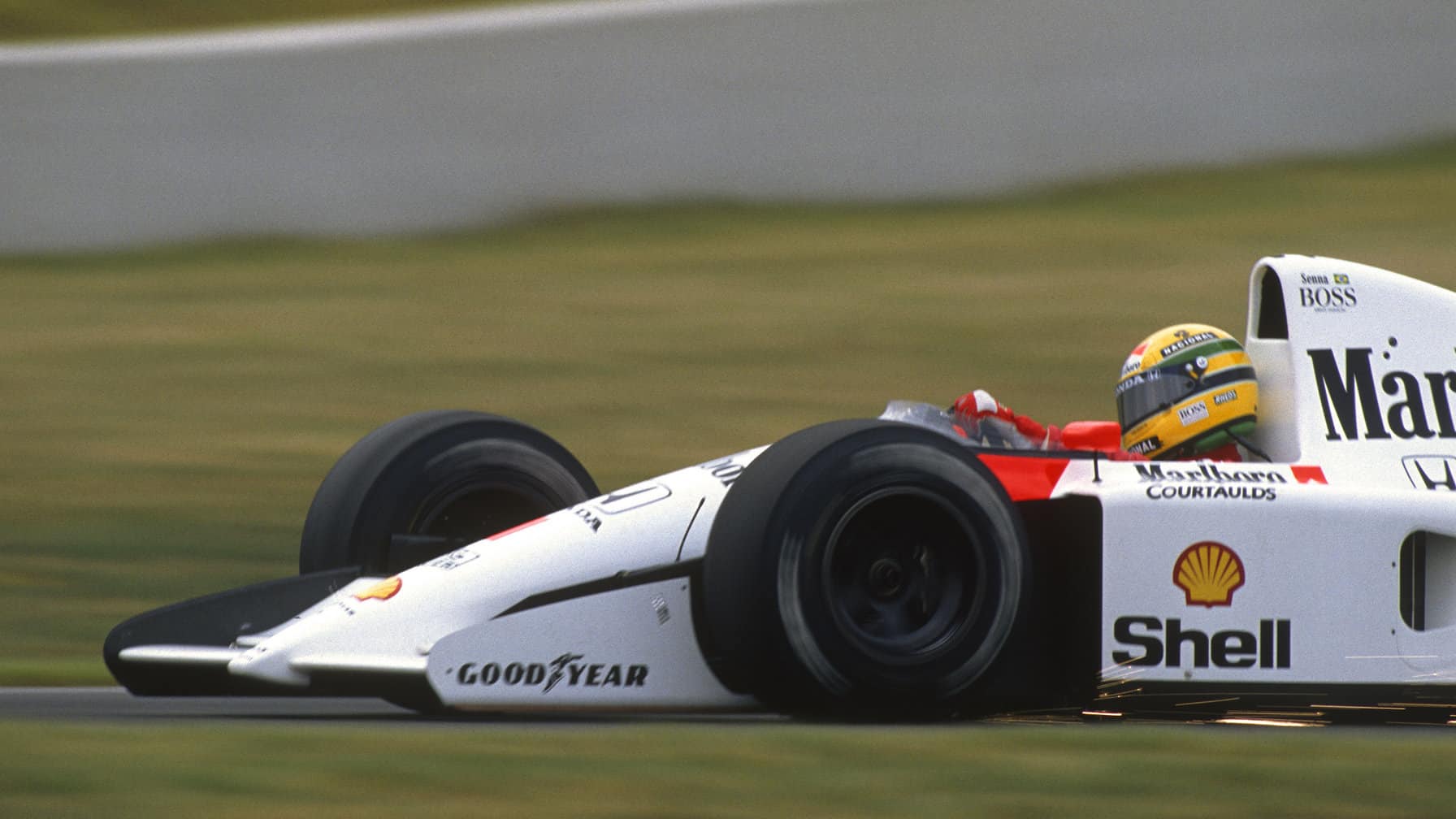
So, if we are to consider only the modern era, then in my opinion the optimal season from a regulatory, specificatory, and formulaic point of view is 1991. Unbelievably, because time flies when you are enjoying yourself — and I have indeed been doing exactly that during my long career in F1 — that was now 35 years ago.
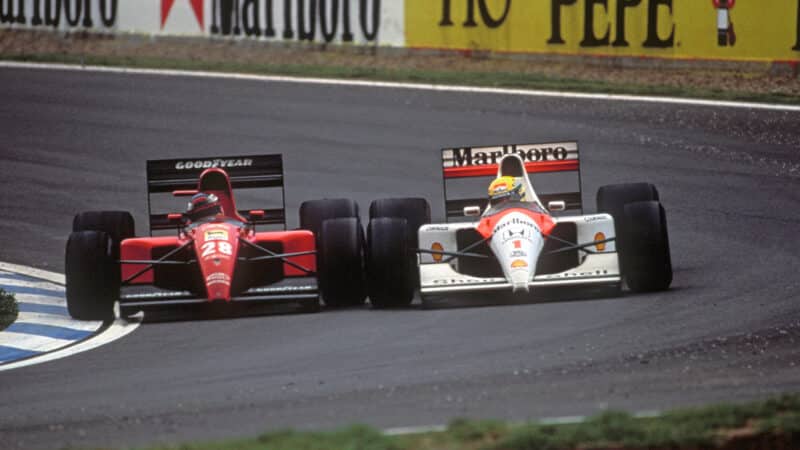
Ferrari and Honda were just two of nine engine manufacturers in F1 in 1991
Grand Prix Photo
Why 1991? Well, here goes. But first, before we dive into an examination of the rules that dictated what the cars were like, let us take a look at the calendar. There were 16 grands prix, the first in early March and the last in early November. That, to my mind, is the correct number: enough to establish a true F1 world champion, to allow narratives to ebb and flow, and to let form wax and wane, yet not so many that the season becomes an endurance test for anyone whose role encompasses the whole shebang. The rhythm was humane, the itinerary logical, and the anticipation between grands prix delicious rather than debilitating. All the best circuits that still grace today’s F1 calendar were present and correct – Interlagos, Monaco, Montreal, Mexico City, Silverstone, Hungaroring, Spa, Monza, Barcelona, and Suzuka, plus the old and much missed Hockenheim, Imola, Estoril, and Adelaide. Oh, and Phoenix and Magny-Cours, too — which, so good were all the others, we could complacently regard as meh, not that we used that ‘word’ back then.
Second, and more pertinent to the ruckus recently fomented by Hamilton, Verstappen, and Alonso, let us look at the engines. The F1 cars of 1991 were powered by a splendid mixture of V8s, V10s, and V12s, all naturally aspirated, and all displacing 3.5 litres. There were no turbos, no hybrid appendages, no energy deployment maps, and no doctorates in thermodynamics required to understand the rules that governed their operation; just pistons, valves, crankshafts, and combustion. Moreover, nine manufacturers supplied F1 engines that year: Honda, Renault, Ford, Ferrari, Lamborghini, Porsche, Yamaha, Ilmor, and Judd. The F1 paddock was a veritable United Nations of brake-horsepower.
Drivers heel-and-toed into corners and snickety-snicked a dinky lever from ratio to ratio
The diversity was not merely numerical and marque-related; it was also philosophical and acoustic. A V12 did not sound like a V10, and a V10 did not sound like a V8. One could stand at the exit of a corner and identify a car by ear alone. The Honda V12 had a silken, soaring wail; the Renault V10 a harder-edged, metallic snarl; the Ford V8 a punchy, workmanlike bark. It was an aural banquet, and it mattered to us, as indeed it should have done, for F1 has a duty to stir the soul as well as to deliver the dollars.
Technically, the regulations were tight enough to dictate parity of displacement yet loose enough to encourage architectural variety. Working together, teams and manufacturers made choices. They weighed the smoothness and top-end power of a V12 against the tractability and fuel efficiency of a V10, or the lighter weight of a V8. Designers argued, engineers adapted, and drivers felt the differences in throttle responses and torque curves. It was complex, yes, but its complexity was rooted in mechanical ideology rather than in the choreography of electrons.