
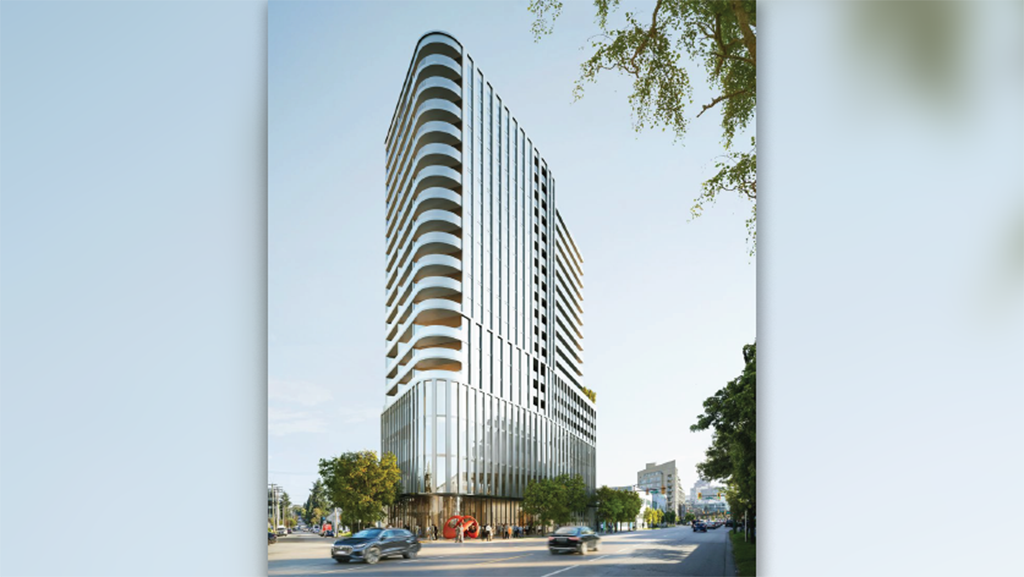
Vancouver City Council recently made the rare decision to go against the advice of its own staff when it approved a developer’s proposal to build a residential tower on a property zoned for industrial use.
Strand Development wants to build a 25-storey tower with a six-storey podium at 320-360 West 2nd Avenue between Main and Cambie.
The lower three levels are for industrial use, with 200 market rental homes on the upper floors.
City staff had recommended against approval, noting residential use is prohibited on the site and “the inclusion of housing is incompatible with the goal of preserving industrial and employment land in the city.”
About 90 per cent of Vancouver’s land base is zoned for residential use and only six per cent is zoned for industrial.
Industrial land is concentrated in the city in seven areas, such as Mount Pleasant and South Vancouver.
The new tower will be located in the Mount Pleasant Industrial Area in mid-town Vancouver.
Retired Vancouver and Metro Vancouver planner Christina DeMarco calls council’s decision “a short-sighted and reckless decision that reverses 30 years of industrial land protection in the city and 15 years of regional regulations put in place to conserve the region’s industrial land base. “Council has announced to the development industry that speculation of industrial land for residential uses has a good chance of being rewarded,” says DeMarco.
Most Vancouverites understand a well-functioning city needs locations for activities that do not fit neatly into residential and commercial areas, she says.
“For thousands of Vancouverites, this (industrial areas) is their place of work,” says DeMarco. “For many businesses, such as restaurants and hotels, this is where they get supplies and where their repair services are located. This is where the film industry finds space for studios, set designs and post- production. The construction industry relies on industrial areas for supplies, and for equipment, such as crane storage.”
DeMarco says a diverse urban economy gives a city strength and resilience as well as a range of employment opportunities to suit a variety of skills.
“Do we want to convert the city to a place where one can find work only as a café barista or in the real estate industry?” she says.
DeMarco says council’s decision is a risky experiment.
“Council thinks it can have its cake and eat it too, by combining residential and industrial uses in one building,” she says.
There is no evidence this combination works, however.
“Residential uses in industrial areas drive up land prices and rents, resulting in the loss of jobs and businesses,” says DeMarco.
In an open letter it presented to Vancouver mayor and council before the public hearing that approved the project, 23 members of a group of local urban planners and architects called HousingReset wrote, “This spot rezoning flies in the face of decades of industrial land protection and stewardship of the precious jobs and services provided by the city’s industrial lands.”
They wrote approval of the development could drive up land and rent prices and force industrial businesses from a location that is relatively inexpensive and is also close to downtown, customers and employees.
“The Mount Pleasant Industrial Area is one of the city’s vital production,
distribution, service and repair districts and has the highest density of employment of any industrial area in the region.”
Adjacent to and just east of Mount Pleasant, in the False Creek Flats, are two “green” industrial businesses – Recycling Alternative Ltd. and Terraforma Systems Inc.
Recycling Alternative is a recycling service for industrial, commercial and institutional customers.
Terraforma designs, engineers and manufactures composting technology for large food waste generators. The equipment creates a dry, inert soil amendment that enhances soil health.
Co-owner Louise Schwarz (and co-owner Robert Weatherbe) also oppose city council’s decision.
“I’m very concerned that it establishes a dangerous precedent for future rezoning requests,” says Schwarz. “Industrial users are gradually getting squeezed out of the city, and they end up locating further away, which leads to more vehicle trips and emissions.”
Schwarz worries the Flats could be rezoned for residential use.
“St. Paul’s Hospital is moving into the area and many of the people who work there will want to live nearby,” she says.
Schwarz says Vancouver needs to have protected industrial areas.
“We will need more industrial land in the future as Canada and Vancouver work to become more self-sufficient,” she says. “Industrial land helps keep the city running. It’s productive land that supports services for all of our residents.”