
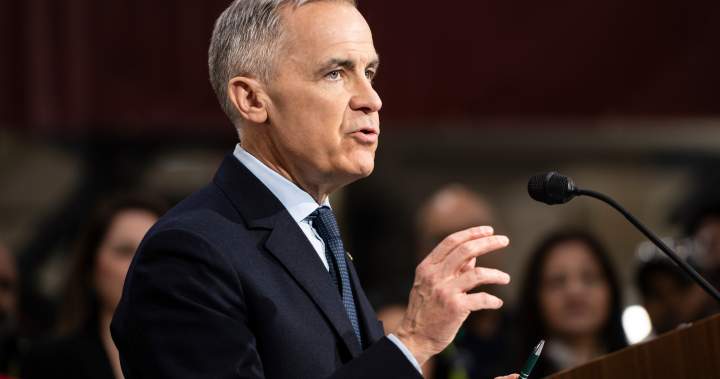
Prime Minister Mark Carney released his new Buy Canadian plan for supplying the military and growing Canada’s domestic defence industry on Tuesday, saying Canada can never be “hostage” to the decisions of others when it comes to security.

The $6.6-billion plan promises to prioritize building military equipment at home, hike the share of defence contracts awarded to Canadian firms and add up to 125,000 new jobs over the next decade.
The goal, Carney said, is to go from using domestic defence procurement for roughly one-third of Canada’s needs to around 70 per cent, and increase Canada’s defence exports by 50 per cent over the next decade.
“Defending Canada means more than just increasing the size of our military. It also means the strength of our industries, the resilience of our economy and our capacity to act independently when it matters the most,” he said.
Story continues below advertisement
10:44
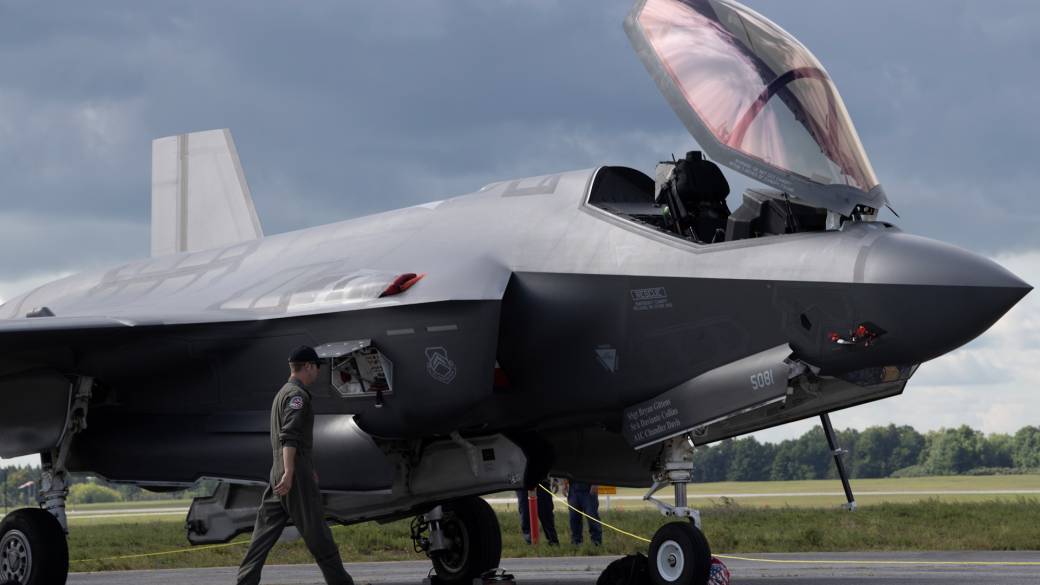
A lot of disinformation out about Canada’s potential F-35 deal: Trade and defence expert
Carney said that as a matter of policy, military procurement will be directed to Canadians firms first.
“Where we can’t build alone, we will partner with like-minded allies, helping to attract investment, transfer intellectual property and integrate supply chains so that public dollars flow back to Canada and Canadian jobs created right here,” he said.
“Only after exhausting those first two options will we buy from abroad,” Carney said.
He added that Canada’s defence industrial base will be “complementary” and not “competition” to American defence supply chains.

0:42
Canada’s defence minister says F-35 fighter jet purchase ‘remains under review’
The centrepiece of Canada’s new industrial strategy will be the Defence Investment Agency, or DIA, which Carney said will “streamline speed procurement, will cut red tape and it will expand domestic production.”
Story continues below advertisement
The DIA will work towards strengthening Arctic security, creating more Canadian jobs and ensuring Canada can “act independently.”

Get breaking National news
For news impacting Canada and around the world, sign up for breaking news alerts delivered directly to you when they happen.
“This strategic autonomy doesn’t mean isolation. It means being strong enough to be a partner of choice rather than a dependent. It means building a domestic defence industrial base so we are never hostage to the decisions of others when it comes to our security,” he said.
Canada will also boost government investment in defence related research and development by 85 per cent to expand its capabilities in artificial intelligence, quantum computing, robotics and autonomous systems.

1:30
Canada launches defence investment agency
“In part to do that, we’re creating a new Bureau of Research, Engineering and Advanced Leadership, or BOREALS, to coordinate and accelerate defence research and innovation in frontier technologies like quantum and AI,” he said.
Trending Now

France suspends Crinon after fight vs Canada

Father of Tumbler Ridge school shooter issues statement: ‘I carry a sorrow’
The Canadian Association of Defence and Security Industries (CADSI) called the announcement a “historic turning point.”
Story continues below advertisement
“For the first time, we can see a clear, accountable vision for the defence sector, with specific targets to grow and sustain the sovereign industrial capabilities that underpin our national security, economic resilience, and technological leadership,” Christyn Cianfarani, president and CEO of CADSI.
The Canadian Chamber of Commerce also welcomed the announcement.
“The scale of new funding is unprecedented, but the true measure of success will be how these dollars translate into real operational readiness, modernized equipment and a stronger Canadian Armed Forces,” said David Pierce, the Chamber’s vice president.
More on Canada
More videos
The Business Council of Canada called the strategy an “important step towards strengthening Canada’s security.”
“Investing in Canada’s defence industrial base supports secure, high-paying jobs across the country, reinforces the nation’s role in developing critical technologies and supply chains and helps the government uphold its commitments to allies around the world,” said the council’s CEO Goldy Hyder.
Canadian manufacturers have the “talent, technology and capacity to deliver” on the potential of the defence industrial strategy, said Dennis Darby, president and CEO of Canadian Manufacturers and Exporters.
“Success will depend on close coordination between government, prime contractors and domestic suppliers, especially small and mid-sized firms,” he said.
U15 Canada, an association of fifteen leading research universities across Canada, said Canada’s universities are poised to help lead defence research.
Story continues below advertisement
“As the Prime Minister articulated at Davos, we are in an era of geopolitical risk and technological competition. The new Defence Industrial Strategy makes it clear that leading research universities can help Canada respond by driving innovation and securing sovereign capabilities here in Canada,” said Robert Asselin, CEO of U15 Canada.
Conservative Leader Pierre Poilievre criticized the plan as a “salad bowl of buzzwords” that won’t deliver, and is calling on Ottawa to instead cut bureaucracy and streamline the government’s purchasing decisions.
The much-anticipated road map for growing the defence industry was supposed to be released last week ahead of the Munich Security Conference which took place over the weekend, but was delayed following the mass shooting in Tumbler Ridge, B.C.
Its release comes as Ottawa moves to shore up military supply chains and meet a new and ambitious NATO commitment of spending the equivalent of five per cent of GDP on defence by 2035.
–with files from Canadian Press
© 2026 Global News, a division of Corus Entertainment Inc.