
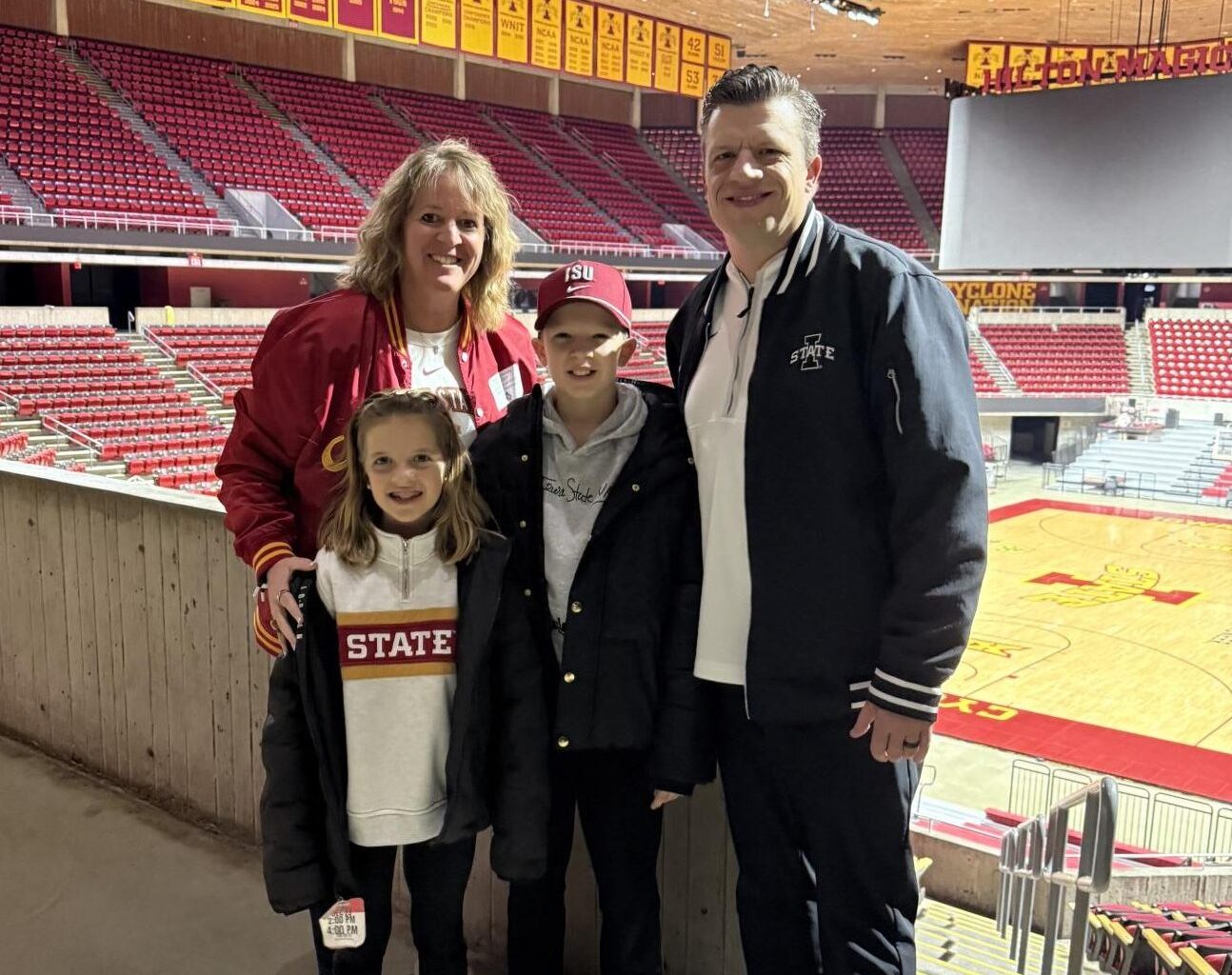
After days without sleep and with a mind that wouldn’t slow down, Lyndsey Fennelly reached a moment she could no longer live in denial. “You have to take me to the hospital,” Lyndsey said to her husband, Iowa State University assistant women’s basketball coach Billy Fennelly.
Her words marked a turning point from denial towards acceptance and, finally, advocacy.
Mental illness doesn’t always look like sadness, staying under the sheets of your bed or refusal to move out of a dark room. Sometimes it looks like endless energy, sleepless nights, packed schedules and a life that appears widely successful. For Lyndsey, it took her two hospital visits to stop trying to outrun her mental illness and ask for help.
As a former Iowa State women’s basketball player who was recently added to the 2024 Iowa State Athletic Hall of Fame and drafted in 2007 by the Indiana Fever, Lyndsey didn’t think the premise of mental illness would be apparent to her.
As an athlete, one holds countless responsibilities on their shoulders: class, practices, games, workouts, traveling, homework and so much more. For Lyndsey, an athlete under Iowa State women’s head coach Bill Fennelly, her busy mind was nothing out of the ordinary as she carried an active mind wherever she went; it was just who she was.
“I remember I could sit in Hilton Coliseum, coach Fennelly would be talking to me, I could hear people talking behind me in the stands, I could make eye contact with a teammate, I could look up at the scoreboard, I could assess the next possession,” Lyndsey said. “I remember thinking, ‘So wow, I’m pretty tuned in to a lot of what’s going on.’ I thought that was just being a good point guard.”
It wasn’t until 2012 that a turning point happened for Lyndsey’s mental health: a miscarriage.
Lyndsey’s father and doctor encouraged her to seek professional help with her loss. While they recommended support options such as therapy and talking to someone, Lyndsey chose a different approach.
“That’s where I did the opposite, I busied myself for the next six months, I was in the gym as much as humanly possible, training kids and I thought if I couldn’t have my own kids, then it’s time to help everyone else’s kids,” Lyndsey said. “I was doing lessons at 6 a.m. and 6 p.m. and running this intense, crazy schedule and that’s when it all came crashing down six months later.”
Following a manic episode, Lyndsey was admitted to Mary Greeley Medical Center in 2013 for a 15-day stay, where she was first diagnosed with a mental illness.
After being discharged, Lyndsey denied having a mental illness. She was a successful woman who owned a business, was married and played in the WNBA. Why would she, of all people, have a mental illness? Her life was seemingly perfect; she was not a person who would have a mental illness, and Lyndsey believed that.
“In 2013, if you were mentally ill, you were deranged, suicidal, violent, a bunch of negative connotations,” Lyndsey said. “So I said, ‘No way this is me, there’s nothing wrong with me, I don’t need therapy and medication is for weak people.’ So I went five years, no medication, no treatment and just ignored the reality of what the heck was going on.”
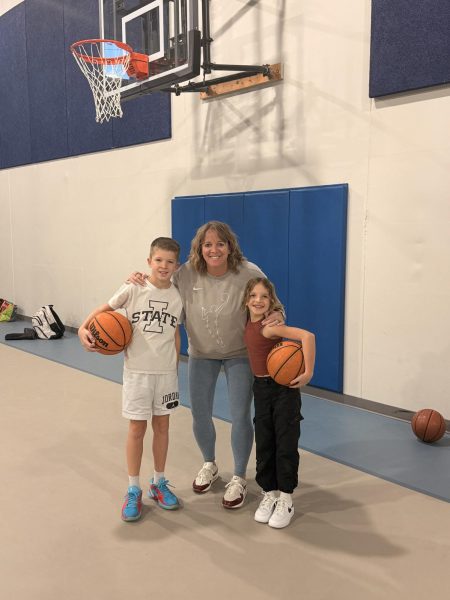 Photo provided by Lyndsey Fennelly.
Once discharged, Lyndsey went on for five years without another thought about being diagnosed with a mental illness. She continued to strive in her work, family and keeping a busy schedule.
The best part of those five years? Her two children were born, Will and Callie, now ages 11 and 8.
Living life to the fullest, Lyndsey took a trip with a close friend to California, but the trip took a downward spiral as her mind was plagued with constant thoughts. Juggling a bunch of responsibilities, she lost control in what she’s called a manic episode, leading her to cut her trip short.
Lyndsey recalled what she said to her friend during her manic episode while in California.
“I don’t feel good about myself,” Lyndsey said. “It was the lowest someone could think of themselves. I was there.”
Lyndsey was put in a straitjacket and taken by ambulance to the medical center at UCLA, before flying back to Iowa.
During those days of travel and rest, Lyndsey turned to her husband and said, “Take me to the hospital.”
Lyndsey was admitted back to Mary Greeley Medical Center in 2018.
For 21 days, Lyndsey stayed in the unit and gained a better insight into her illness, taking medication, sleeping, having three meals a day and even doing arts and crafts.
Although in the process of trying to stabilize her condition, Lyndsey felt foggy in the beginning, didn’t talk to other patients and kept mostly to herself. However, the biggest win for her was having visitors during the hospital’s two-hour visiting window.
“I’ll never forget the look on the patients’ faces when they saw my father-in-law [Bill Fennelly] walk into the unit and just give me a big hug,” Lyndsey said.
With an underlying thought that she brought embarrassment to the Fennelly name, Lyndsey did not go around Mary Greeley and tell the patients who she was family with; however, Bill did not care and walked straight into the facility during visiting hours and gave her a big hug.
“When I went to see her, obviously, she was going through a tough time and the chance just for all of us as a family to show her how much we love her, we care about her, the pride that we have in the way she’s handled all this, this has been amazing,” Bill said.
With her family coming together for support, Lyndsey’s most important and favorite visitors were her two children, alongside her husband, who visited every day. Lyndsey was described as lighting up like a Christmas tree anytime she got a visitor.
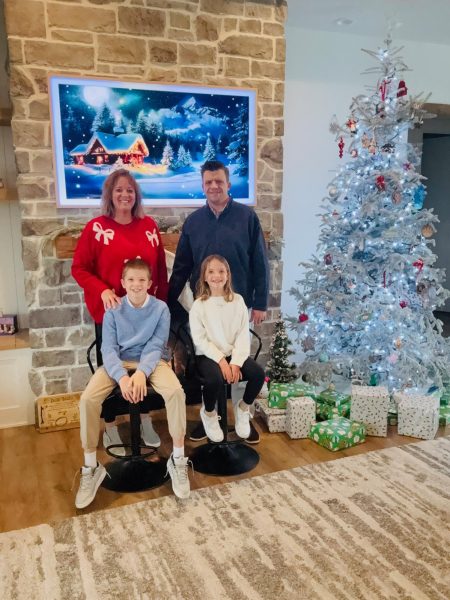 Photo provided by Lyndsey Fennelly.
“I just had this army of people, family and friends who said, ‘Okay, you’re going to be up there, you’re not going to have your phone, you’re not going to have the most important person in your life keep being your backbone. You’re not going to have the light of your lives, you’re gonna just have yourself and you’re going to get through this,’” Lyndsey said. “That’s as much love as I have ever felt in the world.”
Discharged in late April of 2018, Lyndsey spent weeks without a phone, and it wasn’t until May that she posted on Instagram, announcing she experienced an episode leading to an extended hospital stay. She also announced her desire to break the stigma around mental health and be an advocate.
Since then, Lyndsey has led over 250 events, reaching over 20,000 individuals as she shares her experiences of her mental health journey and hopes to reduce the stigma that follows mental health.
“I still live, anything and everything I have touched professionally or personally, I have to convince myself that I am enough and I am awarded every single day,” Lyndsey said. “So it starts and ends with me, and that’s kind of my parameter of healing and recovery.”
A common occurrence for Lyndsey, also known as a trigger for her hospital stay, was that she did not sleep for a couple of days, alongside not eating and forgetting to do basic self-care.
Knowing her limits and when she needs help, Lyndsey was admitted back to Mary Greeley in 2023 for a 12-day stay.
Lyndsey has continued to grow, showing once again how it is not embarrassing to ask for help, and has gained a better understanding of herself and her mental illness. Since then, Lyndsey has developed schedules, met with therapists, all while also expanding her businesses and, above all, has continued to be a mom to her two children, whom she calls the lights of her life.
However, Lyndsey is human; she will make mistakes, she, like everyone else, is not perfect, but she does not let past mistakes keep her from living a life that is well deserved.
“It’s the mirror, I can’t stand myself, I still can’t,” Lyndsey said. “There are moments, there are things, that I question, ‘Did I do this right? Was I perfect here? Or was I helpful enough in this setting?’ But if I can look in the mirror a couple of seconds at a time and just pause and say, ‘You know what, you’re doing alright, you’re doing good,’ then I know I made it.”
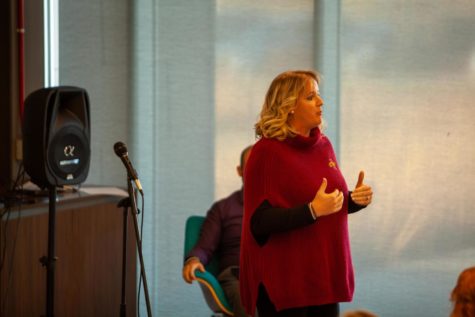 Lyndsey Fennelly talks for SheTalks at the Women Who Create Conference at the ISU Economic Development Core Facility on Oct. 24. (Matthew Eclatt/ Iowa State Daily)
Lyndsey has now created a podcast called “Perfectly Imperfect” with co-host Brittnie Landsgard, where both women have an honest conversation around mental health, share experiences and empower individuals to feel seen and supported.
“I had a lot of people tell me she was a really, really, really good basketball player,” Bill said. “I’ve had a hell of a lot more people tell me how much they appreciate what she’s done in this journey.”
Lyndsey’s journey is a reminder that mental illness does not discriminate and asking for help is a sign of strength, not weakness. Through her resilience, openness and unwavering commitment to her family, Lyndsey shows that life doesn’t need to be perfect to be meaningful and through her imperfections, the most powerful victories are not the ones we achieve alone, but the ones we reach together.
988 Suicide & Crisis Lifeline is available 24 hours a day, seven days a week. If you or someone you know needs help, call or text (855) 581-8111, or chat at yourlifeiowa.org.