
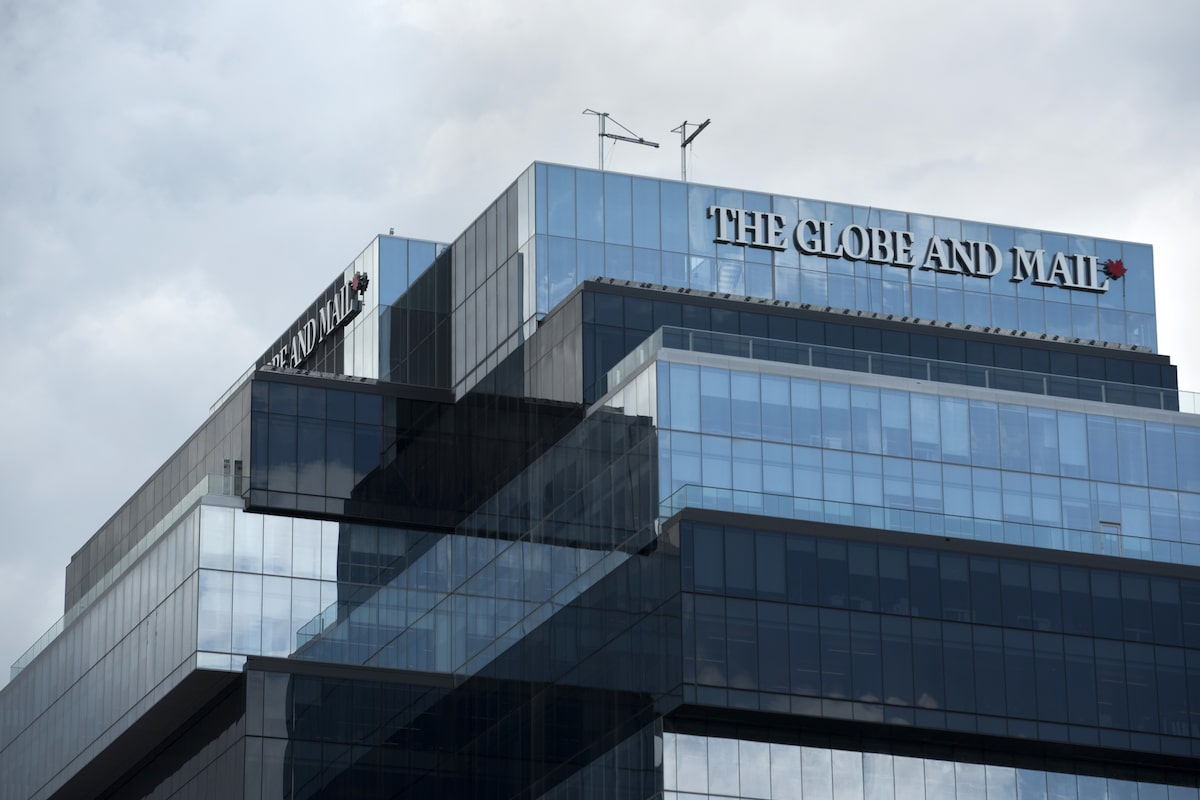
The Globe and Mail on Tuesday launched a new digital nameplate, its ninth iteration.The Globe and Mail
Today sees the continued evolution of our design with a new digital nameplate for The Globe and Mail.
This is the ninth iteration of our digital nameplate since the first was introduced in the earliest internet years of the mid-1990s.
And while we modernize our design, we maintain The Globe and Mail promise – to stand behind everything we publish.
And when, on occasion, we get it wrong, we correct the record.
We don’t cater to division. We are about nation-building, not ceding authority for convenience. Facts can be uncomfortable, but by using our convening power we ensure Canadians have a home for the national conversation.
This country faces profound questions.
The Globe and Mail Editor-in-Chief David Walmsley.Melissa Tait/The Globe and Mail
National unity is once more being tested, but this time on two fronts – Quebec and Alberta. We have brought more staff into Alberta, in both news and opinion. We have also added staff in Quebec.
The Prime Minister, Mark Carney, talks about a rupture between the U.S. and Canada, and how our economic relationship cannot return to the era that is bookended by the Free Trade Election of 1988 and the re-election of the current U.S. President.
How does Canada navigate this world? How do we expand our partnerships without compromising our principles? How do we not merely survive this global reordering but thrive in it, and chart a course to a more prosperous future for all Canadians?
Part of that means doing hard work within our borders, and working together for a common good. On interprovincial trade, for instance, we are creating a scorecard to track promises made to reduce friction and improve the flow of goods and workers across the country.
Housing affordability, overregulation of businesses, too-high taxes, a generational lack of economic growth, unskilled workers losing their last jobs. We face, like the U.S., an increasingly K-shaped economy where those who do well do even better and those sliding face ever-harder circumstances.
To understand how communities are faring, we have for years been in places, including Fort McMurray, Alta., Windsor, Ont., Thunder Bay and Winnipeg. We made those last two cities permanent bureaus. This month, we launched a bureau in Sault Ste. Marie, with visual journalist Deb Baic telling the story from inside that cross-border Ontario city.
Farther north, on Feb. 23, we embed with the Canadian Forces on Operation Nanook-Nunalivut. This is the harshest of all northern deployments. The best way I can sum up the expected conditions is with the simple fact we had to buy a new camera, full-frame mirrorless, in order for it (and our defence specialist Gavin John) to be able to operate in potentially -50 C temperatures. Plus, extra battery packs.
The magnificence of technological convenience of course continues at a breathtaking speed inside the newsroom, too. The great benefit of large language models for our investigative work is instantly understood, showing both patterns, and gaps, from the masses of material that traditionally took months to work on. It means our investigations will be more pointed and speedy.
Unlike the birth of the internet, where too many made the mistake of thinking it could be ignored, the usable benefits of computer-assisted research and design is an obvious win for our designers, visual crew and reporters.
We always use set piece moments, such as the Olympics, for experimentation. The big events are a rare gift in the maelstrom of news. They give us fantastic natural visuals, obvious high drama and they are set in our calendar from years before. The biggest gift in news is time, and this advantage means we can plan and try new things, like Learning to Fly.
You, the audience, are why we are journalists and the formats through which you want to engage with our work grow each year.
We promise you more audio and video. This attracts a younger audience, though we should be clear that already 25 per cent of our digital audience is under 34.
We also use these formats to provide more of a conversation than just the facts. Exchanging ideas about your life, your worries as a parent, or as an investor or small business owner, often brings together others with ideas that help. We love being a positive force for the community.
And, despite the headlines, the world is not all serious or absurd. Sometimes, we all just want some downtime. As part of the digital redesign, we have introduced an online Games destination as both a source of fun away from the news and to keep you sharp, mentally.
Isolation and feeling unseen and unheard remain obvious issues today. That is why we have doubled down on our live events. About 30,000 Canadians take part in Globe events annually, and we know the networking is invaluable. We will be hosting three big events, Intersect, in the coming months in Calgary, Toronto and Halifax. The agenda will be the news of the day and the direction of the country. The two priorities that never change as The Globe and Mail evolves.
David Walmsley
Editor-in-Chief