
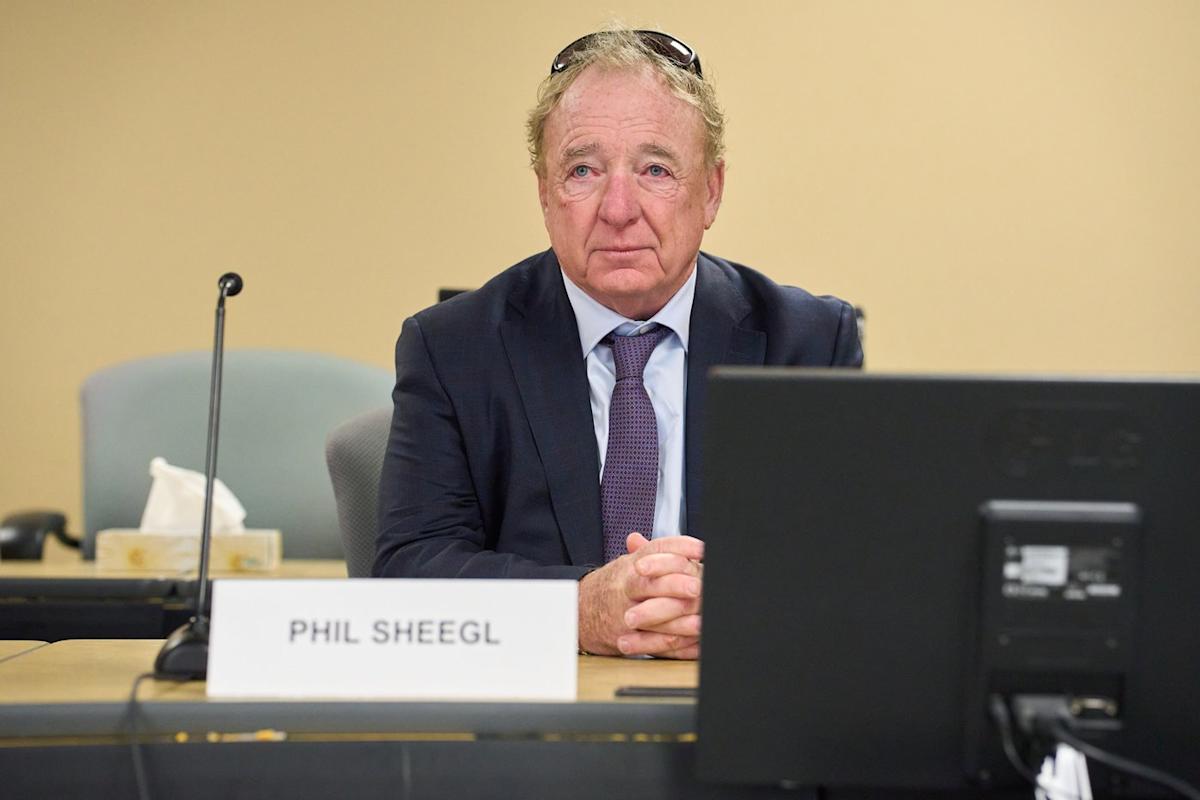
WINNIPEG — A former chief administrative officer with the City of Winnipeg met with a contractor and shared confidential city information during the bidding process on a major redevelopment project, a public inquiry heard Tuesday.
The inquiry is examining the city’s purchase and renovation of a former Canada Post building that became the headquarters for the Winnipeg Police Service.
The project ran more than $70 million over its $135-million budget by the time it was completed in 2016.
Former chief administrative officer Phil Sheegl was found in civil court to have accepted a bribe from an executive with Caspian Construction, which was awarded the bulk of the work.
Sheegl has denied accepting any bribe and said the money was for an unrelated real estate transaction in Arizona — an explanation that the civil court judge called “fictional.”
Former mayor Sam Katz earlier told the inquiry he was part of the same real estate deal and received money for selling his interest in the property.
Sheegl was asked by inquiry counsel Heather Leonoff about a meeting he had with a Caspian executive after the city issued a request for proposals in late 2010. Other potential bidders were not part of the meeting.
“But you do understand that the RFP process is a legal process that is governed by some pretty strict rules … and that meeting with one potential bidder without the others being present may be seen as in some ways biasing or changing that process, causing it to lose its legal structure?” Leonoff asked.
“In retrospect, I agree with you, and it was probably not right to meet with him,” Sheegl replied.
Sheegl added that he didn’t remember what was discussed at the meeting. His testimony marked the first time he’s spoken publicly on the matter.
The inquiry was also shown a series of email exchanges between Caspian executive Armik Babakhanians and Sheegl. Some concerned the company’s desire to have the city lower a requirement that bidders put up a $40-million performance bond to cover costs if the project ran into trouble.
The inquiry was shown a December 2010 email in which Sheegl tells Babakhanians: “I am about to send you a. Blind copy of a confidential email Please be careful with it, its part of my strategy to get this done for you.”
Leonoff pointed out that Sheegl’s employment contracts with the city, including in earlier positions, required him to not reveal confidential information.
“Of course you recognize that, at least in all of those employment contracts that we looked at, that confidential information of the city is to remain confidential,” Leonoff said.
“I do remember reading that,” Sheegl replied.
Sheegl said he was open to helping anyone wanting to do business with the city and supported lowering the performance-bond amount in order to open up bidding to smaller companies and have a more competitive process.
Sheegl said he felt the need to respond to the emails from Babakhanians, which grew more frequent.
“Every other person doing business with the city would get the same treatment,” Sheegl said.
In 2011, Caspian was awarded the contract in two stages, and costs continued to rise in the following years.
RCMP investigated the project but no charges were laid. The Manitoba government agreed last year to a request from city council to call the inquiry.
Sheegl appealed the civil court ruling and lost. The Manitoba Court of Appeal said Sheegl’s actions amounted to “disgraceful, unethical behaviour by a public servant.”
Babakhanians is scheduled to testify later this week.
This report by The Canadian Press was first published Feb. 17, 2026.
Steve Lambert, The Canadian Press