
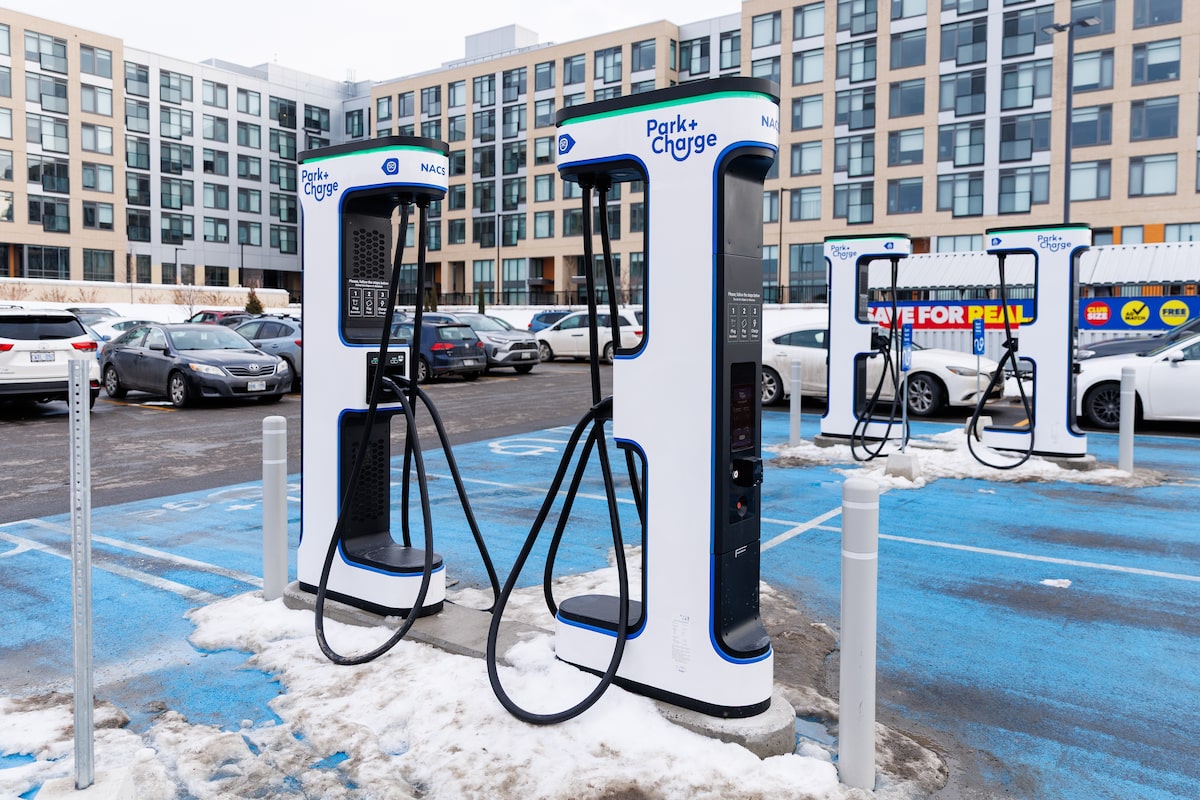
Park and Charge EV charging stations in Ottawa.Keito Newman/The Globe and Mail
Ottawa’s new measures to promote electric-vehicle charging should revive the expansion of the network, but the key to mass EV adoption will be a consistent message to drivers, industry backers say.
Natural Resources Minister Tim Hodgson announced last week an $84-million plan to add 8,000 charging ports across the country. This would be in addition to about 35,000 stations now in operation, with the bulk of them in Quebec, Ontario and British Columbia.
The push is part of the Liberal government’s strategy, announced by Prime Minister Mark Carney early this month, to spend $1.5-billion on EV infrastructure.
On the charging front, the country was already well behind previous projections. A study by Dunsky Energy + Climate Advisors for Natural Resources Canada in 2021 estimated that there would be 52,000 ports in place by 2025. Most of them were to be public level 2 chargers, with 4,300 DC fast chargers. Longer term, it called for 643,000 by 2040.
Opinion: EVs hit their first speed bump in 2025. It won’t be the last
With a new, less-ambitious goal of 75 per cent EV sales by 2035, the public charging needs will be lower, said Joanna Kyriazis, director of policy and strategy at Clean Energy Canada, an environmental think tank. EV adoption and charging availability go hand in hand, and uncertainty over Canadian EV policy last year led to a drop in charge-port installations and vehicle sales, Ms. Kyriazis said.
“Last year, we were one of the only countries in the world that saw EV sales decline. But now, the new auto strategy sent a very clear signal that we’re all in on EVs and the federal government sees EVs as our future once again,” she said.
Under former prime minister Justin Trudeau, the shift to EVs was mandated, albeit against the industry’s assertions that the targets were not attainable. But Mr. Carney’s government kept the market guessing about its policies through U.S. President Donald Trump’s tariff offensives and the removal of restrictions on limited numbers of Chinese vehicles.
Consistent policy messaging is crucial for EV adoption and the expansion of the charging network; several other countries in Latin America and Asia have shown how it works, said Maxime Charron, president of LeadingAhead Energy, a Vancouver-based EV consultancy with a focus on charging networks. In Canada, drivers are holding off on buying the cars in the absence of that, he said.
“We need to have a narrative in this country where it’s aligned and consistent. There’s so much lobbying and other parties that are trying to put a negative connotation to the EV industry in general – thousands of reasons why EVs don’t work. It’s almost more effective than the charging stations themselves,” Mr. Charron said.
Ottawa plans to add 8,000 charging ports as part of wider EV infrastructure investments
Success of the new policy will depend on how stringent the government is in achieving reductions in tailpipe emissions and how quickly it reaches its targets, said Suzanne Goldberg, senior director, public policy at ChargePoint Holdings Inc., one of the largest commercial, fleet and residential charging-technology providers.
The government’s strategy includes investments through the Canada Infrastructure Bank’s Charging and Hydrogen Refuelling Infrastructure Initiative, which has been increased to $1.5-billion from $500-million.
The initial program committed financing to such charging companies as Flo, JOLT and Parkland, enabling up to 5,400 ports, the government has said.
For its part, Parkland, now a unit of U.S.-based Sunoco Inc., received $210-million in 2023 aimed at adding 2,000 new fast charger ports at up to 400 On The Run sites. In June, JOLT announced it had secured $194-million in federal funding to deploy up to 1,500 curbside chargers in major cities.
The next stage of funding is critical for providing access to charging for Canadians who live in urban areas or in multiunit dwellings, said Brendan Dillon, head of revenue and market growth – North America, for JOLT. “Long-distance travel infrastructure is important, but everyday access to convenient urban charging is what will ultimately unlock mass adoption,” Mr. Dillon said in an e-mail.
The Decibel: Carney shifts gears on EV and climate policies
FLO chief executive officer Louis Tremblay said the company applauds the government’s strategy and will provide an update on its plans for deployment in the coming weeks. “Our network consists of tens of thousands of charging infrastructure and is constantly expanding,” he said in a statement.
One concern is that only the largest providers have the financial wherewithal to take advantage of the program, and that could lead a small number of players to dominate the market, Mr. Charron said. However, Natural Resources Canada’s Zero Emission Vehicle Infrastructure Program (ZEVIP) offers funding for smaller retail operators, which may keep the market competitive, he said.
The gaps that remain in the strategy involve installations for workplaces, smaller businesses, retail, rural and multi-family dwellings, Ms. Goldberg said. Some of this could be addressed through an expansion of the ZEVIP, clean technology tax credits for off-road charging and potential tweaks to clean-fuel regulations, she said.
There is also an opportunity in pairing charging capabilities with Ottawa’s home-construction push known as Build Canada Homes, which includes $7.3-billion in spending over five years. It makes sense to make housing EV-ready, even if that means roughing in the wiring needed to install chargers later, Ms. Kyriazis said.
Provinces, including Quebec, and more than 30 municipalities in B.C. are changing zoning bylaws to have such requirements in place for new builds, she noted.
“But we really want to see this happen more at the provincial level, or even at the federal level. It costs three to four times more to retrofit an existing building to add electrical circuitry and what’s needed for EV charging compared to just putting that EV readiness in place when you build the home from the start,” she said.
Mr. Charron said these types of decisions will be made locally, though the government could make incentives available for homebuilders to defray the extra cost.
“In Vancouver, it’s pretty straightforward because the uptake is so high compared to other provinces that it’s a no-brainer,” he said.