
As Phil Sheegl was testifying at the Winnipeg Police Service headquarters inquiry on Tuesday, it was hard not to think back to the damning words from the Manitoba Court of Appeal.
Two-and-a-half years ago, the now-disgraced former chief administrative officer for the city asked the appellate court to overturn a civil suit verdict that found him guilty of accepting a $327,000 bribe as part of a “breach of trust” of his fiduciary duties.
The court dismissed Sheegl’s appeal with vigour.
RUTH BONNEVILLE / FREE PRESS FILES
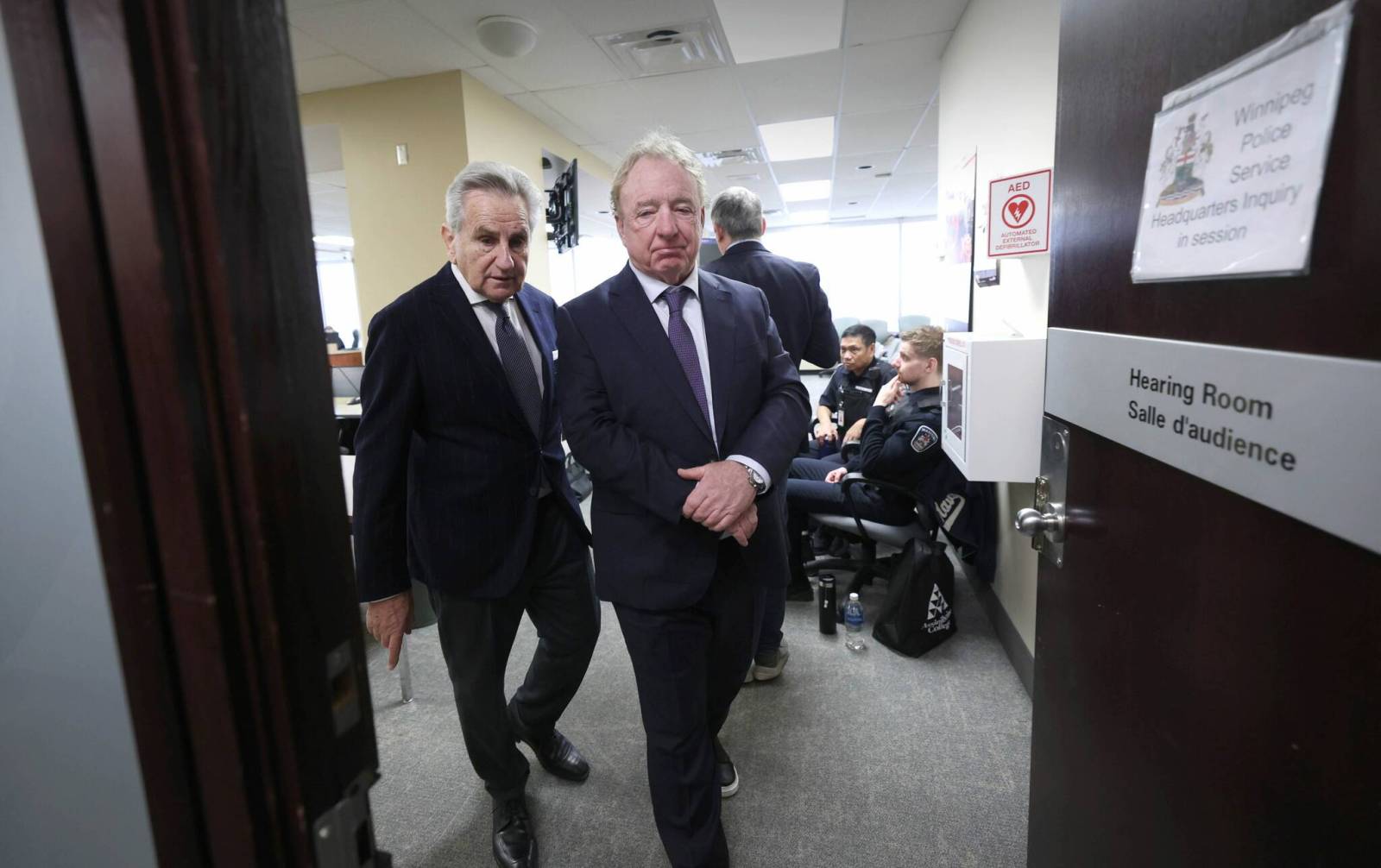
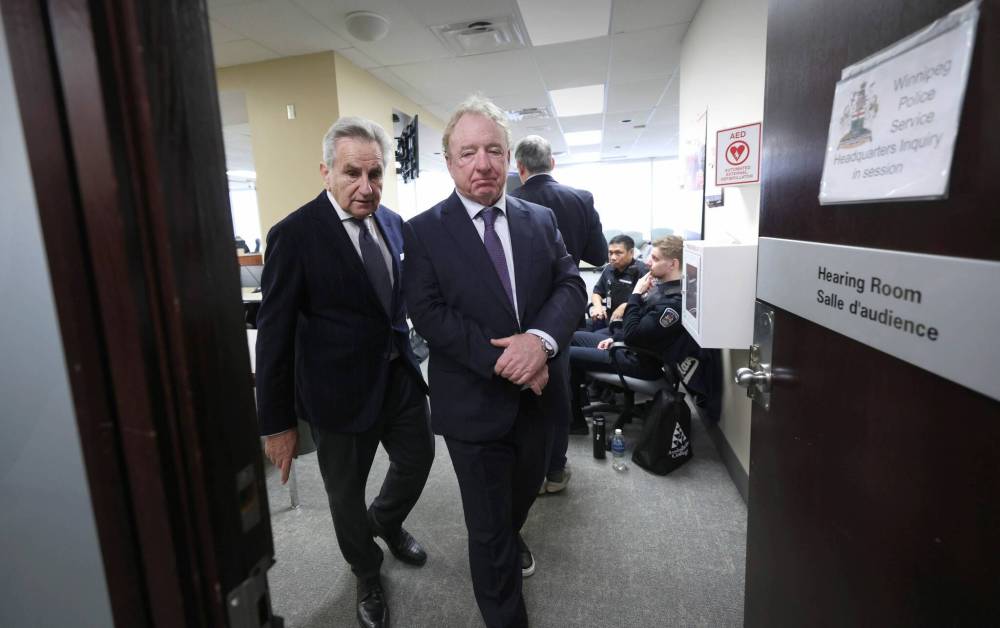
Former city CAO Phil Sheegl took the stand to testify in the police headquarters inquiry last week. His lawyer, Richard Wolson, walks with him out of court on Feb. 13.
“The integrity of public finances must be protected by the courts from large-scale bribery and the systemic ignorance of fiduciary duties, particularly those involving the most senior public officials.”
Ah yes, the systemic ignorance of fiduciary duties.
Anyone who thought the court’s choice of words was unfair to Sheegl should listen to Tuesday’s testimony.
For more than five hours, Sheegl answered painstakingly detailed questions from inquiry counsel Heather Leonoff about his moral, ethical and legal duties as CAO, and the way he repeatedly violated those duties by mixing private and civic business interests.
Sheegl acknowledged he knew by the terms of his employment contract and the city’s code of conduct that he was not allowed to do personal business with anyone doing public business with the city. He also acknowledged he undertook multiple instances of personal business with Armik Babakhanians, the owner of Caspian Construction and general contractor for the WPS downtown headquarters, while the city was in the process of awarding that contract.
Winnipeg Free Press | Newsletter

Sheegl’s excuse for violating his fiduciary duties to the city — over and over again — was both bizarre and remarkable. “I completely acknowledge today that it was a conflict,” Sheegl said. “At the time I did not realize. Again, in hindsight, it was stupid of me not to to realize that.”
And then, Sheegl delivered the punch line. “It didn’t even enter my mind.”
At this stage, it’s getting harder and harder to believe Sheegl still believes anything he’s saying. It’s intellectually impossible to say that you knew on the one hand that you couldn’t do something, but did it anyway because the wrongdoing “never entered” your mind.
The absurdity of Sheegl’s assertions only becomes fully clear when you consider the enormity of his transgressions.
At one point, Sheegl confirmed that during the awarding of the WPS headquarters contract, he was regularly conducting private and city business on city hall computers. In fact, his personal mobile phone — a BlackBerry he said he refused to give up — was receiving emails from both his city email address and one tied to Winnix, a company he owned in Arizona.
Sheegl admitted he was doing city and personal business on most days at city hall. “Any given day in my office, I would have three screens in front of me going back and forth,” he testified.
“This is where Sheegl’s superpower comes clearly into view: not admitting to anything.”
The chronic mixing of personal and city business was not limited to Caspian. To the astonishment of commissioner Garth Smorang, Sheegl admitted he conducted a large, somewhat curious cash transaction with Sandy Shindleman, co-owner of Shindico Realty. Sheegl testified that Shindleman gave him $35,000 in Canadian funds, which he exchanged for US$28,000.
Although not at issue in this proceeding, a city audit previously raised serious concerns about a series of questionable real estate transactions involving Shindico and Sheegl.
And then there is the matter of the sale of a single acre of undeveloped Arizona pasture to Babakhanians, the transaction at the heart of the civil trial that found Sheegl had accepted a bribe that was shared with his friend and business partner, former mayor Sam Katz.
This is where Sheegl’s superpower comes clearly into view: not admitting to anything even when the evidence against you is so utterly overwhelming.
BORIS MINKEVICH / WINNIPEG FREE PRESS FILES
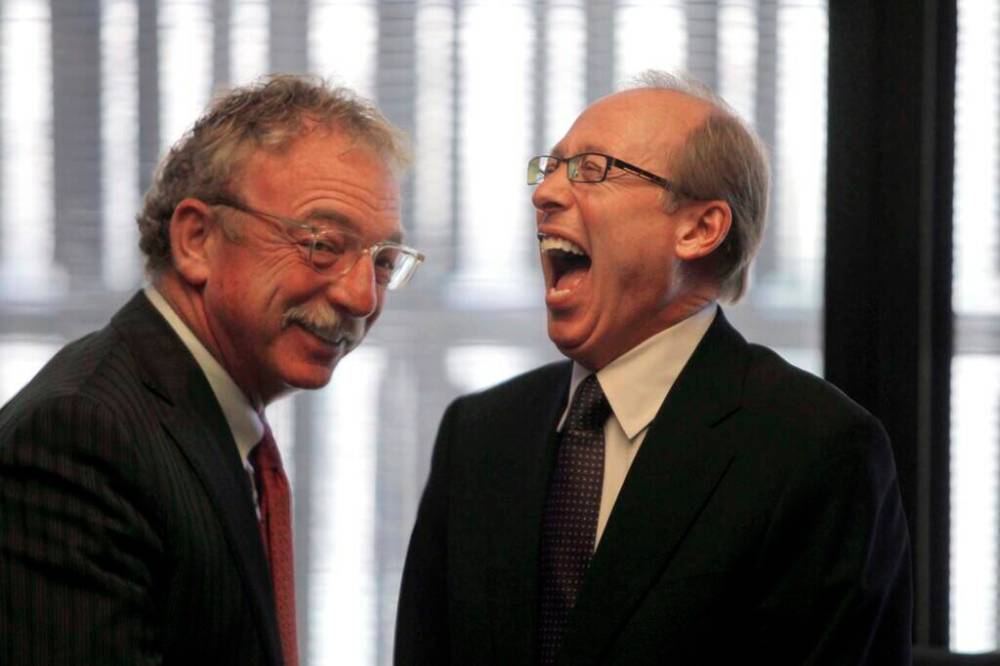
Former Winnipeg mayor Sam Katz, right, and former chief administrative officer Phil Sheegl in 2012.
In 2011, as the WPS headquarters contract was just about to be awarded, Babakhanians wrote a $200,000 cheque to a company owned by Sheegl that was labelled “consulting services.” Subsequently, Sheegl wrote a $100,000 cheque to Katz that was labelled “loan.”
Both men claim the money was for the purchase of the aforementioned Arizona land and had nothing to do with the WPS headquarters project. Of course, Justice Glenn Joyal called that claim “a fiction.”
It’s not hard to see why, when large sums of money are secretly moving between citizens doing business with the city and senior city officials, deliberately mislabelled to obscure what the Court of King’s Bench believed was their true purpose: securing a lucrative contract.
At this point, it’s important to note that notwithstanding this testimony, neither Sheegl nor Katz will face criminal charges. The RCMP did an exhaustive investigation and recommended charges, but Manitoba Justice took two looks at the case and decided against proceeding. Legally, neither man can be charged with a crime based on their inquiry testimony.
There will be some who argue that being exposed at this inquiry is punishment, in and of itself. And from the expressions on the faces of both Sheegl and Katz while they were testifying, there might be a grain of truth in that.
Sheegl and Katz won’t go to jail, but they will forever be known as the men who admitted they knew right from wrong, and did wrong anyway.
dan.lett@freepress.mb.ca

Dan Lett is a columnist for the Free Press, providing opinion and commentary on politics in Winnipeg and beyond. Born and raised in Toronto, Dan joined the Free Press in 1986. Read more about Dan.
Dan’s columns are built on facts and reactions, but offer his personal views through arguments and analysis. The Free Press’ editing team reviews Dan’s columns before they are posted online or published in print — part of the our tradition, since 1872, of producing reliable independent journalism. Read more about Free Press’s history and mandate, and learn how our newsroom operates.
Our newsroom depends on a growing audience of readers to power our journalism. If you are not a paid reader, please consider becoming a subscriber.
Our newsroom depends on its audience of readers to power our journalism. Thank you for your support.