
Former foreign affairs minister Peter Mackay weighs in on Canada normalizing relations with China, and U.S. threats against Greenland.
Nearly two thirds of Canadian survey respondents say they are concerned about the U.S. being a potential threat to Canada’s sovereignty, according to new data from Nanos Research.
According to the survey, 64 per cent of respondents say they feel concerned, while 19 per cent say they are not concerned, and 17 per cent say they are neutral, about the U.S. being a threat to Canadian sovereignty.
Broken down by demographic, the age group with the highest level of concern is Canadians aged 55 and older, while women are also more likely to be concerned than men — 69.3 per cent compared to 57.9 per cent — and people in Atlantic Canada are more likely to be concerned than those in the Prairies.
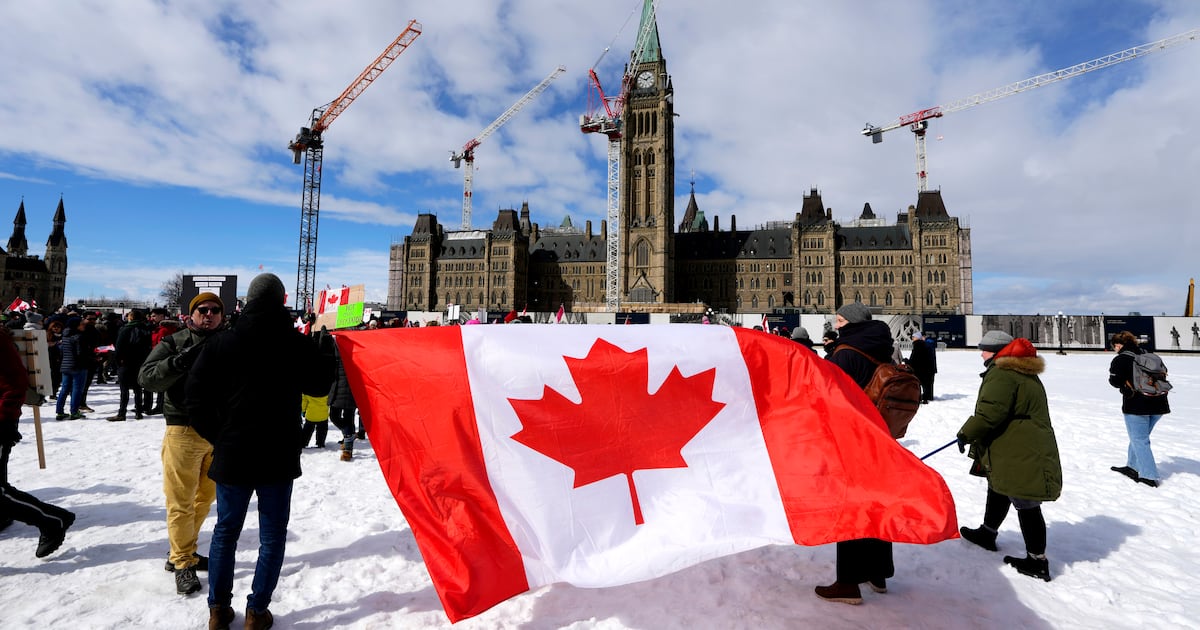
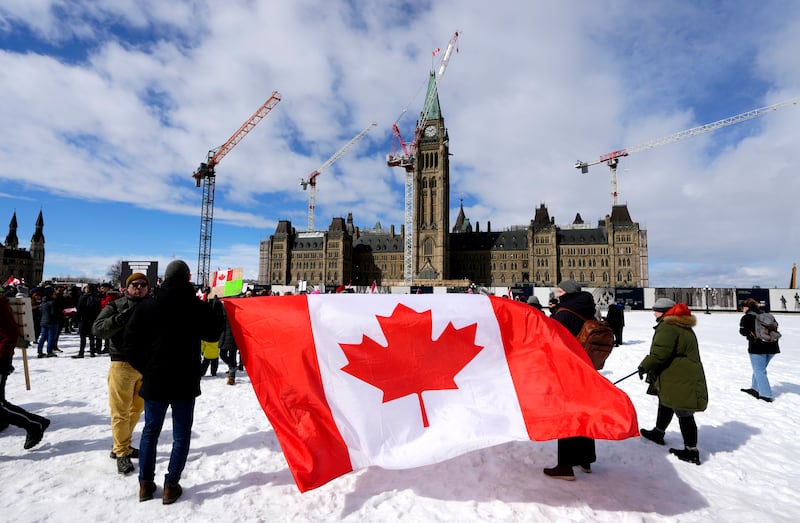 elbows up rally canada flag People hold a large Canadian flag as during a rally in response to U.S. President Donald Trump’s threats to Canadian sovereignty, on Parliament Hill in Ottawa, on Sunday, March 9, 2025. THE CANADIAN PRESS/Justin Tang
U.S. President Donald Trump first threatened to make Canada the 51st state more than a year ago, and for months would refer to former prime minister Justin Trudeau as “governor.”
Despite multiple missed deadlines to reach a new economic and security deal between the two countries, Trump over the summer signalled more of a willingness to work with Trudeau’s replacement, Mark Carney.
Then, amid a now-yearlong trade war, Trump referred to Carney as “governor” for the first time late last month, after the prime minister inked a new deal with China to allow up to 49,000 Chinese electric vehicles into the Canadian market.
A recent report by Bloomberg out of Washington, meanwhile, suggests the president is mulling walking away from the Canada-U.S.-Mexico trade agreement entirely. The deal is up for review this year.
Trump has since set his sights on Greenland — a Danish autonomous territory — insisting he needs to “acquire” the island for national security purposes.
And, he’s made comments about American pre-eminence in the Western Hemisphere, including a social media post by the U.S. State Department calling it “our” hemisphere.
Nanos Research also collected data relating to whether Canadians believe the United States will pull out of NATO.
While Trump has asserted the U.S. will “always be there for NATO,” he has also heavily criticized the alliance and repeatedly stated the U.S. has “never needed” it.
According to Nanos Research, more than half of Canadians believe Trump is either likely or somewhat likely to abandon NATO, at 14 per cent and 44 per cent respectively.
Twenty-three per cent of respondents said they believe it’s somewhat unlikely the U.S. president leaves the alliance, and 11 per cent of people said they believe it’s unlikely.
Methodology
Nanos conducted an RDD dual frame (land- and cell-lines) hybrid telephone and online random survey of 1,009 Canadians, 18 years of age or older, between Jan. 31 and Feb. 4, 2026, as part of an omnibus survey. Participants were randomly recruited by telephone using live agents. The sample included both land- and cell-lines across Canada. The results were statistically checked and weighted by age and gender using the latest Census information and the sample is geographically stratified to be representative of Canada. The margin of error for this survey is plus or minus 3.1 percentage points, 19 times out of 20.