
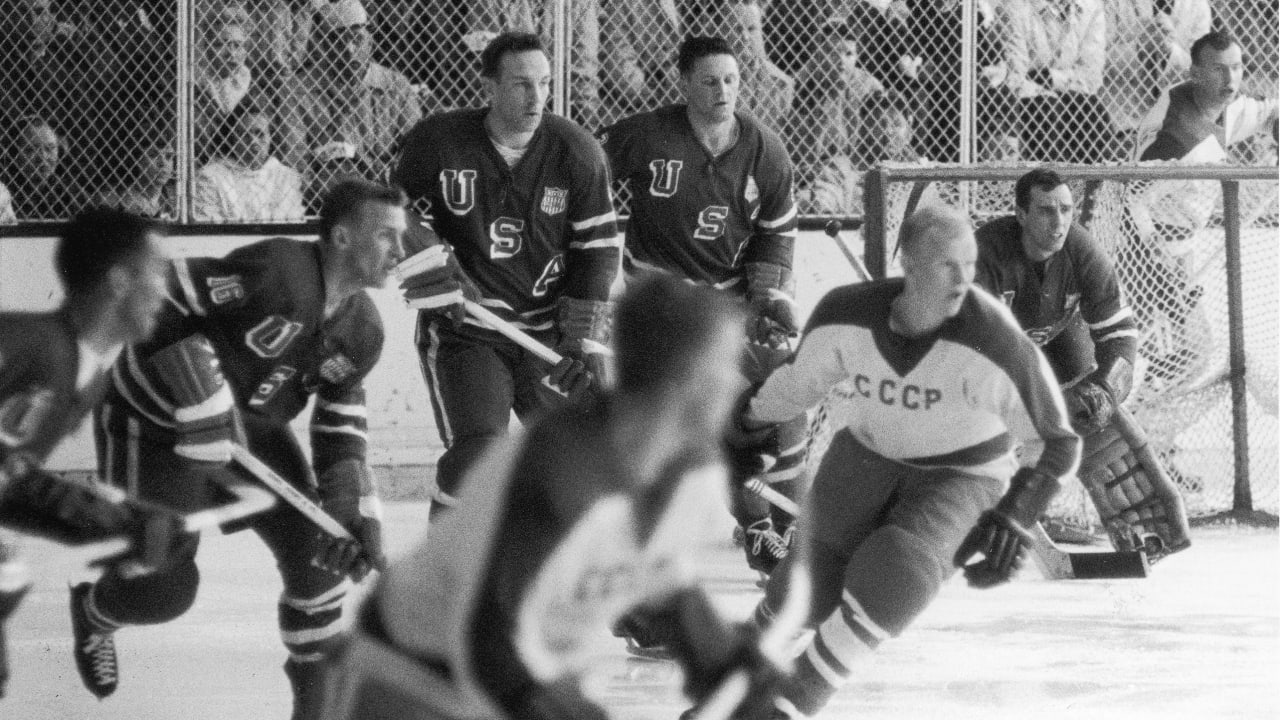
Bill Cleary of Cambridge, Massachusetts led Team USA in scoring (14 points; seven goals, seven assists) and behind him was Bill Christian out of Warroad, Minnesota, with 13 points (two goals, 11 assists). Jack McCartan, from St. Paul, Minnesota, was voted best goalie of the tournament.
“Jack was the reason we won,” Williams said. “We had tremendous goaltending and he deserved the credit. The difference between our win and the miracle fellas was the huge media attention they got, and the little we got, but that was OK. What we wanted was the gold, not cheers.”
There was no miracle talk against Team Sweden on Feb. 22, 1960, but the strong skating, hard-shooting Scandinavians were routed 6-3. Heads began turning in Riley’s direction two days later when the U.S. defeated Germany 9-1.
“After we beat the Germans, the press started talking about McCartan,” Riley said. “Then again, our Christian Brothers, Roger and Billy, also were getting attention. Other reporters began noticing Kenny Yackel and John Mayasich, but we only had two wins under our belt and next up was Canada.”
A 2-1 win against Canada was the turning point behind McCartan’s 39 saves.
“Jack made one incredible save after another,” Riley said. “After we took the Canadians, we became the talk of the Olympic Village.”
The talk got louder against the formidable Soviet Union on Feb. 27. The game was tied 2-2 after two periods with the final result in doubt until 14:59 of the third.
And then it happened.
Bill Christian broke free, skating one-on-one against Nikolai Puchkov. The Soviet goalie tried to cut down the angle, but Christian completed his deke by skimming the puck over the goal line.
“That was it,” Riley said. ” McCartan wasn’t going to let the Russians score again.”
They didn’t. The U.S. won 3-2, but then slumped through two periods against Czechoslovakia in the final.
“It looked like the wins over Canada and Russia took the edge off us,” Riley wrote in “Skates, Sticks and Men: The Story of Amateur Hockey in the United States.”
Czechoslovakia led 4-3 until Lady Luck intervened for the United States. During the second intermission, Soviet defenseman Nikolai Sologubov knocked on Team USA’s clubhouse door and whispered to Riley.
“He suggested our players take some oxygen to restore their pep,” Riley said. “Some of my guys took his advice, but not the Christians or the Clearys.”
Back for the third, Roger Christian was relentless, delivering a hat trick amid a six-goal deluge for a 9-4 victory.
“For us,” McCartan said, “it was a special feeling because something like that never happened before. A gold medal for America, first in our hockey history.”
“Looking backward,” Mayasich said, “I came to realize that the whole USA was a part of this unprecedented hockey achievement. We started what was to become a boom in kids hockey. At the time though we just didn’t realize what an achievement it was.”
As for the oxygen whiffs, Riley laughed them off. “Oxygen or not, it was our team’s burning desire to win that made the difference.”
To which Roger Christian ad-libbed his coach:
“It was the gold medal that spurred us on.”