
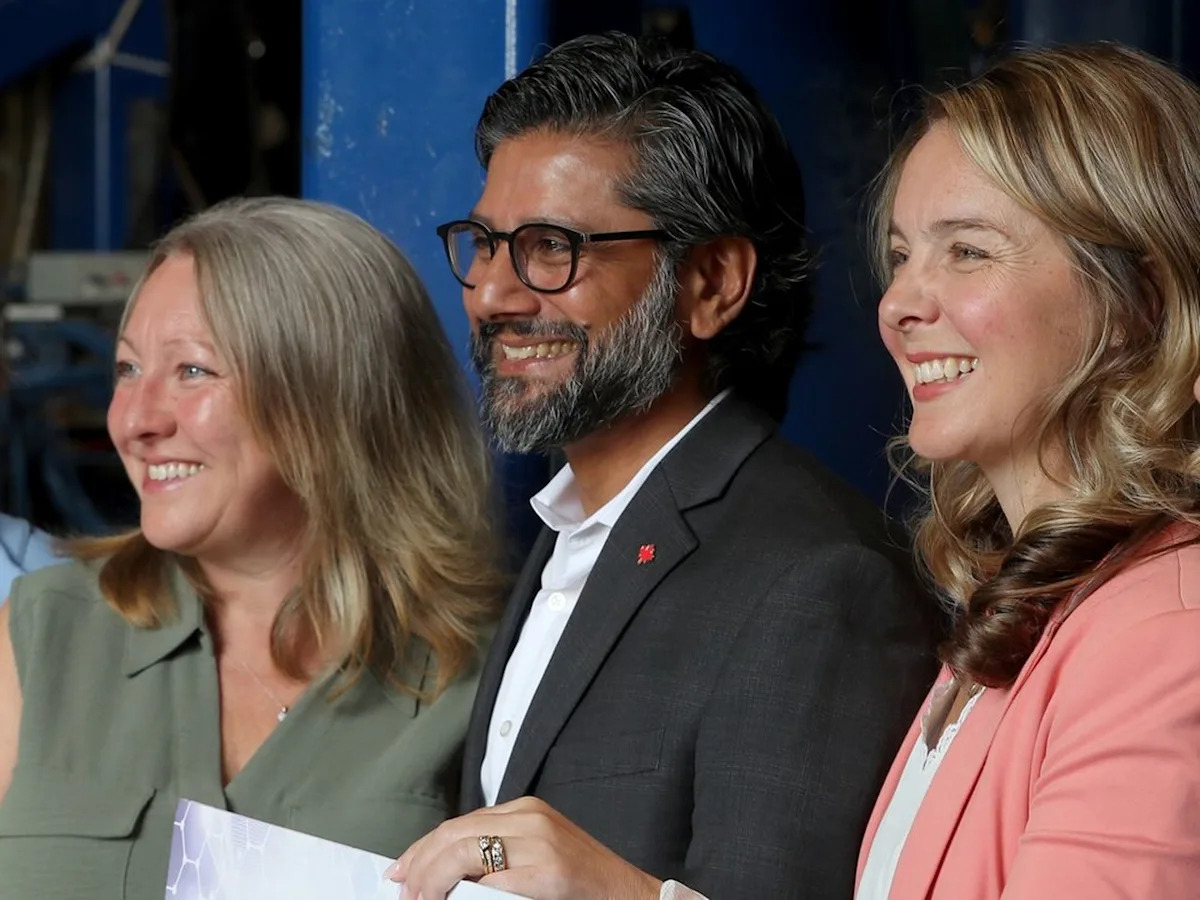
Bruce Fanjoy has already slain one giant. Now he’s doing something arguably rarer in politics: disagreeing with his own party leader.
Last spring, the political newcomer defeated Conservative leader Pierre Poilievre in Carleton, a result few saw coming. Now the freshman Liberal MP has aimed his sights within his own party, publicly urging the government to reconsider its expanded return-to-office mandate for federal public servants.
Under the new policy, executives will be in the office five days a week beginning in May. Other employees will be required to work in person four days a week starting in July. In a region where roughly 150,000 people work for the federal government, the effects will be far-reaching — not just in office buildings but on roads, in public transit, schools and daycares, and people’s wallets.
Fanjoy argues the policy will be costly for the government, bad for the environment, and is accompanied by little evidence that its one-size-fits-all approach will improve productivity or service delivery. Further, he raises concerns about how the move will upset many employees’ work-life balance.
You may agree with him. You may not.
The point is that he’s taken a clear and public position. It may alienate some colleagues and constituents. It may endear him to others. Regardless, that’s what Carleton voters elected him to do. It’s called representation. If they don’t like it, they can let him know, either now by email and other means, or later at the ballot box.
Contrast that with the other Liberal MPs in the National Capital Region — excluding the Prime Minister — who, when asked by my colleague Ben Andrews, declined to make public statements on the matter. And when responding to constituents’ concerns, at least judging by some of the correspondence shared on social media platforms, they seem content to describe the position rather than voice an opinion.
Ottawa West-Nepean MP Anita Vandenbeld’s office said she would not be issuing a public statement, preferring instead to respond directly to constituents.
In an email, her office noted that the decision by public service management was made to encourage collaboration and teamwork, but that she has been encouraging “maximum flexibility,” and will “continue to advocate that it makes no sense for public servants to drive to a remote work-station to join with their team virtually.”
At least she offers a nod to the frustration that many employees share. But it stops short of a clear position.
Ottawa Centre MP Yasir Naqvi wrote that the government “has made a decision that has given clarity to the federal public service, while also maintaining flexibility,” language that emphasizes clarity and flexibility without taking a position.
Naqvi did say he has “long advocated for the hybrid workplace for the federal public service” before saying he agrees with the Prime Minister that “in order to live up to this moment, we will need to be laser-focused on building and protecting the Canadian economy.” Again, no indication whether he supports or opposes the return-to-work expansion.
Kanata MP Jenna Sudds’s reply begins by saying “It appears like we are moving in the direction of employees returning to full-time and in-person work…” — phrasing that almost suggests this wasn’t a decision made by elected officials, but more like an approaching weather front. She further says the decision is being made “for the benefits it brings to local businesses and overall office work performance,” the latter an assertion the government has not publicly substantiated.
Sudds’s closing line — offering to “pass these along to my colleagues in future discussions” — reads less like a position than simply a promise to forward a memo.
Meanwhile, at parliamentary committee last week, Sudds called for “meaningful flexibility,” a phrase so flexible it has no meaning.
If Fanjoy hadn’t broken ranks and given his own position statement, it would be easier to shrug and say, “Well, that’s party politics.” But he did, and in a city where the consequences of this policy are especially concentrated, it’s fair to ask why the other Liberal MPs aren’t willing to also go on the record and say whether they support or oppose the policy, and why.
When I was an at-times idealistic teenager trying to understand politics, I remember bristling when my MP mailed questionnaires asking constituents how they felt about contentious issues. Many would have considered it democracy at its finest. To me, it felt like representation by poll — outsourcing judgment to a checkbox.
We elect MPs to listen, yes, but also to weigh competing interests, wrestle with hard questions, and ultimately make a decision. Leadership isn’t promising to forward emails or pass along concerns. It’s taking a stand and accepting the consequences. I suspect Bruce Fanjoy will lose his argument within his own party. Voters may punish or reward him for his position. But at least he has one. That’s how representation is supposed to work.
Related